

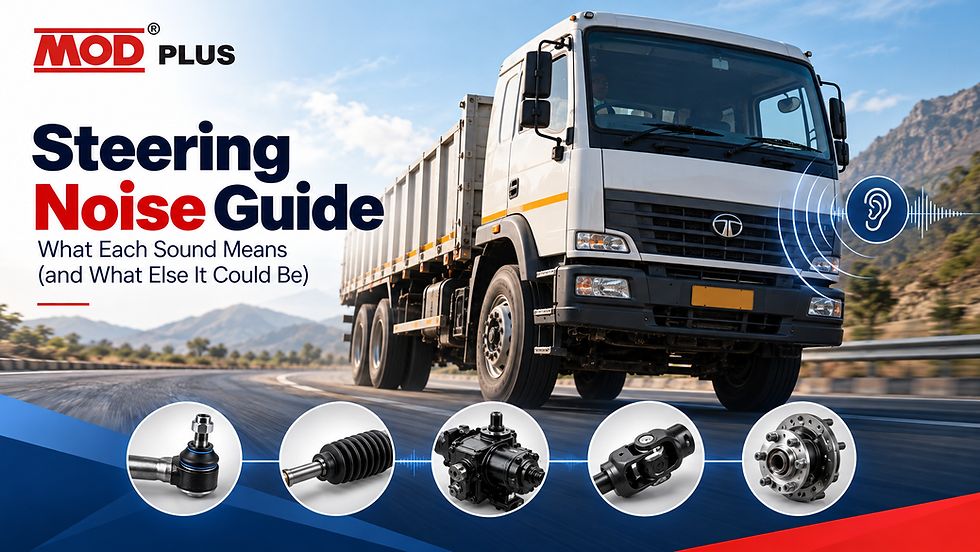
Steering Noise Guide: What Each Sound Means (and What Else It Could Be)
In this guide
Also covered: why sound alone isn't a diagnosis, noises that aren't steering at all, what to do next, the FAQ and parts by vehicle model.
You're crawling over a rough patch, or swinging into a parking bay, and the front end makes a sound it didn't make last week. The steering still works. That gap, an odd steering noise with no other symptom, is where most worry starts.
This guide sorts noises by what you hear, not by which part you suspect. MOD Plus, established in 1978 at Sanjay Gandhi Transport Nagar, Delhi, and distributing OEM-grade spares across India, hears the same thing at the counter: a sound described first, a part requested second. A sound narrows the list. It rarely closes it.
Why Sound Alone Isn't a Full Diagnosis (but Is a Great Starting Point)
A sound tells you where to look, not what to replace. Steering, suspension, brakes, wheel bearings and driveline parts all sit within a metre of each other, and metal noise travels through the chassis until it seems to come from everywhere.
Treat a sound as a shortlist, not a verdict. Two different faults can make almost the same clunk, and one fault can sound different depending on load, speed and road surface.
Use the sections below in three steps: match your sound, read the "it could also be" list before you settle on the first cause, then confirm with a physical check or a mechanic before buying any part. On a loaded tractor trolley or a dusty field track, the same worn joint can sound different from one day to the next.
1. Clunk or Knock Over Bumps and Uneven Ground
A dull, heavy clunk or knock from the front end when a wheel drops into a pothole or crosses a speed breaker. It repeats on each bump and can often be felt through the steering wheel or floor. This is the clunking noise steering owners most often describe.
Most likely (steering linkage): a worn ball-and-socket joint, meaning a tie rod end, drag link end or track rod end, where the ball stud has developed play in its socket. The complete guide to tie rod ends explains how these joints wear on Indian roads. A worn steering cross assembly can also knock, usually with slack at the steering wheel; see the Steering Cross Assembly engineering guide.
It could also be: ball joints, stabiliser link ends and bushes, leaf spring shackles or pins on trucks, worn shock absorber mounts, or a loose wheel nut. Stabiliser links and shackle wear are often blamed on the steering.
A clunk only over bumps, with steering that feels normal, points more toward suspension. A clunk with vague or loose steering points back to the linkage.
How to confirm: check each joint for play with the wheels raised and a helper turning the steering; the method is in the final section. If the joints are tight, have a mechanic check links, bushes and mounts. For the wider handling picture, see pulling, wandering and clunking symptoms explained.
2. Continuous Grinding or Growling While Driving Straight
A continuous growl, hum or grind that rises with road speed and continues while you drive straight. It may get louder or quieter as you swerve gently left and right, and some drivers hear it as a grinding sound turning through a bend.
Most likely: this is the category where steering linkage is least likely. The classic cause is a worn wheel bearing, not a steering part, and its noise changes as load shifts from one side of the vehicle to the other.
It could also be: cupped or unevenly worn tyres (usually a hum), brake pads worn to the backing plate or a caliper that is dragging, a dry hub or axle-end bearing on a front axle, or driveline noise. A tie rod end or ball joint with a torn boot that has run dry can groan, but that is heard while steering, not steadily at speed; see the squeak section below.
How to confirm: raise the wheel and spin it by hand, listening for roughness. Grip the tyre at 12 and 6 o'clock and rock it; movement there suggests a wheel bearing or ball joint, while play at 3 and 9 o'clock suggests a steering joint. A bearing that keeps deteriorating can seize, so get it checked promptly.
3. Squeal or Squeak When Turning
A squeak, creak or groan that appears only while the steering wheel is moving, often worse at parking speed or on the first turns after a cold start. A steering squeak is usually a lubrication or friction problem, not a sudden failure.
Most likely: a dry or dust-contaminated ball joint or tie rod end, especially with a torn dust boot that has let grease out and grit in, or a dry joint in the steering column. On tractors, dry king pins and knuckle bushes are also candidates. Here is how to tell these three joints apart.
It could also be: a slipping power steering belt, worn suspension or anti-roll bar bushes that creak as the body rolls, strut top mounts, or brake noise that happens to show at low speed.
A squeal that follows engine revs rather than steering movement is a belt or pump issue, not a joint. Test it: with the vehicle parked, rev the engine without turning the wheel.
How to confirm: with the engine off, have a helper rock the steering wheel while you watch and listen at each joint. A torn boot is visible evidence. A squeak alone is not proof of wear.
4. Whine That Changes Pitch With Engine Speed
A whine or moan whose pitch rises and falls with engine revs, not road speed, and is loudest when the wheel is turned to full effort.
This is almost never a steering linkage problem. Tie rod ends, drag links and steering crosses are mechanical joints; they do not whine. The usual cause is the power steering system: low or foamy fluid, a leaking hose letting air in, or a wearing pump. A wheel held at full lock makes the pump work against its relief valve, which is why a struggling pump is loudest there.
It could also be: a slipping or worn drive belt, a failing alternator or idler pulley bearing, or, on tractors, low oil or trapped air in the hydraulic steering circuit.
How to confirm: park, engine running, and rev in neutral. If the pitch follows the revs, the source is engine-driven. Check the fluid level and condition (foamy, dark or burnt-smelling fluid is a warning), look for wet hoses, and inspect the belt. Then have the pump and lines checked by a mechanic. Do not buy a tie rod end for this sound.
5. Rattle at Idle or Very Low Speed
A light, tinny rattle or chatter at idle or while crawling over rough ground, coming from around the front wheels rather than the engine.
Most likely (linkage): a worn tie rod end or drag link end with a lot of play can rattle at low speed, and tie rod end noise of this kind often gets worse as the joint loosens. A loose castle nut or missing split pin is the critical one to rule out, since it lets the joint knock and can let it separate.
It could also be: loose brake caliper hardware or missing anti-rattle clips, a loose heat shield, a worn stabiliser link, a loose hub cap or wheel trim, or a loose mudguard. On trucks, check leaf spring clamps; on tractors, front weights and bumper brackets. Many rattles turn out to be a heat shield.
A rattle that changes with engine revs, or stops when you press the brake, is often not steering at all.
How to confirm: look for missing split pins, loose nuts and torn boots before anything else, then check for joint play as described at the end of this guide. Note whether the rattle changes when you brake gently or turn; that detail helps a mechanic more than the sound itself.
6. Clicking or Popping at Full Steering Lock
A rhythmic click or pop that speeds up with the vehicle, heard when the steering is at or near full lock, such as in a U-turn or when reversing into a bay.
It could be (and often is): a worn outer CV joint.
On front-wheel-drive cars, and on tractors and 4WD vehicles with driven front axles, CV or axle-end joints click on tight turns. This is a driveline part, not a steering linkage part. Look for a split rubber boot and grease flung around the wheel arch.
Linkage-related: a single pop or bump felt as the wheel starts to move is more typical of a worn ball joint, tie rod end or strut top mount than of a CV joint. A steering rack or gearbox that is worn or low on fluid can also clunk at the ends of its travel.
A repeating click that matches wheel rotation is CV-like; a single knock is joint-like.
How to confirm: drive slowly in a tight circle in an empty area, in both directions, and note whether the click repeats. Inspect the CV boots, then check the tie rod ends and ball joints for play. If both look fine, ask a mechanic to check the rack or steering box.
When It's Not Your Steering at All
Some of the noises most often blamed on steering come from elsewhere entirely.
Wheel bearings growl or hum with speed and can change when you swerve. Brakes squeal from glazed pads or wear indicators, click from loose hardware, and grind once pads are worn to metal.
Tyres hum when cupped, tick with a stone in the tread, and thump with a bulge or flat spot. CV joints click on tight turns.
Suspension bushes, shocks and linksclunk over bumps. Exhaust heat shields rattle at certain revs.
Propeller shaft joints on rear-drive trucks can clunk when you get on or off the throttle, a sound easily mistaken for steering.
A noise that occurs with the wheel straight, or when you touch the brake or throttle, and does not change with steering input, deserves a look away from the linkage first.
Ask three things: does the sound follow steering wheel movement, engine revs or road speed? Each answer rules whole groups of parts in or out.
If you can't answer, don't guess. On a lift, with an assistant turning the wheel, a mechanic can usually place the noise in minutes.
What To Do Once You've Narrowed Down the Steering Noise
The sound moves with the steering wheel, or comes with looseness or wander: check the joints for play with the 2-minute DIY test for a worn tie rod end. You need a helper and a few minutes.
You find play but can't tell which joint it is: the comparison of tie rod end, ball joint and track rod shows how they differ. If the part is new to you, this explainer on the hidden steering part covers what it does.
The noise follows engine revs, braking or wheel speed: it is probably not linkage. Take it to a mechanic and hold off on steering parts.
You find a loose castle nut, a torn boot with grit inside, or clear play: avoid loaded or highway driving until it is repaired, and get a wheel alignment after any tie rod end replacement.
Steering Noise FAQ
What does tie rod end noise sound like?
Usually a dull clunk or knock over bumps, and sometimes a rattle at low speed. Sound alone cannot confirm it, because ball joints, stabiliser links and suspension bushes make similar noises. Check the joints for play before replacing anything.
Why does my steering make a noise only when I turn?
Sounds that appear only while the wheel is moving point to parts that move with steering: dry ball joints or tie rod ends, a power steering belt or pump, strut top mounts, or a CV joint at full lock. Note whether it squeaks, clicks or groans, because each points somewhere different.
Is a clunking noise from the steering dangerous?
It can be. A clunk from a worn steering joint can progress to loss of steering control, so treat a clunk that comes with loose or vague steering as urgent. A clunk from a stabiliser link or bush is less critical but still worth fixing promptly.
Can a wheel bearing sound like a steering problem?
Yes. A worn wheel bearing usually growls or hums, rises with road speed and may change when you swerve gently. Spinning the raised wheel by hand and checking for play tells you more than the sound alone.
Why does my power steering whine?
A whine that follows engine revs and is loudest at full lock usually points to low or foamy fluid, a leaking hose, a worn pump or a slipping belt. It is rarely a steering linkage part.
What causes a steering squeak?
Common causes are dry ball joints or tie rod ends with damaged dust boots, dry steering column joints, worn suspension or anti-roll bar bushes, and a slipping power steering belt. Check for torn boots and, on serviceable joints, missing grease.
Can I keep driving with a steering noise?
It depends on the sound and what comes with it. A noise with loose or vague steering, pulling or vibration means avoiding loaded or high-speed driving until it is inspected. A light squeak with no play is less urgent, but still worth a check.
How do I tell a CV joint click from a tie rod end noise?
A CV joint click repeats rhythmically at full lock and speeds up with the vehicle. Tie rod end or ball joint noise is more often a single knock over bumps or as the wheel starts to turn. A split CV boot with flung grease supports the CV explanation.
Can I diagnose a steering noise myself?Y
ou can narrow it down by noting when the sound happens and checking for torn boots and joint play. Confirming a specific part needs a physical inspection, ideally by a mechanic with the wheels raised.
Shop Genuine Tie Rod Ends by Vehicle Model
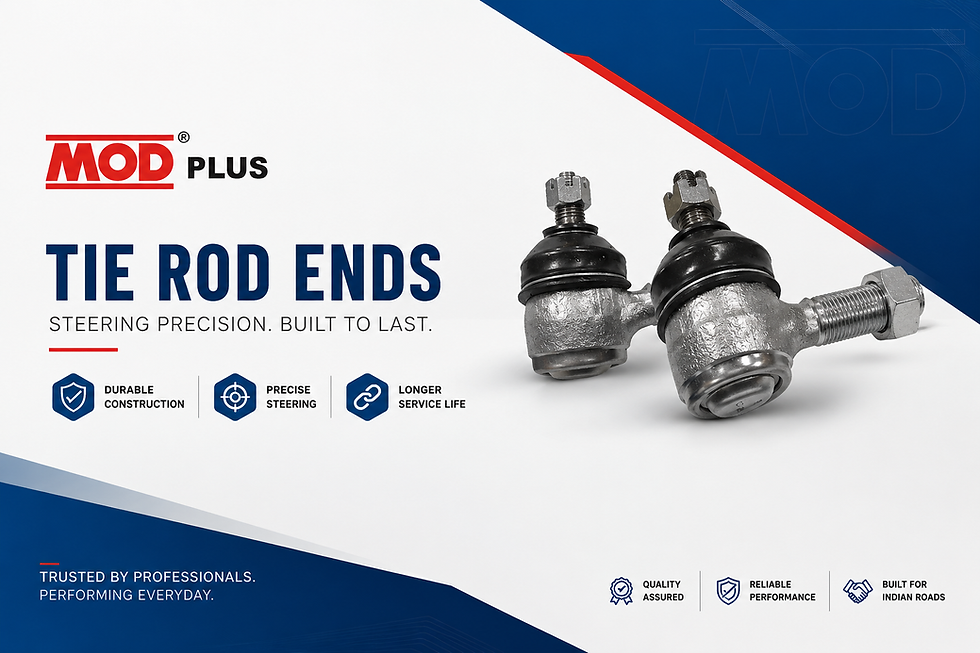
Use this section only after a physical check has pointed to a linkage part. Match by exact vehicle model, and contact MOD Plus if you are unsure of fitment. The full MOD Plus tie rod end range has more listings than are shown here.
Tata light and commercial vehicles
Eicher, Iveco and Swaraj Mazda
Mahindra vehicles and tractors
International and Farmtrac tractors
If your checks point to a worn tie rod end, drag link end or track rod end, MOD Plus can help. We have supplied OEM-grade steering parts across India since 1978 from Sanjay Gandhi Transport Nagar, Delhi.
Browse the full tie rod end rangeor contact MOD Plus with your vehicle model for fitment help.
Written by the MOD Plus Technical Team. Reviewed for technical accuracy by the MOD Plus technical team, Sanjay Gandhi Transport Nagar, Delhi.


Comments