

The Complete Guide to Tie Rod Ends: Everything You Need to Know Before You Buy
Updated: Jul 23
By MOD Plus | India's Trusted Aftermarket Steering Components Supplier Since 1978
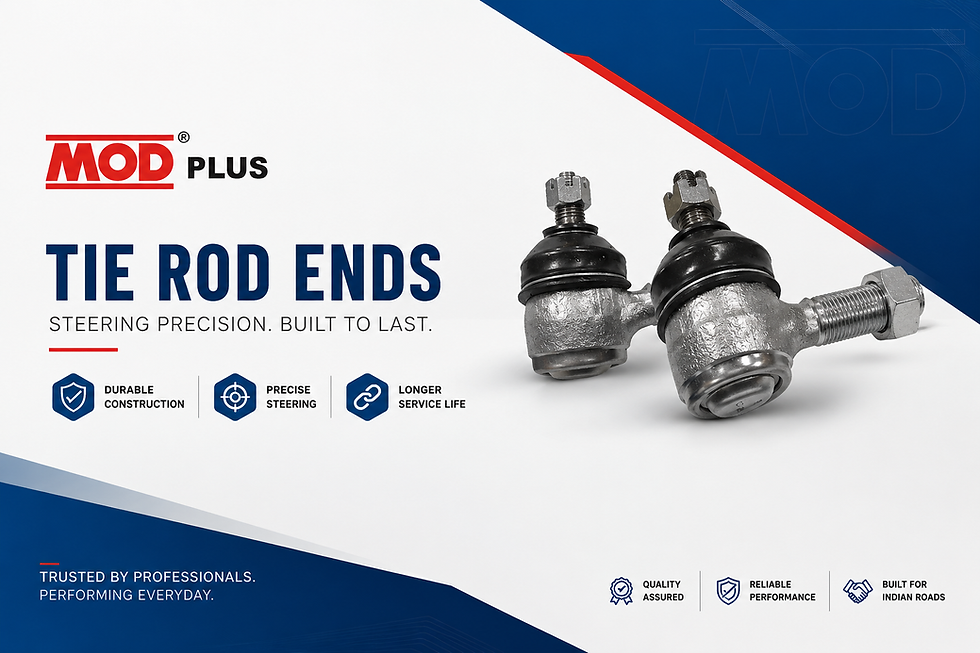
Table of Contents
What Is a Tie Rod End?
A tie rod end is a small but critically important steering component that connects the steering rack or steering linkage to the steering knuckle at each front wheel. It is the mechanical joint through which steering input is transmitted from the driver to the wheels, enabling the vehicle to turn left and right with precision and control.
Featured Snippet Answer — What Is a Tie Rod End? A tie rod end is a pivoting ball-and-socket joint that links the steering rack or drag link to the wheel's steering knuckle. It transfers the driver's steering input to the front wheels, controlling directional movement. It consists of a ball stud, housing, dust boot, and threaded shank, and is critical for steering precision and vehicle safety.
In commercial vehicles — trucks, buses, tractors, and heavy agricultural machinery — tie rod ends are subjected to far greater stress than in passenger cars. They must tolerate heavy axle loads, rough road surfaces, dust, moisture, and continuous vibration. This is why the quality of aftermarket tie rod ends matters enormously in the Indian operating environment.
How Does a Tie Rod End Work?
Featured Snippet Answer — What Does a Tie Rod End Do? A tie rod end transmits the lateral force from the steering rack or drag link to the steering knuckle, causing the wheel to pivot and change direction. It allows for angular movement as the suspension travels up and down, while maintaining precise steering geometry. Without a functioning tie rod end, a vehicle cannot be steered safely.
The steering system in a commercial vehicle operates as an interconnected chain of components. When the driver turns the steering wheel, the input travels through the steering column to either a rack-and-pinion or recirculating ball steering gear. The output of this gear moves the drag link (in heavier vehicles) or the tie rod (in rack-and-pinion systems), which in turn pushes or pulls the steering knuckle via the tie rod end.
What makes the tie rod end unique is its ball-and-socket design. The ball stud sits inside a lubricated housing and can rotate through a limited arc in multiple planes. This allows the joint to accommodate:
Steering movement — the wheel turning left or right
Suspension travel — the wheel moving up and down over bumps
Toe angle changes — minor geometric adjustments during cornering
Without this articulating joint, the steering linkage would bind and fail under normal road use. The tie rod end is, in essence, the mechanical handshake between your steering system and your wheels.
In recirculating ball steering systems common to Indian trucks and buses — such as those used on Tata, Ashok Leyland, Eicher, and Mahindra commercial vehicles — the steering linkage typically runs: steering box → pitman arm → drag link → steering arm → tie rod → tie rod end → steering knuckle. Each joint in this chain must function correctly. The tie rod end, being the last link before the wheel, bears the most direct load from road surface inputs.
Anatomy of a Tie Rod End: Construction and Materials

Understanding what goes into a tie rod end helps explain why quality varies so dramatically between products in the Indian aftermarket.
The Ball Stud
The ball stud is the heart of the joint. It is a hardened steel pin with a spherical head that sits inside the housing and pivots freely. In premium tie rod ends, the ball stud is manufactured from medium carbon alloy steel and subjected to induction hardening or case hardening to achieve the surface hardness necessary to resist wear. The shank is precisely machined with a tapered section for tight fitment into the steering knuckle, and a threaded end for the castle nut.
The Housing
The housing encases the ball stud and bears the load of the joint. It is typically manufactured from forged steel or high-strength cast steel, then precision machined to tight dimensional tolerances. In heavy-duty applications, forged housings are significantly preferred over cast alternatives — forging produces a denser, more structurally sound grain structure that resists cracking under impact.
The Bearing / Seat
Inside the housing, the ball stud seats against a bearing seat — often made of hardened steel or, in some designs, a PTFE-lined composite material. This bearing seat distributes the load and allows smooth rotation. The quality of this interface directly determines the longevity of the joint.
The Dust Boot
The dust boot (also called the dust seal or gaiter) is a flexible rubber or polyurethane boot that encloses the ball socket opening. Its role is entirely protective: it retains the grease that lubricates the joint and excludes dust, water, and contaminants from entering. In Indian road conditions — where red dust, mud, water crossings, and construction debris are everyday hazards — the durability of the dust boot is critically important. A torn boot accelerates joint wear dramatically.
The Grease Chamber
Inside the housing, grease fills the cavity around the ball stud. In serviceable designs, a grease nipple allows re-greasing in the workshop. Non-serviceable (sealed for life) designs are pre-packed with high-quality grease and sealed permanently.
Thread and Shank
The threaded shank connects the tie rod end to the tie rod itself. Threads must be precisely cut to the correct specification — both thread pitch and diameter must match exactly. Imprecise threading leads to misalignment, improper torque loading, and premature failure.
Material Comparison Table
Component | Economy Grade | Standard Grade | Heavy-Duty Grade |
Ball Stud | Carbon steel, untreated | Medium carbon steel, surface hardened | Alloy steel, induction hardened |
Housing | Cast iron | Cast steel, machined | Forged steel, precision machined |
Bearing Seat | Plastic insert | Hardened steel | Hardened steel / PTFE composite |
Dust Boot | Basic rubber | Rubber compound | High-grade rubber / polyurethane |
Grease Type | General purpose | Lithium-based | Extreme pressure lithium complex |
Surface Finish | Painted | Painted / zinc plated | Zinc plated + corrosion inhibitor |
Why Tie Rod Ends Matter for Vehicle Safety
It is not an overstatement to describe tie rod ends as safety-critical components. A single failed tie rod end can result in complete loss of steering control — particularly dangerous on highways, mountain roads, or in heavy traffic. For trucks, buses, and tractors operating in Indian conditions, the consequences of such a failure can be catastrophic.
Beyond outright failure, worn tie rod ends degrade gradually — and this degradation has measurable effects on vehicle behaviour and running costs:
Tyre wear: Play in the joint causes the toe angle to shift unpredictably, producing rapid, uneven tyre wear. In commercial vehicles, tyres are a significant operating cost, and premature wear directly impacts profitability.
Wheel alignment: Accurate wheel alignment is impossible to maintain with worn tie rod ends. The vehicle will pull to one side, reducing fuel efficiency and increasing driver fatigue.
Handling and stability: Even modest play in the joint introduces vagueness into the steering feel. At highway speeds, this becomes unsafe — particularly in crosswinds or emergency avoidance manoeuvres.
Component stress: A loose tie rod end places uneven loads on adjacent components — the steering knuckle, king pin, and front axle — accelerating their wear as well.
For fleet operators and transport businesses, maintaining tie rod ends in good condition is not just a safety obligation — it is sound financial management.
Types of Tie Rod Ends
The Indian commercial vehicle market uses several distinct configurations of tie rod ends, and understanding these differences is essential for correct replacement.
Inner and Outer Tie Rod Ends
In rack-and-pinion steering systems, both an inner and an outer tie rod end are used per wheel. The inner end connects directly to the steering rack; the outer end connects to the steering knuckle. They serve different load profiles and are not interchangeable.
Tie Rod Assemblies (T.R. Assembly)
For many tractor and agricultural applications, a complete tie rod assembly — including the tie rod tube and both ends — is the standard replacement unit. MOD Plus stocks complete T.R. assemblies for Mahindra tractors including the Arjun, Yuvo, and Novo ranges, as well as assemblies for Sonalika, John Deere, New Holland, Swaraj, Farmtrac, and other popular Indian tractor brands.
Drag Link Ends
In recirculating ball steering systems used on trucks and buses, the drag link connects the steering gear output to the steering arm. The drag link end is a tie rod end variant designed for this position and is subject to particularly high loads. MOD Plus carries drag link ends and kits for Tata 609/709, Tata 1210, Tata Signa, Tata Prima, Tata Ultrabus, and a wide range of Ashok Leyland commercial vehicles.
Track Rod Ends
In agricultural machinery, the equivalent of the tie rod end is often called a track rod end or track end. These link the steering cylinder output to the wheel hub assembly. MOD Plus stocks track rod ends for Farmtrac 70, Mahindra Arjun 555, International B-275, International B-575 DI (Balwan), and others.
Power Steering Tie Rod Components
Power-assisted steering systems — increasingly common on modern tractors such as the Sonalika, John Deere, New Holland, and Swaraj — use jack rods or piston rods as part of the power steering cylinder assembly. MOD Plus stocks these specifically for Sonalika power steering, John Deere power steering, New Holland power steering, and Swaraj power steering.
Symptoms of a Worn or Failing Tie Rod End
Featured Snippet Answer — What Are the Symptoms of a Bad Tie Rod End? Common symptoms of worn tie rod ends include steering vibration or shimmy, uneven tyre wear (especially on the inner or outer edge), loose or vague steering feel, the vehicle pulling to one side, clunking or knocking sounds from the front axle area, and wheels that appear visually misaligned. Any of these symptoms warrants immediate inspection.
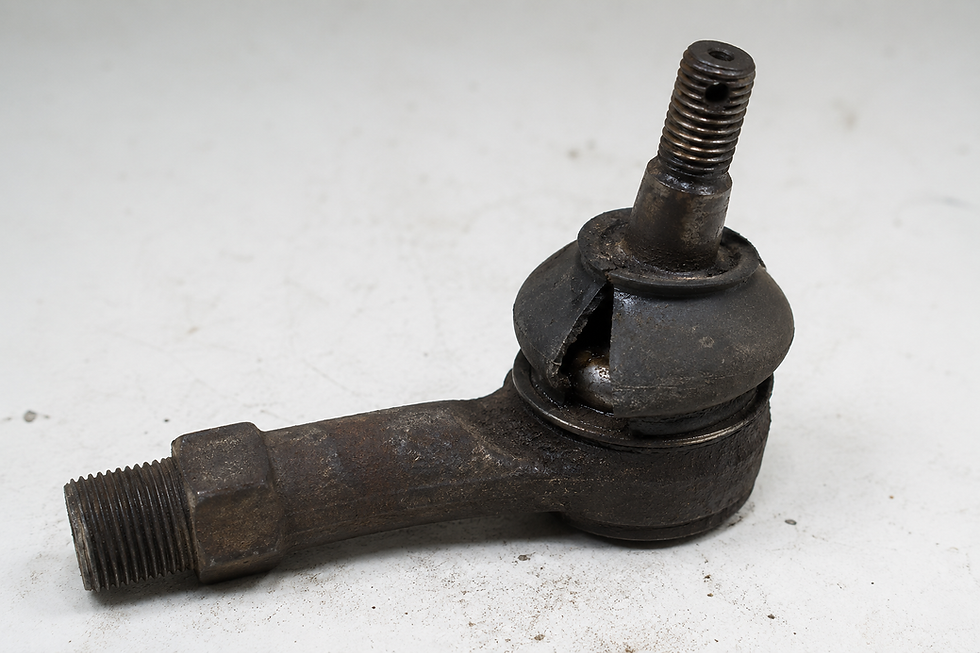
The challenge with tie rod end wear is that it develops gradually. There is rarely a sudden, dramatic failure — instead, the joint deteriorates incrementally, and symptoms appear progressively. By the time a driver notices obvious handling problems, significant wear has often already occurred. This is why periodic inspection is so important.
Symptom and Cause Reference Table
Symptom | Most Likely Cause | Urgency |
Steering vibration / shimmy | Worn ball stud or loose joint | High – inspect immediately |
Uneven tyre wear (inner or outer edge) | Toe misalignment from worn joint | Medium – inspect at next service |
Vehicle pulls to one side | Unequal play in left/right joints | Medium – inspect soon |
Loose / vague steering feel | Excessive play in ball stud | High – inspect immediately |
Clunking sound on bumps | Ball stud moving within housing | High – inspect immediately |
Steering wander at speed | Combined wear in linkage joints | High – inspect immediately |
Visible joint movement under load | Joint at end of service life | Immediate – replace now |
Torn or cracked dust boot | Boot damage, contamination likely | Medium – inspect joint condition |
Common Causes of Tie Rod End Failure
Road Conditions
India's road network presents some of the most demanding conditions for suspension and steering components anywhere in the world. Potholed urban roads, unpaved rural tracks, waterlogged crossings, and heavily loaded axles combine to subject tie rod ends to constant impact loading. This is why tie rod ends on Indian commercial vehicles often need replacement more frequently than the same components on equivalent vehicles operating in better-surfaced markets.
Contamination
Dust and water are the primary enemies of the tie rod end joint. Once the dust boot tears or deteriorates — which can happen through impact damage, UV degradation, or simply age — fine abrasive dust enters the grease chamber. This grit acts as a lapping compound and rapidly grinds away the bearing surfaces. Agricultural vehicles working in dry field conditions are particularly vulnerable.
Insufficient Lubrication
In serviceable designs, neglecting re-greasing intervals causes the grease to dry out or be displaced, leaving the ball stud running metal-on-metal. This accelerates wear dramatically and can lead to seizure.
Impact Damage
A single severe impact — kerbing, pothole strike, or a road accident — can instantly damage a tie rod end even if it appeared to be in good condition. The ball stud can be deflected beyond its design range, damaging the bearing seat, or the housing can crack.
Overloading
Commercial vehicles operating above their rated GVW place disproportionately higher loads on all suspension and steering components. Overloading is a consistent factor in premature tie rod end failure in Indian freight operations.
Improper Installation
Cross-threading the ball stud taper, incorrect torque on the castle nut, or failure to complete wheel alignment after replacement all contribute to premature failure. A properly installed tie rod end, correctly aligned, will always outlast a poorly fitted one.
Age and Fatigue
Even under ideal conditions, metal fatigue accumulates. High-mileage vehicles — particularly in intercity freight operations — will naturally reach tie rod end replacement intervals based on cumulative stress cycles rather than any specific fault.
Tie Rod End Inspection: A Step-by-Step Checklist
Regular inspection is the most effective way to prevent tie rod end failure on the road. The following procedure should be performed at every scheduled service on commercial vehicles and at minimum every 10,000–15,000 km on tractors and agricultural machinery.
Visual Inspection
Examine the dust boot for tears, cracks, or missing sections
Check for grease leakage around the boot, indicating boot failure
Look for corrosion on the housing or ball stud shank
Inspect the threaded shank for damage or corrosion
Manual Play Check (Vehicle on Ground)
Grip the tie rod end housing firmly
Attempt to move it up-down and side-to-side
Any perceptible movement beyond 1–2 mm lateral play indicates wear
Compare left and right sides — asymmetric wear indicates one joint is failing
Manual Play Check (Vehicle Lifted, Wheel Off Ground)
Have an assistant move the steering wheel left and right
Observe the tie rod end for play or lag between steering input and wheel movement
Any visible lag, clunking, or movement in the joint itself indicates replacement is needed
Torque Check
Verify that the castle nut is torqued to the manufacturer's specification
Check that the split pin is correctly fitted
A loose castle nut is an immediate safety concern — do not drive until corrected
Inspection Checklist Table
Inspection Item | Pass | Attention Required | Replace Immediately |
Dust boot condition | Intact, supple | Minor surface cracking | Torn, missing, or leaking |
Lateral play | < 1 mm | 1–3 mm | > 3 mm |
Axial play | < 0.5 mm | 0.5–2 mm | > 2 mm |
Castle nut torque | At specification | Slightly loose | Missing or severely loose |
Housing corrosion | None or surface | Light rust | Pitting or structural corrosion |
Ball stud condition | Smooth | Minor wear marks | Pitting, grooving, or roughness |
Boot grease | Present, clean | Contaminated | Absent or black/gritty |
How to Choose the Right Tie Rod End
Selecting the correct replacement tie rod end is not simply a matter of finding something that physically fits. The following factors must all be considered.
Vehicle Application Compatibility
The single most important criterion is correct vehicle compatibility. Tie rod ends are not generic components — thread pitch, taper angle, ball stud diameter, housing dimensions, and overall length vary between vehicle models and even between model years. Always verify compatibility using the vehicle make, model, and year before purchasing.
MOD Plus organises its tie rod end range by vehicle application — covering tractors, trucks, buses, and light commercial vehicles — so that customers can identify the correct part without ambiguity.
Construction Quality
As discussed above, the materials and manufacturing methods used determine durability in service. For heavy-duty commercial vehicle applications, forged steel housings and induction-hardened ball studs are the benchmark. For agricultural machinery, the additional consideration is resistance to contamination — heavily ribbed, robust dust boots are particularly important.
Thread and Taper Specification
Thread pitch (whether metric or imperial, and the exact pitch within each standard) and the taper angle and diameter of the ball stud shank must match the original specification precisely. Even small deviations in taper specification can result in improper seating in the steering knuckle, leading to progressive loosening in service.
Dust Boot Material
For agricultural and off-road applications, polyurethane dust boots offer superior resistance to abrasion and UV degradation compared to standard rubber. If the vehicle operates in particularly dusty or muddy conditions, this specification is worth specifying.
Buying Checklist for Workshops and Fleet Buyers
Criterion | What to Verify |
Vehicle compatibility | Make, model, year, axle specification |
Housing material | Forged vs cast — specify forged for heavy-duty |
Ball stud hardness | Confirm induction hardening for commercial vehicles |
Thread specification | Pitch, diameter, left or right hand |
Taper specification | Angle and diameter at major diameter |
Dust boot material | Rubber vs polyurethane for harsh environments |
Grease type | Verify appropriate grease for application temperature range |
Serviceability | Grease nipple present for re-greasing? |
Surface protection | Zinc plating, paint, or bare? |
Packaging / storage | Properly sealed packaging to prevent corrosion before installation |
OEM vs Aftermarket Tie Rod Ends
This is a question that almost every fleet operator, workshop manager, and transport business owner asks at some point. The honest answer is nuanced.
OEM Parts
Original Equipment Manufacturer (OEM) tie rod ends are manufactured to the exact specification of the vehicle builder and carry the OEM brand name. They typically offer guaranteed fitment and consistent quality, but come at a significant price premium — often 30–60% above quality aftermarket equivalents. In some cases, OEM parts can only be obtained through authorised dealer networks, which adds further cost and lead time.
Quality Aftermarket Parts
The aftermarket has matured considerably in India over the past two decades. Quality aftermarket suppliers manufacture to the same dimensional and material specifications as OEM parts, often sourcing from the same manufacturing facilities or from manufacturers that supply both OEM and aftermarket channels. The result is a product that performs equivalently in service at a substantially lower price point.
The critical distinction is between quality aftermarket and economy aftermarket. Low-cost economy products use inferior materials, loose tolerances, and inadequate surface treatments. These may appear to offer significant savings at purchase but typically deliver a fraction of the service life of quality alternatives, often failing in field conditions where quality products would continue performing.
OEM vs Aftermarket Comparison Table
Factor | OEM | Quality Aftermarket | Economy Aftermarket |
Fitment accuracy | Guaranteed | Very high | Variable |
Material specification | OEM standard | OEM-equivalent | Below standard |
Heat treatment | Yes | Yes | Often absent |
Dimensional tolerance | Tight | Tight | Loose |
Dust boot quality | Good | Good | Variable |
Price point | Highest | 20–40% below OEM | 50–70% below OEM |
Availability | Dealer network | Wide distribution | Wide distribution |
Service life | OEM rated | Comparable to OEM | Significantly shorter |
Warranty | Manufacturer | Supplier warranty | Minimal |
Quality aftermarket tie rod ends from established suppliers like MOD Plus deliver OEM-equivalent fitment and durability at a price point that makes sound commercial sense for fleet operators managing large numbers of vehicles.
Tie Rod End Replacement: What to Expect
Featured Snippet Answer — Can You Drive with a Worn Tie Rod End? Driving with a worn or loose tie rod end is strongly inadvisable and potentially dangerous. A significantly worn joint can fail without warning, resulting in sudden loss of steering control. At the first signs of wear — unusual tyre wear, vague steering, clunking sounds — have the vehicle inspected and the tie rod end replaced before returning to normal operation.
Replacement Procedure Overview
Tie rod end replacement is a straightforward procedure for a competent workshop, but it must be performed correctly to ensure safety and longevity.
The general sequence is as follows: raise and support the vehicle safely; remove the road wheel; remove the split pin and castle nut from the ball stud; separate the ball stud taper from the steering knuckle using a tie rod end separator (never a hammer directly on the ball stud); count the number of turns to remove the old tie rod end from the thread; install the new unit to the same number of turns (to preserve approximate alignment); torque the castle nut to specification and fit a new split pin; and then perform a full wheel alignment before returning the vehicle to service.
The wheel alignment step is non-negotiable. Even if the number of turns is matched precisely, the actual alignment should always be confirmed and adjusted on an alignment rig. Incorrect toe angle after tie rod end replacement will cause rapid tyre wear and potentially unsafe handling.
Replacement Interval Guidelines
Featured Snippet Answer — How Long Do Tie Rod Ends Last? Under normal operating conditions on well-maintained roads, quality tie rod ends on passenger vehicles can last 80,000–150,000 km. On commercial vehicles operating in Indian conditions — heavy loads, rough roads, frequent overloading — service life is typically 40,000–80,000 km. Agricultural vehicles should have tie rod ends inspected every season regardless of hours worked.
Vehicle Type | Typical Replacement Interval | Inspection Frequency |
Passenger car / SUV | 80,000–150,000 km | Every 20,000 km or annually |
Light commercial vehicle | 60,000–100,000 km | Every 15,000 km |
Heavy truck / bus | 40,000–80,000 km | Every 10,000 km |
Agricultural tractor | Every 1–2 seasons | Every 250 hours |
Off-road / construction | 20,000–40,000 km | Every 5,000 km |
These are general guidelines. Actual intervals depend heavily on operating conditions, load, road quality, and maintenance standards. In harsh conditions, inspect more frequently.
Maintenance Tips for Long Service Life
A few straightforward maintenance practices can substantially extend the service life of tie rod ends, particularly in commercial vehicle and agricultural applications.
Re-grease regularly. On serviceable designs (those with a grease nipple), grease the joint at every service interval. Use a lithium-complex or molybdenum-disulphide grease rated for the operating temperature range. Do not over-grease — excessive pressure can rupture the dust boot.
Inspect the boot at every service. The dust boot is the first line of defence for the joint. A small tear caught early can sometimes be repaired with a boot replacement before the joint itself is damaged. A missed boot failure will destroy the joint within a short period in dusty conditions.
Avoid high-pressure washing directly at the joint. High-pressure water jets can force contaminated water past even an intact dust boot. When washing vehicles, avoid directing the jet at steering joints.
Always align after replacement. This cannot be over-emphasised. Wheel alignment protects both tyres and the new components.
Use quality replacement parts. The economics of maintenance are clear: a quality tie rod end that lasts twice as long as an economy alternative costs less per kilometre even if its purchase price is higher. For fleet operators managing dozens of vehicles, this multiplies significantly.
Store parts correctly. If purchasing in bulk for a workshop or fleet operation, store tie rod ends in their original packaging in a dry, cool location. Moisture will corrode threads and ball studs even before installation.
MOD Plus Tie Rod Ends: What We Offer
MOD Plus has been supplying quality spare parts to India's commercial vehicle and agricultural machinery sectors since 1978. Based at Sanjay Gandhi Transport Nagar, Delhi — the heart of India's commercial vehicle parts trade — MOD Plus operates with a deep understanding of the products, the vehicles, and the demanding conditions under which they operate.

Our Tie Rod End Range Covers:
Commercial Vehicles — Tata Motors
Commercial Vehicles — Eicher
Commercial Vehicles — Swaraj Mazda
Agricultural Tractors — Mahindra
Agricultural Tractors — Arjun / Eicher
Agricultural Tractors — Novo
Agricultural Tractors — International / Balwan
Agricultural Tractors — Farmtrac
Power Steering Components (Tractors)
Light Commercial Vehicles
📄 Download our complete Tie Rod End catalogue: Download PDF
Why Workshops and Fleet Operators Choose MOD Plus
MOD Plus has built its reputation not on marketing claims but on consistent product performance across decades of supply. Workshops that stock MOD Plus tie rod ends benefit from reliable fitment on the vehicle applications they cover most, predictable quality that reduces comebacks, and a supply chain capable of supporting both retail counter sales and bulk fleet contracts.
From our base at Delhi's Sanjay Gandhi Transport Nagar — one of India's busiest commercial vehicle parts hubs — we maintain broad inventory across the range and can support enquiries from across India. For fleet operators, we welcome bulk pricing discussions and can provide comprehensive support for procurement teams managing multi-vehicle replacement programmes.
Also explore our complementary range of Steering Parts, Propeller Shaft Components, and JCB Parts.
Fleet and Workshop Buyer's Guide
For transport operators, fleet managers, and workshop owners, tie rod ends represent a high-volume consumable across the vehicle population. Managing this category effectively requires a systematic approach.
Establish a Vehicle Mapping
Document every vehicle in the fleet with its make, model, year, and the exact tie rod end specification it requires. This prevents the costly situation of ordering incorrect parts, which wastes time and ties up capital in unusable stock.
Set Inspection Protocols
Implement a formal inspection protocol that includes tie rod end checks at every scheduled service interval. Catching wear early means planned, cost-controlled replacement rather than reactive breakdown response.
Stock Strategically
Identify the top 3–5 tie rod end references that cover the majority of your fleet or workshop vehicle mix. Maintaining a working stock of these reduces vehicle downtime. MOD Plus can assist with identifying which references to prioritise and can support regular replenishment orders.
Understand Total Cost of Ownership
When evaluating tie rod end suppliers, total cost of ownership is the relevant metric — not unit price. A tie rod end that lasts 60,000 km at ₹500 costs less per kilometre than one that lasts 25,000 km at ₹300. Factor in labour for replacement, downtime costs, and the risk cost of roadside failures when comparing suppliers.
Align Always
Make post-replacement wheel alignment a non-negotiable workshop standard. A clear alignment policy protects tyres, protects the new parts, and protects the business from liability.
Frequently Asked Questions
Q1: What is a tie rod end and what does it do?
A tie rod end is a ball-and-socket joint that connects the steering linkage to the steering knuckle at each front wheel. It transmits steering input from the driver to the wheel, allowing the vehicle to turn. It also accommodates suspension movement, maintaining correct steering geometry as the wheel travels up and down over road surfaces.
Q2: How do I know if my tie rod end needs replacing?
The most common signs are: vibration or shimmy in the steering wheel, uneven tyre wear (particularly on the inner or outer edge), the vehicle pulling to one side, a clunking or knocking sound from the front axle area when going over bumps, or vague and imprecise steering feel. A physical inspection with the vehicle raised — checking for play in the joint — is the most reliable test.
Q3: Can I drive with a worn tie rod end?
Driving with a significantly worn or loose tie rod end is dangerous and should be avoided. A failing joint can result in sudden, unexpected loss of steering control. If you notice any of the symptoms above, have the vehicle inspected by a qualified mechanic as soon as possible.
Q4: How long do tie rod ends last?
Under normal operating conditions, quality tie rod ends on passenger vehicles can last 80,000–150,000 km. On commercial vehicles in Indian conditions — heavy loads, rough roads — expect 40,000–80,000 km. Agricultural tractors should have tie rod ends inspected every working season regardless of hours.
Q5: Do I need to align the wheels after replacing a tie rod end?
Yes, always. Even if the new tie rod end is installed to the same thread depth as the old one, a proper wheel alignment on an alignment rig is necessary. Incorrect toe alignment causes rapid, expensive tyre wear and can make the vehicle unsafe.
Q6: What is the difference between a tie rod end and a drag link end?
A tie rod end connects the tie rod to the steering knuckle and controls the wheel's angle. A drag link end connects the steering gear output (pitman arm) to the steering arm — it is the first link in the steering chain on recirculating ball systems used in trucks and buses. Both are ball-and-socket joints and require similar maintenance, but they are not interchangeable.
Q7: How often should tie rod ends be greased?
On serviceable designs with a grease nipple, re-grease at every service interval — typically every 10,000–15,000 km for commercial vehicles, or every 250 engine hours for tractors. Use a lithium-complex grease. Do not over-grease, as excessive pressure can rupture the boot.
Q8: Are MOD Plus tie rod ends compatible with OEM specifications?
Yes. MOD Plus tie rod ends are manufactured to OEM-equivalent dimensional and material specifications, ensuring correct fitment, correct load rating, and comparable service life to original parts. Always verify compatibility using the specific vehicle make, model, and year.
Q9: Does MOD Plus supply tie rod ends for tractors as well as trucks?
Yes. MOD Plus carries one of the most comprehensive tie rod end ranges in India for both commercial vehicles (Tata, Eicher, Swaraj Mazda, and others) and agricultural tractors (Mahindra, Sonalika, John Deere, New Holland, Swaraj, Farmtrac, International, and others). Browse the full range here.
Q10: What is the difference between inner and outer tie rod ends?
In rack-and-pinion steering systems, the inner tie rod end connects directly to the steering rack and experiences primarily tensile and compressive loads. The outer tie rod end connects to the steering knuckle and experiences both these loads and angular articulation. They have different geometries and are not interchangeable.
Q11: What causes uneven tyre wear related to tie rod ends?
A worn tie rod end introduces play into the joint, causing the toe angle — the degree to which the front wheels point inward or outward — to vary unpredictably. This deviation from the correct toe setting causes the tyre to scrub sideways as it rolls, wearing rubber unevenly across the tread width. Typically, worn toe-out causes inner edge wear; worn toe-in causes outer edge wear.
Q12: Can I replace just one tie rod end, or should I replace both sides?
It depends on the condition of both joints. If one joint has failed significantly earlier than the other, it may be appropriate to replace just the failed side. However, if both joints have significant mileage and one has worn to replacement threshold, replacing both simultaneously is typically recommended — the second joint is likely near end of life, and the cost savings in labour justify replacing both in one service.
Q13: What is a tie rod assembly (T.R. Assembly)?
A tie rod assembly is a complete unit comprising the tie rod tube and both tie rod ends, supplied pre-assembled. This format is common for tractor steering systems. Replacing the complete assembly ensures that both ends and the connecting tube are in new condition, eliminating the risk of one component failing shortly after the other is replaced.
Q14: How do I find the right tie rod end for my vehicle?
The most reliable method is to identify your vehicle's make, model, year, and — for trucks — the relevant model variant (e.g., Tata 1210, Tata 3718, Eicher Canter). Cross-reference this with the supplier's catalogue. MOD Plus provides a downloadable PDF catalogue and can be contacted directly for compatibility queries.
Q15: What is a stabiliser link, and is it related to tie rod ends?
A stabiliser link (also called a sway bar link) connects the anti-roll bar to the suspension wishbone or strut, and is a separate component from the tie rod end. However, it is also a ball-and-socket joint that wears in similar ways and produces similar symptoms — clunking, instability in corners — when worn. MOD Plus stocks stabiliser links for several Tata vehicle ranges including the Tata Prima and Tata 3718/Signa.
Q16: Does a worn tie rod end affect fuel efficiency?
Yes, indirectly. A worn tie rod end leads to incorrect toe alignment, which causes the tyres to scrub rather than roll cleanly. This tyre scrub increases rolling resistance, reducing fuel efficiency. On a heavily loaded truck covering long distances, this can represent a measurable increase in fuel consumption.
Q17: What is a draglink kit?
A draglink kit is a complete replacement set for the drag link assembly, including the drag link tube and both ends (one at the pitman arm, one at the steering arm). These are commonly available for Tata vehicles. MOD Plus stocks draglink kits for Tata 609/709 and repair kits for the Tata 1210, 2416, and 2516 EX.
Q18: Can I bulk-order tie rod ends from MOD Plus for a fleet?
Yes. MOD Plus welcomes bulk and trade orders and is positioned to support workshops, distributors, and fleet operators with high-volume requirements. Contact us to discuss your requirements and pricing.
Q19: How should I store tie rod ends before installation?
Store in original packaging in a cool, dry location away from direct sunlight. UV radiation degrades rubber components including dust boots, even before installation. Avoid storing in damp areas where threads and ball studs can corrode. Rotate stock on a FIFO basis.
Q20: Where can I download the MOD Plus product catalogue?
The complete MOD Plus Tie Rod End catalogue is available for download directly from the Tie Rod End category page. The All Products catalogue is also available on the MOD Plus homepage.
© MOD Plus. All rights reserved. Established 1978. Sanjay Gandhi Transport Nagar, Delhi – 110042. Phone: +91-9671451179 | +91-9215867193 | Email: modspareparts@gmail.com


Comments