

Tie Rod End vs Ball Joint vs Track Rod: What's the Difference
Written by the MOD Plus Technical Team Reviewed for technical accuracy against MOD Plus product and application data. Last updated: August 3, 2026
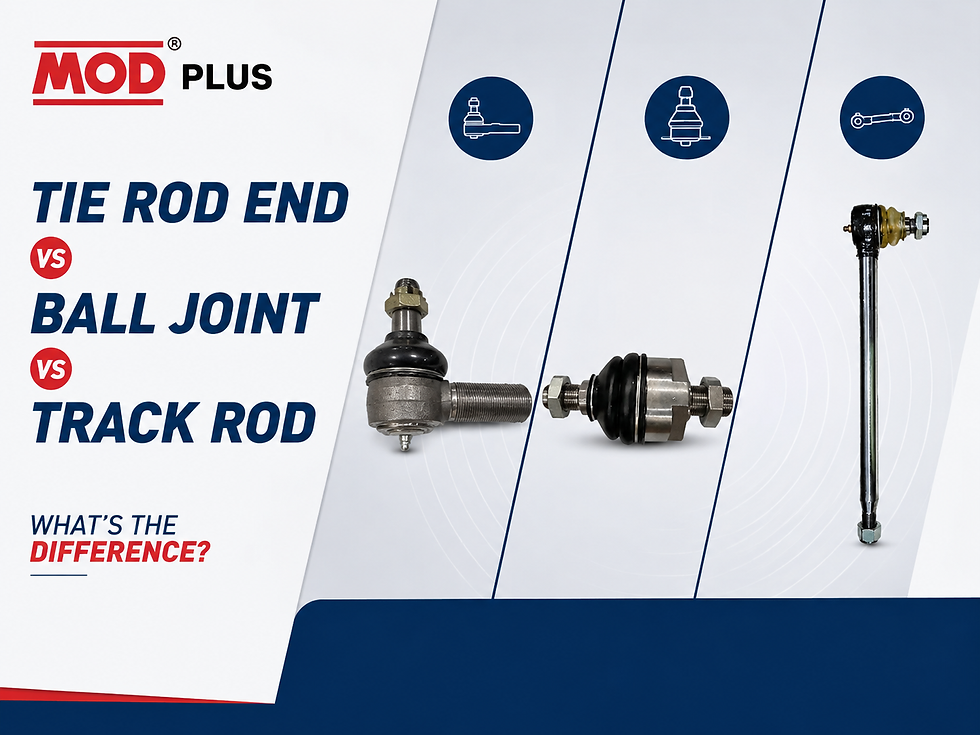
Table of Contents
A mechanic looks under your Mahindra pickup or Massey Ferguson tractor, feels a clunk, and says "tie rod end" — or "ball joint" — or "track rod." Most owners never learn the difference between a tie rod end, ball joint, and track rod until a repair bill forces the question. All three sit in the same steering assembly and cause similar looseness, so the mix-up is an easy one to make.
MOD Plus — the leading supplier of high-performance propeller shaft, steering, and braking components for commercial and agricultural vehicles in India since 1978 — sees this confusion daily.
By the end of this guide, you'll know exactly what each part does and how to tell which one is actually worn.
Why These Three Get Confused
All three parts live in the same short stretch of steering and suspension linkage, all three are ball-and-socket or pin joints that develop play as they wear, and all three produce nearly identical symptoms — clunking over bumps, vague steering, uneven tyre wear. Workshop staff use the terms loosely, too: some mechanics call any worn joint in that area a "tie rod problem" out of habit, even when the actual culprit is a ball joint or track rod.
Add regional and dealer-catalogue naming differences — track rod ends are sometimes called tie rod ends in casual conversation — and it's easy to see why an owner walks away from a diagnosis more confused than when they arrived. Steering linkage parts genuinely do share failure symptoms; they just don't share a job.
What a Tie Rod End Does
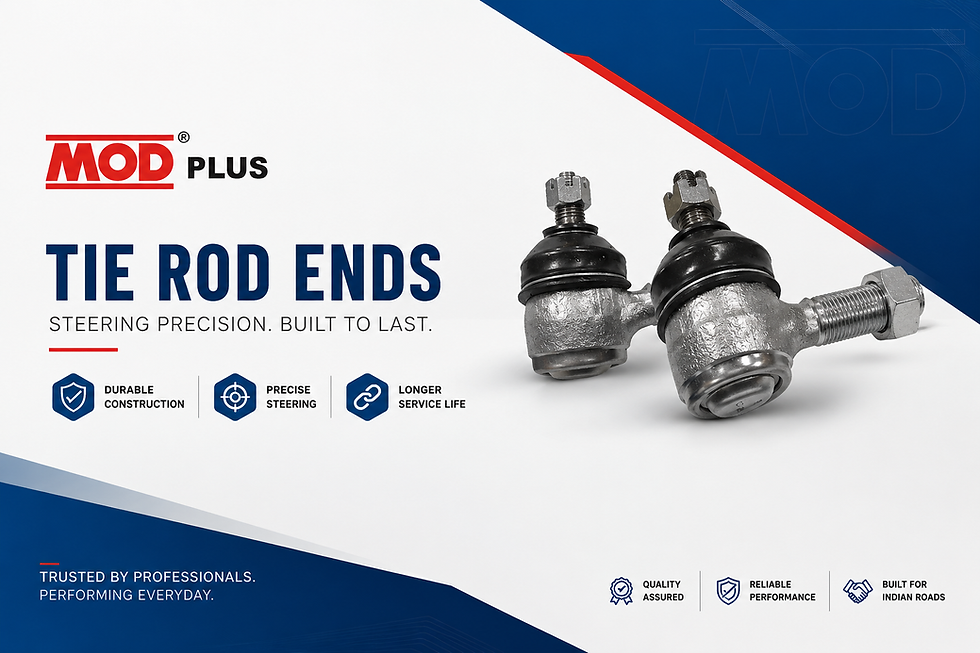
A tie rod end is the ball-and-socket joint at the outer end of the steering linkage, connecting the drag link (or steering rack, on rack-and-pinion vehicles) directly to the steering knuckle at the wheel. It is the joint that physically carries the driver's steering input to the wheel — turn the steering wheel, and the tie rod end is what pushes or pulls the knuckle to match.
On tractors like Massey Ferguson, Swaraj, and John Deere models, and on LCVs like the Tata Ace or Mahindra Bolero Pickup, this small component absorbs constant directional load and road shock, plus — in Indian operating conditions — dust and mud ingress through the boot seal. Worn tie rod ends show up as vibration in the steering wheel, a clunk when turning, and uneven wear on the inner or outer tyre edge.
This part has already been covered in full detail — construction, materials, symptoms, and replacement — in MOD Plus's complete guide to tie rod ends. This section exists only to set up the comparison that follows.
What a Ball Joint Does
A ball joint connects the steering knuckle to the suspension — either the lower (and sometimes upper) control arm on independent-suspension LCVs and trucks, or the front axle beam on solid-axle tractors and heavier commercial vehicles. Unlike a tie rod end, a ball joint isn't part of the steering circuit at all — it's a suspension pivot that happens to also let the wheel turn.
Every time the wheel moves up and down over a bump, pothole, or uneven field, it pivots through the ball joint. Every time you steer, the knuckle also rotates around that same joint. That dual role — vertical suspension travel plus steering rotation — is what makes a ball joint's wear pattern different from a tie rod end's. On older kingpin-style front axles without ball joints, this same task is handled by a kingpin and bushes instead, but on ball-joint-equipped Mahindra, Eicher, and International models, the principle above applies.
A worn ball joint typically announces itself with a distinct clunk or knock over bumps and rough patches, before steering-wheel vibration becomes obvious. Jack the wheel and grip it at 12 and 6 o'clock (top and bottom, not side to side) — vertical play here points to the ball joint, not the tie rod end. Ball joints are commonly sold as a stand-alone part, or bundled with the tie rod end as a complete steering-knuckle assembly.
What a Track Rod Does
A track rod is a different animal entirely — it doesn't connect to the steering box, drag link, or rack at all. It runs transversely across the front axle, connecting the two steering knuckles directly to each other, so that both front wheels turn together at the correct matching angle.
Think of the steering flow like this: the steering box or hydraulic ram moves the drag link, the drag link moves the steering arm on one knuckle through its tie rod end, and the track rod then carries that same movement across to the second knuckle so the other wheel follows in sync. Without a properly adjusted track rod, one front wheel can end up steering more, or at a different angle, than the other.
This layout is common on solid front-axle tractors — Farmtrac, Mahindra Arjun, International, and similar models all use a track rod (also sold as a track end on some platforms) to hold wheel alignment. A worn or bent track rod throws off toe alignment on both front tyres, causing uneven scrubbing and wear, steering wander at higher speeds, and — because it's inspected less often than the tie rod end — it's a common cause of "we replaced the tie rod end and the wear is still there" complaints.
Side-by-Side Comparison: Tie Rod End vs Ball Joint vs Track Rod
Part Name | Primary Function | Location | Common Failure Signs | Typical Symptom Overlap |
Tie Rod End | Transmits steering input from the drag link/steering rack to the steering knuckle | Outer end of the steering linkage, at the wheel-side knuckle | Steering-wheel vibration, clunk on turning, inner/outer tyre edge wear | Clunk over bumps (with ball joint); tyre wear (with track rod) |
Ball Joint | Connects the steering knuckle to the suspension (control arm or axle beam), allowing pivot plus vertical travel | Between the knuckle and the control arm/front axle | Clunk or knock over bumps, vertical play at the 12–6 o'clock wheel check, uneven wear | Clunk over bumps (with tie rod end) |
Track Rod | Connects the two steering knuckles to each other, keeping both wheels synchronised | Transverse rod across the front axle, below the drag link | Uneven tyre wear on both fronts, steering wander, mismatched wheel angles | Tyre wear and vague steering feel (with tie rod end) |
How to Tell Which One Is Actually Failing
If you're weighing up ball joint vs tie rod symptoms without a lift handy, the wheel-rock test below is the fastest way to narrow it down. Start with the vehicle safely jacked and supported, front wheel off the ground, engine off. Grip the tyre at the 9 and 3 o'clock positions (the sides) and rock it firmly in and out. Play here most often means a worn tie rod end or a loose track rod — you'll need to isolate which by feeling directly at each joint with the wheel still raised.
Next, grip the tyre at 12 and 6 o'clock (top and bottom) and rock it vertically. Play in this direction, with none felt in the horizontal check, usually points to the ball joint rather than the steering linkage.
To separate a tie rod end from a track rod specifically, have a second person turn the steering wheel slightly while you watch each joint individually with a torch. The joint that visibly opens up or clunks as the wheel turns is the worn one — if it's the joint nearest the drag link, that's the tie rod end; if it's the crosswise rod between the two wheels, that's the track rod.
For anything beyond a basic play check — or if you're not confident isolating the joint yourself — get the vehicle onto a lift and have a mechanic confirm the diagnosis before ordering a replacement part.
Do They Ever Fail Together?
Yes — more often than owners expect, especially on vehicles running rough rural roads, overloaded LCVs, or tractors working consistently in mud and dust. All three joints sit within the same few feet of linkage, absorb the same shock loads, and are exposed to the same dust and moisture ingress through worn boots. A vehicle old enough, or worked hard enough, to wear out a tie rod end has usually put comparable stress on the ball joints and track rod ends too.
This is why an experienced mechanic checking one joint for play will usually check all three while the wheel is already jacked up — it costs nothing extra and avoids a second visit a few weeks later for the joint that got missed. If you're replacing a tie rod end, it's worth having the ball joint and track rod checked in the same session rather than waiting for the next symptom to show up.
Why Correct Identification Matters Before You Buy
Tie rod ends, ball joints, and track rods aren't interchangeable, and none of them are universal across brands — a tie rod end for a Mahindra MKM tractor won't fit a Massey Ferguson 1040. Ordering the wrong part means a delayed repair and the vehicle sitting off the road longer than necessary — a real cost for a fleet operator or a farmer mid-season.
This is where knowing exactly which joint is worn, and matching it to the exact model and variant, pays off. MOD Plus stocks tie rod ends, ball joints, and track rods engineered to OEM fitment specs across a wide range of Indian tractor, LCV, and commercial vehicle models — so once you've identified the right part, getting a correctly fitted one isn't the hard part anymore.
FAQ
What does a tie rod end actually do?
A tie rod end connects the steering linkage — the drag link or steering rack — to the steering knuckle at each front wheel. It's the joint that carries steering input from the cab to the wheel; turn the wheel, and the tie rod end is what moves the knuckle in response.
What does a ball joint do?
A ball joint connects the steering knuckle to the suspension — the control arm or front axle — letting the wheel pivot for steering while also moving up and down with the suspension. It's a multi-directional pivot, not a steering-only link, which is why a worn ball joint often shows up over bumps before it shows up in the steering wheel.
What does a track rod do?
A track rod runs across the front axle, connecting the two steering knuckles directly to each other. Its job is to keep both front wheels turning at the same matching angle and hold correct wheel alignment — it never connects to the steering box or drag link itself.
What's the fastest way to tell a tie rod end apart from a ball joint?
Jack up the wheel and grip it at the 9 and 3 o'clock (side) positions, then rock it — play here usually points to the tie rod end or track rod. Grip again at 12 and 6 o'clock (top and bottom) — play in that direction points to the ball joint instead.
How is a track rod different from a tie rod end if both attach to the steering knuckle? A tie rod end connects the knuckle to the steering gear — the drag link or rack — so it moves every time you turn the wheel. A track rod connects one knuckle to the other, so it moves only to keep both wheels synchronised; it can be worn even when the steering-gear side is fine.
Can steering play come from more than one of these parts at once?
Yes, and on higher-mileage or hard-working vehicles it often does. Tie rod ends, ball joints, and track rod ends share the same road shocks, dust exposure, and load cycles, so if one has worn significantly, the others are usually not far behind.
Do all three wear out on the same schedule?
Not exactly. Ball joints carry vertical load and tend to wear with suspension travel and payload, while tie rod ends and track rod ends wear more from lateral steering shock and vibration. Terrain, duty cycle, and boot condition matter more than any fixed distance interval.
What happens if I replace the wrong part by mistake? The original play or noise stays, you've spent money on a part you didn't need, and the vehicle keeps running with a genuinely worn joint — which is the bigger safety concern. Identifying the correct part before ordering avoids both problems at once.
Does MOD Plus stock tie rod ends, ball joints, and track rods for the same vehicle? Yes. MOD Plus supplies all three — matched to Mahindra, Massey Ferguson, Swaraj, Tata, Eicher, International, and other tractor, LCV, and commercial vehicle models — so once you've identified the worn joint, you can order the correctly fitted replacement directly.
Shop the Best Quality Tie Rod Ends, Ball Joints & Track Rods by Vehicle
Tie Rod Ends
Tie Rod End & Ball Joint Assemblies
Ball Joints
Track Rods & Draglink Kits
Once you know which of the three is actually worn, MOD Plus stocks correctly-fitted tie rod ends, ball joints, and track rods for a wide range of Indian tractor, LCV, and commercial vehicle models — the same OEM-grade standard the company has supplied pan-India since 1978 from its Delhi distribution base. Browse the right part by vehicle above, or reach out and MOD's team will confirm fitment before you order.


Comments