

Tie Rod End Price in India: What Actually Drives the Cost

Table of Contents
You've got a quote for a tie rod end replacement, and you have absolutely no way to know if it's reasonable, inflated, or suspiciously cheap. That's the actual problem most people run into when they search for tie rod end price in India — not a lack of numbers, but a lack of context for the numbers they're given.
MOD Plus has been supplying steering and driveline components pan-India since 1978, from Sanjay Gandhi Transport Nagar in Delhi, and this guide exists to close that gap: not with a fixed price list, but with a clear explanation of what actually moves the number up or down.
Why Tie Rod End Prices Vary So Much
A tie rod end for a Maruti 800 and a tie rod end for a Tata Prima heavy truck are, mechanically, the same category of part. In every other respect — size, steel grade, load rating, and manufacturing complexity — they're not comparable at all, and neither is their price.
The single biggest driver of tie rod end price is the vehicle segment it's built for, followed closely by whether it's sold as a single piece, a set, or a full repair kit. Type (fixed vs. adjustable), thread specification, and left/right handing add further variation on top of that. None of this is arbitrary — each factor reflects a real difference in the steel used, the machining involved, or the number of components bundled into the package. Understanding these factors is what turns a confusing quote into one you can actually evaluate.
Vehicle Segment: Passenger/Utility vs. LCV vs. Heavy Truck

Segment is where price differences start, and it's the most intuitive factor once you see it laid out. A tie rod end scaled for a Jeep or passenger car will almost always carry a lower MRP than the same category of part built for a light commercial vehicle, and LCV parts in turn sit below heavy-truck and bus applications.
Passenger and Jeep-segment tie rod ends are built for lighter vehicle weight and lower daily mileage, so they use comparatively lighter forgings. As an example, a Willy's-type Jeep tie rod end set carries an MRP of approximately ₹586 — though this can vary by exact model, variant, and retailer. A tie rod end set for a Maruti 800-class passenger car runs even lighter, at an approximate MRP of around ₹514, again depending on the specific application and where you buy it.
Move up to the LCV segment — vehicles like the Tata 407 or Tata 609/709 that haul cargo daily under sustained load — and the parts get noticeably heavier-duty. A Tata 407 tie rod end set carries an approximate MRP in the region of ₹769, while the equivalent set for a Tata 609/709 runs to roughly ₹815 MRP. Both figures can vary depending on the exact variant and your retailer, but the pattern holds: more load-bearing duty means more steel and more machining, and that shows up directly in the price.
Heavy trucks and buses sit above both categories again, for reasons covered in the O.E.-quality section below.
Set vs. Single Piece vs. Full Kit or Assembly
The second major price factor has nothing to do with the vehicle and everything to do with how the part is packaged. Tie rod ends are commonly sold three ways: as a single piece, as a set of two, or as a full repair kit or drag link assembly bundled with related hardware.
A tie rod end set price will always run higher in total than a single piece, simply because you're paying for two components instead of one — but that doesn't make a set a worse deal. Most vehicles wear both sides of a tie rod end at a broadly similar rate, since they see the same road conditions and steering loads. Replacing only one side while leaving a worn one in place is a common shortcut that undermines the whole point of the repair: your alignment settles unevenly again within a short distance, and you're back to paying for a workshop visit sooner than you should be.
A full repair kit or drag link assembly sits a step above a plain set in price, because it bundles in the additional hardware a proper installation needs — items like castle nuts, cotter pins, and sometimes a grease fitting or dust boot. For a workshop comparing supplier quotes, this is one of the first things worth checking: a quote that looks unusually low next to a competitor's may simply be pricing a bare single piece against someone else's complete kit, not an actual difference in part quality.
Fixed vs. Adjustable Type
Tie rod ends come in two broad mechanical types, and the difference between them directly affects both function and price. A fixed-type tie rod end has no built-in adjustment mechanism — it's set to a fixed length and installed as-is. An adjustable-type tie rod end includes a threaded sleeve or jam-nut arrangement that lets a mechanic lengthen or shorten the rod slightly to fine-tune wheel alignment without replacing the whole component.
That adjustment mechanism adds machining steps and hardware, which is why an adjustable-type tie rod end typically carries a higher MRP than a fixed-type part for the same vehicle. You can see this pattern directly in MOD's own catalogue, where several vehicle applications — including light commercial models — are stocked in both a fixed and an adjustable variant, with the adjustable version priced above its fixed counterpart every time.
Which type you need isn't a matter of preference; it depends on what your vehicle's steering linkage was designed around, and swapping types isn't generally advisable without a mechanic's input. What matters for price comparison is making sure you're comparing like with like — a fixed-type quote against another fixed-type quote, not against an adjustable one.
Thread Size, Type, and Left/Right Variants
Thread specification is a less obvious price factor, but it's a real one. Tie rod ends for different vehicles use different thread diameters and pitches — you'll see this reflected in part descriptions as measurements like 30x1.5 or 24x1.5 — and heavier vehicles generally use larger-diameter, coarser threads to handle higher steering loads. A larger thread diameter means more material and more precise machining, both of which push the price upward.
Left-hand and right-hand threading is a related but separate factor. Many tie rod ends — particularly on heavy trucks and buses — are handed parts, meaning the left-side and right-side components use opposite thread directions and aren't interchangeable. Where a part is sold as a handed, single-side component rather than a matched pair, each side is priced and sold individually, which is a different pricing structure from a straightforward left-and-right set.
This is a detail that trips up a lot of buyers comparing quotes on truck and bus parts specifically: one supplier's quote for "a tie rod end" might be for a single right-hand piece, while another's is for both sides. Always confirm exactly what's included before comparing two numbers against each other.
O.E.-Quality Manufacturing vs. Generic: What the Price Difference Actually Buys You
This is the factor buyers ask about most, because it's the one most directly tied to safety. O.E. (Original Equipment) quality manufacturing costs more to produce than a generic equivalent, and that cost difference is real, not padding — it comes from better steel billets, proper forging rather than casting, and heat-treated ball studs that resist wear under sustained load.
MOD's own price list marks a significant share of its tie rod end range explicitly as O.E. quality or O.E. type — this isn't a vague marketing claim but a specific designation attached to individual part listings, the same way an OEM part number reference is. A heavy-duty, fix-type tie rod end for Tata LPT 2518/3118TC applications, explicitly listed as O.E. type, carries an approximate MRP of around ₹2,079 — considerably above a basic passenger-segment part, which reflects both the heavy-truck segment and the manufacturing standard together. Similarly, an alloy-steel, O.E.-quality tie rod end set for Tata 1210-class trucks runs to an approximate MRP of roughly ₹1,154. Both figures can vary by exact application and retailer.
What that additional cost buys in practice is straightforward: tighter dimensional tolerances so the part fits without forcing, a ball stud that holds its adjustment instead of loosening within a few thousand kilometres, and consistent quality testing before the part ever reaches a shelf. A cheaper generic part might look identical on a shelf, but the steel grade and heat treatment underneath it are exactly where corners get cut.
Red Flags: When a Price Is Too Good to Be True
Most of the price variation covered so far is legitimate and explainable. Occasionally, though, a quote is low for the wrong reasons, and it's worth knowing what that looks like before you commit to a purchase.
A price that sits dramatically below every other quote you've collected for the same part — not slightly lower, but strikingly so — is the clearest warning sign, and it usually means one of a few things: a mismatched or wrong-application part, a single piece being sold as though it were a full set, or a generic part with no O.E. quality marking at all.
A part with no visible stamping, no traceable manufacturer, or packaging that looks noticeably different from what a dealer normally carries deserves a second look before you install it on a steering component — this isn't a part where a failure is a minor inconvenience.
None of this means the cheapest option on the table is automatically wrong. It means an unusually low price is a reason to ask a follow-up question — what exactly is included, and what quality standard is it built to — rather than a reason to buy on the spot.
Why Your Nearest Dealer Is the Right Place to Confirm Exact Pricing
Every price mentioned in this guide is an approximate MRP drawn from specific catalogue examples, and every one of them can shift. Retail prices vary by retailer, by region, and over time as input costs and logistics change — that's true of MOD's range and of the aftermarket in general, and it's not something a published article can account for in real time.
The only way to get a number you can actually rely on for your specific vehicle is to confirm current pricing directly with your nearest MOD dealer or distributor, quoting your exact model and part application.
This also protects something worth protecting: retailers set their own final selling prices based on their own costs and local market conditions, and a dealer conversation is the only way to get a price that reflects where you actually are, not a generic national average.
FAQ
How much does a tie rod end cost in India?
There's no single number — MRP depends on vehicle segment, whether it's a single piece, set, or kit, and fixed vs. adjustable type. Passenger and Jeep parts run lowest, LCV sits above that, and heavy-truck or bus parts sit highest. Confirm the exact current MRP with your nearest MOD dealer.
What is the MRP of a tie rod end set?
MRP is the India-wide ceiling price printed on the packaging — the most a retailer can legally charge, though many sell below it. It varies by vehicle model and segment, so check the specific part number with a dealer for an accurate figure.
Why do LCV tie rod ends cost more than passenger car ones?
LCVs carry heavier payloads and cover more daily distance, so their tie rod ends use thicker ball studs, larger housings, and heavier-gauge forgings. That extra material and machining shows up directly in a higher MRP.
Is a genuine tie rod end price always higher than a local or duplicate part? Usually, but not by an extreme margin — O.E.-quality manufacturing costs more due to better steel and heat treatment, though the gap over a reasonable generic part is normally moderate. A price dramatically lower than everything else is a red flag, not a bargain.
What's the difference between a tie rod end set price and a single-piece price?
Sets cost more in total than a single piece because both sides usually wear together and need replacing as a pair. A full repair kit or drag link assembly costs more again, since it bundles in nuts, cotter pins, or a boot.
Does an adjustable-type tie rod end cost more than a fixed type?
Generally yes. An adjustable type includes a threaded sleeve or jam-nut mechanism for fine-tuning alignment, and that added machining and hardware typically pushes its MRP above an equivalent fixed-type part.
How can I verify a tie rod end is O.E. quality before I pay?
Look for a stamped or forged O.E.-quality marking on the body, check that the ball stud has a smooth, hardened finish rather than a rough or painted one, and buy from a dealer who can show you the official price list.
Do left and right tie rod ends cost the same?
Sold as a set, left and right are usually priced as a pair. Some heavy-truck and bus applications sell handed left/right ends separately, in which case each side carries its own individual MRP.
Why does the same tie rod end have different prices at different shops?
MRP sets the ceiling, but each retailer sets their own selling price below it based on margins, local demand, and operating costs. Region and how competitive the local market is can shift the final price you pay.
Where can I get the current tie rod end MRP for my specific vehicle?
The most reliable way is to confirm directly with your nearest MOD dealer or distributor, quoting your vehicle model and part number if you have it — published figures can shift over time.
Shop Genuine Tie Rod Ends by Vehicle Model
Once you know what should be driving your quote, browsing real parts by model is the next step. Below are genuine MOD tie rod end and related steering-linkage products, grouped by vehicle brand.
Tata
A complete draglink kit for the Tata 609/709 range
Mahindra
A rear tie rod end for Mahindra DI tractors with Matrik thread
The equivalent assembly for Mahindra MKM tractors, nut no. 24
A tie rod end assembly with ball joint for the Mahindra Novo
The power steering ball joint shared across Arjun and Eicher tractor lines
A tie rod end with ball joint for the Mahindra Yuvo XP variant
Eicher & IVECO
Swaraj Mazda
Tractor & Farm Equipment Brands
Power Steering Jack Rods
Can't find your exact model above? Browse the full Tie Rod End catalogue or reach out directly — MOD's team can confirm compatibility and current MRP for any vehicle in the range.
Closing
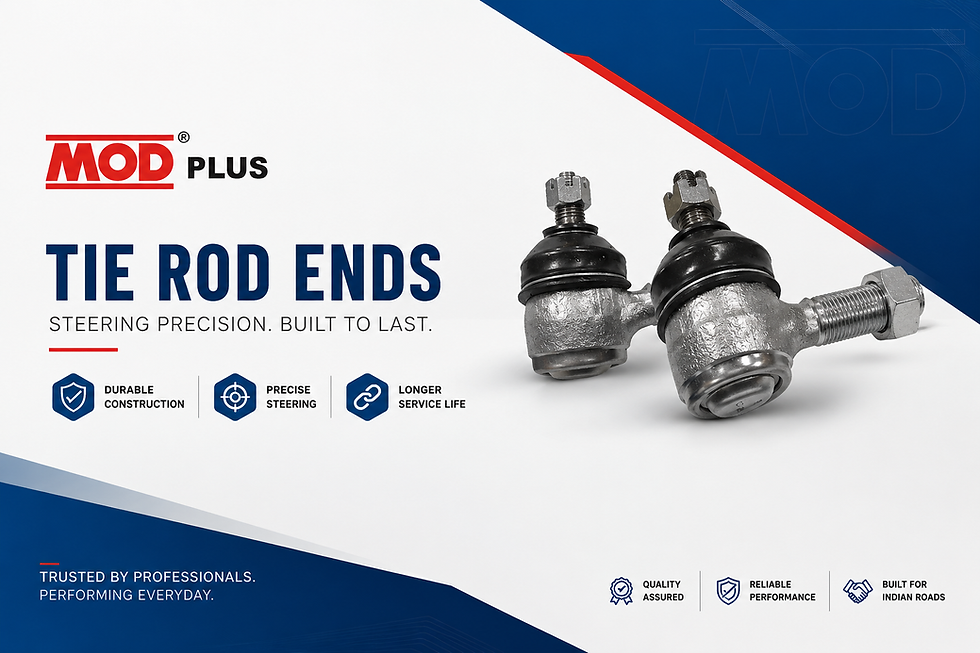
Once you understand what drives the number — segment, packaging, type, thread design, and manufacturing standard — a quote stops being a mystery. MOD Plus has supplied OEM-quality steering components pan-India since 1978 from its Delhi base, and any dealer in that network can confirm exact, current MRP for your vehicle.
Written by the MOD Plus Technical Team Reviewed for accuracy against MOD's official price list and current product catalogue.
Last updated: [LAST UPDATED DATE 18th September 2026 — pricing information in this article should be verified as current with your nearest MOD dealer, as MRP figures are subject to change]


Comments