

Steering Cross Assembly: The Complete Engineering & Buyer's Guide
A technical handbook for fleet owners, mechanics, workshops, OEM buyers, and engineers — written and maintained by the technical desk at MOD Plus, driveline and steering component specialists serving India's commercial vehicle and agricultural sectors since 1978.

Quick Answer: What Is a Steering Cross Assembly?
A steering cross assembly is the universal-joint coupling that connects sections of a vehicle's steering shaft — most commonly the joint between the steering column/intermediate shaft and the steering gearbox (worm-and-sector, worm-and-roller, or recirculating-ball box), or between two shaft sections where the steering column cannot run in a straight line. At its core sits a forged steel cross (also called a spider), four needle roller bearings, and two yokes (forks) — one splined to each shaft section. When the steering wheel is turned, the cross allows rotational motion to pass through an angle, transmitting torque from the driver's hands all the way down to the steering gearbox and, from there, to the wheels.
It is functionally identical in principle to a propeller-shaft universal joint (UJ cross), but sized, splined, and hardened specifically for steering-column torque and duty cycles rather than driveline torque and speed.
If your steering feels loose, clunks over bumps, vibrates at the wheel, or has developed noticeable play, a worn steering cross is one of the most common — and most overlooked — causes, particularly in Tata, Ashok Leyland, Eicher, and Mahindra commercial vehicles running on Indian roads.
Table of Contents
Steering System Fundamentals
Before the cross assembly makes sense on its own, it helps to place it inside the full steering system, because its job is entirely defined by what sits on either side of it.
Most passenger cars today use rack-and-pinion steering, where a pinion gear on the base of the steering column meshes directly with a toothed rack, converting rotation into the straight-line motion that pushes the tie rods and turns the wheels. In this layout, a steering cross (usually as a pair, forming an intermediate shaft) is still typically used between the steering wheel column and the pinion input, because the column rarely lines up in a perfectly straight axis with the rack due to dashboard, pedal box, and crash-safety packaging constraints.
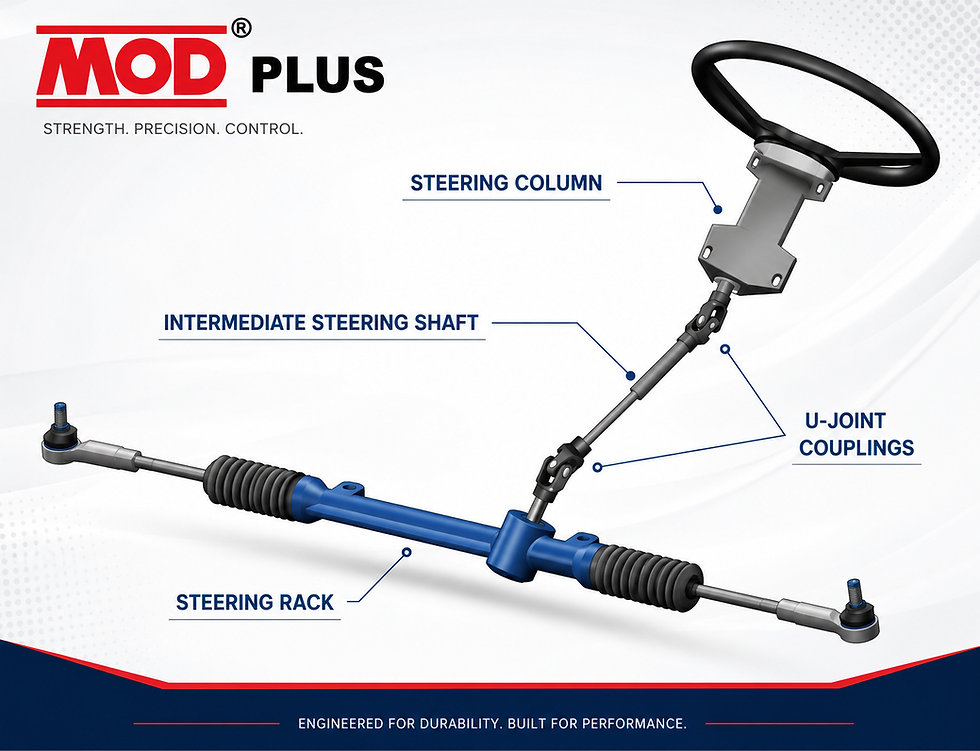
Most Indian commercial vehicles — trucks, buses, and many tractors — instead use a worm-and-sector, worm-and-roller, or recirculating-ball steering gearbox mounted low in the chassis, well away from the driver's steering wheel. Here the steering column has to travel a longer distance, often through one or more bends, before it reaches the gearbox input shaft. This is precisely where steering cross assemblies do their heaviest work: they are the mechanical translators that let a straight steering wheel motion travel through an angled, multi-section shaft and still arrive at the gearbox as clean rotational input.
A typical heavy commercial vehicle steering circuit runs, in order:
Steering wheel → rotates the steering column (upper shaft)
Steering column → connects through a steering cross assembly (universal joint) to an intermediate shaft
Intermediate shaft → often connects through a second steering cross to the steering gearbox input (worm shaft)
Steering gearbox → converts rotation to sector-shaft swing
Drop arm / Pitman arm → moves the drag link
Drag link and tie rods → turn the steering knuckles and wheels
This is why MOD's steering-parts range includes both steering cross assemblies and matched steering worms and sector shafts — in a worm-and-sector gearbox, the cross assembly and the worm shaft are mechanically linked in the same power path, and wear or play in one is frequently misdiagnosed as the other. A mechanic chasing a vibration complaint who only inspects the gearbox internals, while ignoring the column-side cross, will often replace the wrong part.
A Brief History: From Hooke's Joint to the Modern Steering Cross
The universal joint principle behind every steering cross traces back to the 17th century. English scientist Robert Hooke formalized the mechanics of a joint that could transmit rotation between two shafts set at an angle — which is why the mechanism is still widely called a Hooke's joint in engineering literature, alongside the more common name Cardan joint, after the earlier work of Italian mathematician Gerolamo Cardano on gimbal mechanisms.
The core insight has not changed in three centuries: a rigid cross-shaped center piece, pivoting inside two yokes set at 90° to each other, lets torque pass through an angle without the shafts needing to be collinear. What has changed is everything around that principle — the bearings, the metallurgy, the sealing, and the manufacturing tolerances.
Early automotive universal joints ran on plain bronze bushings and required frequent hand-greasing. The shift to needle roller bearings in the mid-20th century was the single biggest reliability improvement in the joint's history, because it replaced sliding friction with rolling friction at the trunnion — dramatically cutting wear rates and allowing the joint to carry far higher torque at the same size.
In India, the steering cross assembly became a distinct, standardized aftermarket part category as the commercial vehicle industry scaled through the 1970s–1990s, with manufacturers like Tata Motors (then TELCO), Ashok Leyland, and Eicher building out extensive truck and bus ranges that all relied on worm-and-sector or worm-and-roller steering boxes fed through column-mounted cross joints. This is also the era in which MOD's own history in this industry began — the company was founded in 1978 in Delhi's Kashmere Gate automotive market, at the same time this category was maturing into the standardized, vehicle-specific parts catalogue that workshops rely on today.
How a Steering Cross Assembly Works
The universal joint principle
A steering cross assembly is a single Cardan (Hooke's) joint: one cross, two yokes, four bearings. Each yoke has two arms with aligned holes; the cross's four trunnions (arms) sit inside needle bearings pressed into those holes, one trunnion pair per yoke, at 90° to the other pair. This lets the two yokes pivot relative to each other around two perpendicular axes simultaneously — which is exactly the freedom needed to transmit rotation across a bend.
Why a single joint isn't perfectly smooth — and why that matters
A textbook property of a single Cardan joint is that when the input and output shafts are not perfectly in line, the output shaft's rotational speed is not perfectly constant even if the input speed is — it accelerates and decelerates twice per revolution. At low steering-column speeds and typical operating angles, this is not something a driver perceives directly as speed variation, but it does translate into cyclic loading on the joint's needle bearings and trunnions. This is one reason operating angle matters: the greater the angle between the two shaft sections, the greater this cyclic effect, and the greater the fatigue loading on the cross. It's also why, on layouts with larger bends, engineers use two crosses in series (a "double cross" or compound intermediate shaft) — arranging the second joint's phasing to cancel out most of the velocity fluctuation introduced by the first. MOD's own catalogue includes a double-cross type assembly for the Tata Sumo Victa, which is a direct real-world example of this compensating layout.
Torque transfer and load path
Torque enters through the input yoke (splined to the steering column or intermediate shaft), passes through two trunnions into the cross body, and exits through the two remaining trunnions into the output yoke. The needle bearings at each trunnion carry the radial load created by this torque transfer while allowing the small oscillating rotation each trunnion makes as the joint articulates. Under normal steering effort this load is moderate and cyclical; under the shock loading of a pothole, kerb strike, or a driver "catching" a wheel that's dropped into a rut, the load spikes sharply and briefly — which is the loading condition that most frequently initiates fatigue cracking or bearing brinelling in a worn or already-marginal cross.
Steering angle transmission and geometry
Because the steering cross sits ahead of the steering gearbox's own internal ratio, any play in the cross is multiplied, not reduced, by the time it reaches the road wheel — in a typical worm-and-sector box the mechanical ratio can be in the range of 15:1 to 20:1 or higher. A small amount of rotational free play at the cross can translate into a comparatively larger amount of perceived play at the steering wheel rim before the road wheels respond, which is exactly the "sloppy steering" complaint drivers describe.
Vibration control
A correctly toleranced, correctly greased cross with matched needle bearing preload runs smoothly with minimal induced vibration. As the needle bearings wear, radial clearance increases, and the trunnion begins to move inside the bearing bore rather than simply rotating within it — this is what generates the knock, clunk, or buzz that owners feel through the steering wheel, especially over rough surfaces or during full-lock manoeuvres like reversing into a loading bay.
Recommended diagram: Exploded view of a steering cross assembly showing the cross, four needle bearing cups, two yokes, circlips, and dust seals, with torque-path arrows.
Anatomy of a Steering Cross Assembly
A steering cross assembly looks simple from the outside — a compact metal knuckle bolted or splined between two shaft ends — but every part inside it is doing specific, load-bearing work. Understanding each component is the difference between a mechanic who can diagnose a fault and one who can only replace the whole unit and hope.
The cross (spider)
The center component, shaped like a plus-sign or four-pointed star. Each of the four arms is called a trunnion. The cross is almost always a single forged-steel piece — forging aligns the steel's internal grain flow along the trunnion shape, which gives dramatically better fatigue resistance than a cast or machined-from-bar equivalent would offer at the same dimensions. This is discussed further in the materials section below.
Needle roller bearings
Each trunnion runs inside a bearing cup packed with needle rollers — small, thin cylindrical rollers arranged around the trunnion's circumference. Needle bearings are chosen over plain bushings or ball bearings for this application because they offer a very high load-carrying capacity relative to their radial size, which matters enormously in a component that has to fit inside a compact yoke. The needles roll rather than slide against the trunnion surface, which is what keeps friction and wear low across millions of small oscillating cycles.
Bearing cups (cross caps)
The needle rollers sit inside a hardened steel cup that is pressed into the yoke's bore. The cup provides the precision-ground outer race surface the needles run against. Correct cup-to-yoke interference fit is what keeps the cup from spinning or working loose in service — too loose, and the cup can walk out of the bore under load; the assembly's fit tolerances are engineered specifically to prevent this over the component's service life.
Yokes (forks)
The two yokes are the "arms" that connect the cross to the shaft sections on either side. One yoke typically carries external splines or an internal splined bore to mate with the steering column/intermediate shaft, while the other mates with the steering gearbox's worm shaft input or the next shaft section. Yoke design varies significantly by vehicle — MOD's catalogue alone spans dozens of distinct yoke geometries (long fork, reverse yoke, half yoke, flange-type yoke) because spline count, spline pitch, yoke arm length, and overall assembly length are all vehicle-specific.
Splines
The splined interface is what actually transmits torque between the cross assembly and the shafts it connects — not friction, not a keyway, but the meshing of many small teeth cut into both the shaft and the yoke bore. Spline count and thickness ("thick spline" vs "thin spline" in MOD's own product naming, for example on Ashok Leyland and Tata 1109 applications) must match the mating shaft exactly; a spline mismatch — even one that "goes on" with force — will wear rapidly and can shear under load.
Circlips and retaining rings
Small circlips seated in machined grooves at each bearing cup keep the cups axially located in the yoke bore, preventing them from working out under the thrust loads generated during steering. Several MOD part numbers are explicitly described as "circlip design" (for example, the Ashok Leyland Tauras 2516/3516 UJ cross), which tells a buyer or mechanic exactly what retention method to expect and inspect during a rebuild.
Dust seals and grease channels
Where the cross assembly is a greasable / serviceable type rather than a sealed-for-life unit, a grease channel runs through the cross body to a nipple (grease fitting) on one arm, allowing lubricant to be pumped into all four trunnion bearings from a single external point. Dust seals or lip seals at each bearing cup keep contamination — road grit, water, corrosive slush — out of the needle bearing race while keeping grease in. Failure of this seal, more than almost any other single factor, is what determines real-world service life on Indian roads, where dust ingress is a far more aggressive environment than on sealed highway driving in cleaner climates.
Greaseless / sealed-for-life variants
Some applications — MOD's rotavator cross range includes an explicitly greaseless 38mm variant — use permanently sealed, factory-lubricated bearings instead of a serviceable grease point. These trade routine maintenance for a fixed service life and are chosen where a grease nipple would be impractical to access or where the operating environment (heavy dust and mud in agricultural PTO applications) would contaminate an open grease channel faster than lubrication could protect it.
Component | Function | Typical Failure Mode |
Cross (spider) | Transmits torque between trunnions; pivot point for both axes | Trunnion wear, fatigue cracking, scoring |
Needle roller bearings | Low-friction rolling support at each trunnion | Brinelling, spalling, seizure from dry-running |
Bearing cups | Precision race for needle rollers; locates in yoke bore | Cup wear, cup migration/loosening |
Yokes/forks | Connect cross to shaft sections; carry spline interface | Spline wear, arm cracking, bore elongation |
Splines | Torque transmission to/from shaft | Spline rounding, shear under shock load |
Circlips | Axially retain bearing cups | Loosening, groove wear, loss under vibration |
Dust seals | Keep contamination out, grease in | Seal hardening, tearing, grease purge |
Grease nipple/channel | Route lubricant to all four trunnions | Blockage, channel corrosion |
Materials, Forging & Heat Treatment
This section explains general engineering and metallurgical practice used across the driveline-component industry. Where a specific claim is about how MOD manufactures or sources a part, it is noted as such; general metallurgy discussion applies to the product category broadly and should not be read as a certification claim for any single supplier unless stated.
Forging vs casting vs machining from bar stock
Three manufacturing routes can produce a cross-shaped part, and they are not interchangeable in a torque-cycling, shock-loaded application like steering:
Forging shapes the steel while hot, under high pressure, which aligns the metal's internal grain flow to follow the part's geometry — critically, along the trunnion arms, exactly where bending and shear stress concentrate. This grain alignment is what gives a forged cross meaningfully better fatigue life and impact resistance than the alternatives at equivalent size.
Casting (pouring molten steel into a mold) is cheaper and faster but produces a part with randomly oriented grain structure and a higher risk of internal porosity — microscopic voids that become stress-concentration points and crack initiation sites under cyclic loading. A cast cross can look dimensionally identical to a forged one and still fail far sooner in service.
Machining from bar stock (turning/milling a cross shape out of solid round bar) avoids porosity risk but cuts across the bar's natural grain flow at the trunnions, which is also a weaker configuration than a properly forged part, and it is generally a less economical process at the volumes the aftermarket requires.
Reputable steering and driveline component manufacturers use forged blanks for the cross body as standard industry practice, precisely because of this stress-concentration and fatigue-life advantage — a fact any buyer should ask their supplier to confirm.
Case hardening and carburizing
After forging and machining to near-final dimensions, the trunnion surfaces — the parts that actually run against the needle bearings — need to be very hard to resist wear, while the core of the part needs to stay tough and ductile so the whole cross doesn't become brittle and crack under shock loads. This is achieved through case hardening, most commonly carburizing: the part is heated in a carbon-rich atmosphere so carbon diffuses into the outer surface layer, then quenched, producing a hard outer "case" (often specified in the 58–62 HRC range in general driveline-component practice) over a tougher, lower-hardness core. This case/core combination — hard skin, tough interior — is the standard metallurgical strategy for any component that must resist both surface wear and shock fatigue simultaneously, and it is why a properly heat-treated cross feels immovable to a file on the trunnion surface while still being able to absorb a pothole impact without shattering.
Case-hardening low-alloy steels such as the EN-series (EN8, EN19, EN353/EN36-type grades) or their international equivalents (including chromium-manganese carburizing grades such as 20MnCr5) are widely used across the Indian and international driveline-component industry for exactly this reason — they carburize predictably and give a good combination of case hardness and core toughness. Buyers evaluating suppliers should ask specifically what grade and case depth is used for their application, since this single specification more than any other determines real-world wear life.
Surface treatments and coatings
Beyond heat treatment, some steering and propeller-shaft components use additional surface coatings for wear or corrosion resistance. MOD's own propeller-shaft range, for example, lists multiple parts explicitly as "Teflon coated"(PTFE coating) on the sliding sleeve/spline interface — a coating chosen specifically to reduce friction and resist corrosion at a sliding spline joint, which is a different wear mode from the rotating trunnion bearings inside the cross itself. This distinction matters: a coating appropriate for a sliding spline sleeve is not the same specification as the case hardening required at a rotating bearing trunnion, and a well-engineered assembly applies the right treatment to the right surface rather than one blanket finish everywhere.
Corrosion protection
Exposed steel components on the underside of a commercial vehicle or tractor are subject to road salt, monsoon water, and agricultural mud and fertilizer residue, all of which accelerate corrosion. Zinc plating, phosphating, and black oxide finishes are common protective treatments for the external (non-bearing) surfaces of yokes and cross bodies, chosen to resist surface rust without interfering with the precision-fit bearing surfaces or spline geometry underneath.
Precision manufacturing and tolerances
None of the above matters if the parts don't fit together correctly. The bearing cup bore in the yoke, the trunnion diameter on the cross, and the needle roller diameter all have to be held to tight tolerances relative to each other, because the bearing preload — the very small controlled clearance or interference between the needle rollers and the trunnion/cup surfaces — directly determines both smoothness of rotation and bearing life. Too loose, and the joint will feel rough and wear rapidly from impact loading between the rollers and races. Too tight, and the joint will bind, generate heat, and fail from overload. This is why cross assemblies are manufactured as matched, pre-set units rather than as a bag of interchangeable loose parts — the trunnion, needle set, and cup are toleranced to work together as supplied.
Steering Cross vs Related Driveline Components
"Universal joint cross" is a broader engineering term that covers several distinct product families in the aftermarket, and mixing them up is a common source of ordering errors at parts counters. Here's how they differ:
Component | Where It's Used | Primary Load | Typical Naming |
Steering Cross Assembly | Steering column ↔ intermediate shaft ↔ steering gearbox worm shaft | Steering effort torque, low-to-moderate, high cycle count | "Steering Cross Assy," "Stg. Cross Assy." |
Propeller Shaft UJ Cross | Gearbox/transfer case output ↔ differential input, along the propeller (drive) shaft | Full engine driving torque, high magnitude | "UJ Cross," "Cardan Cross" |
Rotavator / PTO Cross | Tractor PTO shaft ↔ rotavator or implement gearbox input | High shock loading from soil/implement resistance | "Rotavator Cross," "PTO UJ Cross" |
JCB / Construction Equipment Cross | Drive shaft sections on backhoe loaders and similar equipment | Heavy driving torque, off-road shock loading | "UJ Cross JCB," e.g. 35x106mm |
All four share the same fundamental Hooke's-joint design principle described in Section 3, but they are not interchangeable — dimensions, spline profiles, trunnion size, and heat-treatment specification are all tuned to their specific torque and duty-cycle requirements. A propeller-shaft cross forced into a steering application (or vice versa) will typically be either wildly over-specified and physically incompatible, or under-specified for the mounting and fail prematurely.
This is precisely why a specialist catalogue structure matters to a buyer. MOD organizes its range into these same functional families — Propeller Shaft / UJ Cross, Steering Parts, and Rotavator Parts — rather than one undifferentiated "crosses" bucket, which reflects the underlying engineering reality that these are distinct component classes even though they share a common joint principle.
Applications Across Indian Vehicles & Machinery
Commercial vehicles (LCV, ICV, HCV)
India's commercial vehicle parc runs almost entirely on worm-and-sector or worm-and-roller steering gearboxes at the medium and heavy end, which means the steering cross assembly is a near-universal wear part across the fleet — not an exotic or occasional-failure component. Major nameplates in daily operation include Tata Motors (407, 709, 1109, 1210, 1312, 1613, 2515/2516, Xenon, Signa BS-6 range, Ace, Sumo, Winger), Ashok Leyland (Dost, U-Truck range, Tauras), Eicher (10-tonne to 11-tonne range, Jumbo, Galaxy), Mahindra (Bolero, Marshal, Commander, Jeeto, Maximo, Max Pickup), and Force/Iveco-based platforms such as Stallion. Across these platforms, spline count, spline thickness (thick vs thin), shaft length, and yoke style all vary by model and even by production year, which is why vehicle-specific part numbering — rather than a generic "one size" cross — is standard practice across the aftermarket.
Tractors and agricultural machinery
On the agricultural side, steering cross principles extend into two separate applications that are easy to confuse: power-steering jack rod/piston rod assemblies and track rod (tie rod) ends — which handle the front-axle steering linkage on tractors such as Sonalika, John Deere, Swaraj, New Holland, Mahindra Arjun, and International — and PTO-driven rotavator crosses, which are a different, driveline-side application entirely (see below). Both are wear-prone in tractor use because of constant exposure to field dust, mud, and full-lock turning at headlands.
Rotavator and PTO driveline crosses
Strictly speaking, a rotavator's PTO cross is a driveline component, not a steering component — but it shares the identical Hooke's-joint engineering and is frequently discussed alongside steering crosses because both are "the cross that's always overlooked until it fails mid-season." A rotavator's PTO shaft transmits full engine power (via the tractor's PTO) into the implement gearbox, and the crosses at each end of that shaft absorb both the driving torque and the shock loading generated every time the blades hit dense, wet, or rocky soil. MOD's rotavator range includes greasable and greaseless 38mm crosses, spring yokes, half yokes, and shearing-bolt safety yokes across Sonalika, Shaktiman, Mahindra Gyrovator, and Maschio-pattern implements — a useful illustration of how many distinct yoke and lock styles exist even within a single implement category.
Construction and off-road equipment
Backhoe loaders and similar construction machinery use universal-joint crosses in their drive shaft sections in much the same way as commercial trucks, but with dimensions and duty cycles suited to low-speed, high-torque, off-road operation. This is a distinct product line from both the steering-cross and rotavator-cross families, sized specifically for the equipment's drive shaft geometry.
Representative vehicle coverage (illustrative, not exhaustive)
Segment | Example Platforms | Component Type |
Pickup / Compact LCV | Tata Ace, Tata Sumo, Mahindra Jeeto, Mahindra Bolero | Steering cross assembly, steering worm, sector shaft |
Medium & Heavy CV | Tata 1109/1210/1312/1613/2515/2516, Ashok Leyland U-Truck/Tauras/Dost, Eicher 10.60–11.10/Jumbo/Galaxy | Steering cross assembly (thick/thin spline variants), steering worm |
Bus chassis | Ultra Bus 8/4, 10/4; Tata 909; Marco Polo-bodied chassis | Steering cross assembly, long-shaft variants |
BS-6 platforms | Tata Signa 2518/2818/2823/3521 range | Updated-spec steering cross assembly |
Tractors & implements | Sonalika, Shaktiman, Mahindra Arjun/Gyrovator, Swaraj, New Holland, John Deere, International, Maschio-pattern rotavators | Jack rod/piston rod, track rod end, ball joint, PTO/rotavator cross, spring & half yokes |
Construction equipment | JCB 3DX and similar backhoe loaders | Drive-shaft UJ cross, reverse yoke, coupling flange |
Signs of a Failing Steering Cross Assembly
Featured-Answer Summaries
Can you drive with a worn steering cross? Not safely for long. A worn cross introduces play and unpredictability into the steering circuit, which degrades steering response precisely when you need it most — in an emergency avoidance manoeuvre. Severe wear can progress to trunnion or spline failure, resulting in sudden, complete loss of steering control. Any confirmed play or noise at the steering cross should be treated as a same-week workshop visit, not a "monitor it" item.
How long does a steering cross last? There is no single universal figure — service life depends heavily on operating conditions, load, grease discipline, and dust/water exposure — but a well-maintained, correctly greased cross on a properly aligned steering system commonly gives several years of reliable service in normal commercial operation, while a neglected, ungreased, or contaminated unit can develop damaging play in a fraction of that time. Fleet operators should track cross condition by inspection interval (see Section 13) rather than by calendar age alone.
What causes steering vibration? Steering-cross wear is one of several possible causes, alongside wheel imbalance, tie rod end wear, worn steering gearbox internals, and propeller shaft imbalance on some layouts. A vibration that changes specifically with steering angle or steering effort (rather than with road speed alone) points more strongly toward the steering cross or gearbox than toward wheel balance.
Detailed symptom breakdown
Steering play ("dead zone" at the wheel). The most classic symptom. The driver can rotate the steering wheel a noticeable amount — sometimes several centimetres of rim travel — before the road wheels begin to respond. This is the multiplied effect of small rotational clearance in a worn cross, described in Section 3.
Clunking or clicking noise on direction change. A distinct mechanical clunk, most noticeable at low speed during full-lock manoeuvres (parking, reversing) or when transitioning from acceleration to deceleration, is a strong indicator of trunnion-to-bearing clearance in the cross.
Steering wheel vibration. Felt through the rim, often worsening with vehicle speed or under load (fully laden truck), and frequently accompanied by a low-frequency buzz. This points to bearing wear generating an oscillating, non-smooth torque transfer through the joint.
Stiff or binding steering. Less common than play, but equally serious: a cross that has lost lubrication, seized internally, or been installed with incorrect angularity can bind rather than loosen, making the steering effort abnormally heavy, sometimes only at certain points in the steering arc.
Grinding or grating feel. Suggests advanced bearing degradation — needle rollers that have spalled or a trunnion surface that has worn through its hardened case into softer core material.
Visible grease leakage or dried, cracked dust seals. An early warning sign that should trigger inspection before play develops, not after.
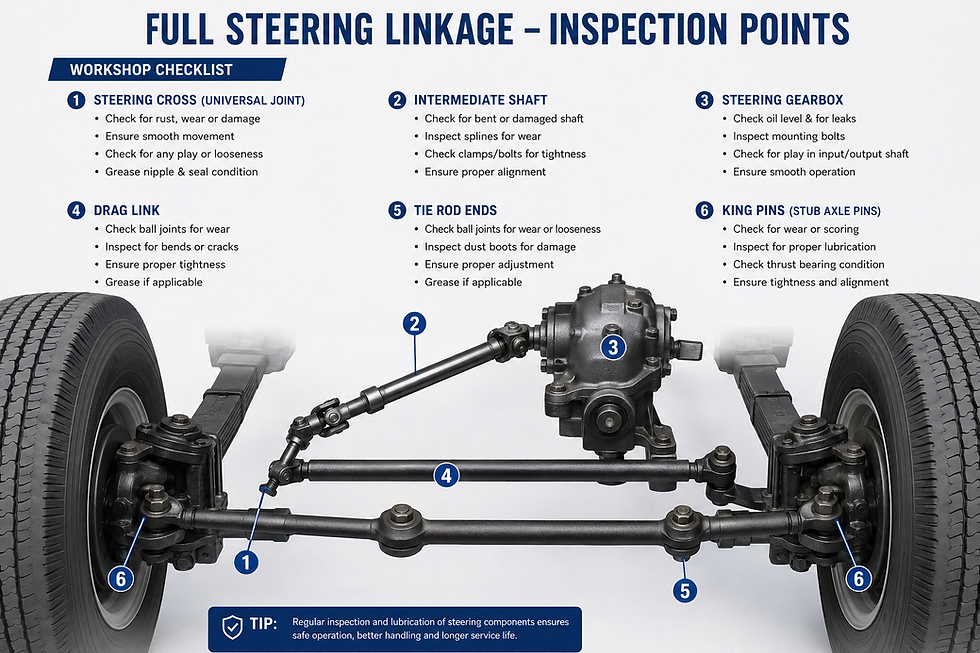
Uneven or accelerated tyre wear pattern combined with steering looseness. While tyre wear has many causes, a combination of unexplained tyre wear and confirmed steering play should prompt a full steering-linkage inspection, of which the cross assembly is one checkpoint among several (tie rod ends, ball joints, king pins).
Symptom | Likely Severity | Typical Cause Location |
Slight play, no noise | Moderate — monitor closely | Early needle bearing wear |
Clunk on direction change | Moderate-High | Trunnion/bearing clearance |
Steering wheel vibration | Moderate-High | Bearing wear, misalignment |
Stiff/binding steering | High | Lubrication failure, seizure, incorrect fitment |
Grinding/grating | High — urgent | Advanced bearing/spline damage |
Grease leakage | Low-Moderate — early warning | Seal degradation |
Root Causes of Steering Cross Failure
Lack of lubrication. The single largest driver of premature cross failure across the aftermarket. Needle bearings depend on a continuous grease film to prevent metal-to-metal contact between roller and race; once that film breaks down — from missed greasing intervals, purged/washed-out grease, or a failed seal — wear accelerates from a slow, gradual process into a rapid one within a comparatively short number of operating hours.
Contamination (dust, water, grit). Indian operating conditions — unpaved rural roads, monsoon water crossings, construction-site dust, agricultural field mud — are far more aggressive on exposed steering-linkage components than clean highway environments. Once grit works past a degraded seal and mixes with grease, it becomes an effective grinding paste against the needle bearing surfaces.
Corrosion. Prolonged exposure to moisture, especially combined with road salt in some regions or standing water in others, attacks unprotected steel surfaces and can pit bearing races and trunnions, creating stress risers that accelerate fatigue cracking.
Fatigue from cyclic loading. Every steering input, even a small one, cycles load through the cross's trunnions. Over enough cycles — and commercial vehicles covering long daily distances accumulate these cycles quickly — microscopic fatigue cracks can initiate at stress-concentration points, particularly in a part that was cast rather than forged, or under-hardened relative to its duty.
Shock loading. A single severe pothole strike, kerb impact, or off-road jolt can do more damage in one event than months of normal cyclic use, particularly to a cross that is already partially worn and has lost some of its manufactured preload tolerance.
Misalignment. If a steering cross is installed at an operating angle outside its design range — for example after a chassis or steering-column mounting repair that wasn't restored to the correct geometry — the joint's angular-velocity fluctuation increases, raising cyclic stress and accelerating wear even under otherwise normal use.
Incorrect fitment or spline mismatch. Forcing a close-but-not-exact spline fit, or fitting a cross assembly intended for a different variant of the same model family, creates uneven load distribution across the spline teeth and can lead to rapid spline rounding or sudden shear failure.
Poor manufacturing quality. Insufficient case hardness, shallow case depth, porosity from a cast (rather than forged) cross body, or loose manufacturing tolerances on bearing preload will all shorten service life regardless of how well the vehicle is otherwise maintained — which is why supplier and manufacturing-quality selection is as important as maintenance discipline.
Step-by-Step Inspection & Diagnostic Process
A proper steering-cross inspection should be done with the vehicle safely supported, wheels off the ground or on a pit/lift where the full steering linkage can be accessed and moved by hand.
Visual inspection first. Look for grease staining/leakage around each cross assembly location, cracked or missing dust seals, obvious corrosion, or a cross assembly that looks visibly different (mismatched replacement part) from its mounting.
Check for physical play by hand. With the steering unloaded (wheels off the ground, or a second technician holding the steering wheel stationary while you work at the joint), grip the shaft on either side of the cross and attempt to rotate one side while holding the other still. Any perceptible rotational play beyond a very slight, uniform resistance indicates bearing wear.
Check for axial/radial movement at each yoke. Try to rock the yoke relative to the cross in directions other than its intended rotation. Looseness here indicates worn bearing cups or trunnion wear.
Inspect splines at each connection point. Look for rounded tooth profiles, visible metal shavings, or a shaft that can be rocked within the yoke bore — all signs of spline wear that will not be solved by simply reinstalling a new cross onto an already-damaged mating spline.
Listen during a controlled steering sweep. With the vehicle safely on stands and wheels able to turn freely, have a second person slowly turn the steering wheel lock to lock while you listen and feel at each cross location for clicking, grinding, or binding.
Check grease nipple condition and grease color/consistency, where the assembly is a serviceable (greasable) type — contaminated, gritty, or emulsified (water-mixed) grease confirms a seal breach even before play becomes measurable.
Cross-check against related components. Because steering play can also originate at tie rod ends, ball joints, the steering gearbox itself, or king pins, a full linkage inspection — not just the cross — is needed before condemning any single part, to avoid a repeat comeback where the real fault was elsewhere in the chain.
Road test after inspection, checking specifically whether the reported vibration or looseness correlates with steering angle/effort (pointing to the steering circuit) versus road speed alone (pointing more toward wheel balance or tyres).
Steering Cross Replacement: What to Expect
Replacement complexity varies by vehicle layout, but the general workflow a workshop follows is consistent:
Confirm the correct part number against chassis/model, spline count and thickness, yoke style, and overall length — not just the broad vehicle name. As the applications table in Section 7 shows, a single model line (Tata 2515/2516, for instance) can have multiple distinct steering-cross variants depending on steering type (e.g. ZF steering) or production spec, so matching by exact reference is essential, not optional.
Support the vehicle safely and gain clear access to the steering column/intermediate shaft/gearbox input area.
Mark relative shaft/yoke orientation before disassembly wherever the design allows, so the replacement goes back in with the same phasing, particularly important on double-cross (compound) intermediate shafts where relative joint orientation affects the velocity-fluctuation cancellation discussed in Section 3.
Remove retaining hardware (circlips, pinch bolts, or clamp bolts depending on design) and separate the worn assembly.
Inspect mating splines and shaft ends before fitting the new assembly — a worn mating spline should be addressed, not covered up by a new cross alone.
Fit the new steering cross assembly, ensuring full spline engagement and correct orientation, and secure all retaining hardware to the vehicle manufacturer's specification.
Grease the new assembly (for serviceable/greasable types) before returning the vehicle to service, even though most quality replacement units ship factory-greased.
Recheck for play and correct operation through full lock-to-lock movement before road testing.
Road test, confirming the original complaint (play, clunk, vibration) is resolved and no new noise or binding has been introduced.
Installation Best Practices
Never substitute a "close enough" spline fit. A cross assembly that requires force to install onto a spline, or that has visible rock/play once installed, is either the wrong part number or is being installed onto an already-worn mating shaft — both need to be resolved before the vehicle returns to service.
Always torque retaining hardware to the vehicle manufacturer's specification, using a calibrated torque wrench rather than "feel." Under-torqued retaining bolts or pinch clamps can allow the assembly to work loose in service; over-torquing can distort yokes or shear fasteners. Because torque specifications are vehicle- and fastener-specific, always refer to the OEM service manual for the exact figure for your chassis rather than relying on a generic number — this is one area where using the correct published specification, not a rule of thumb, is genuinely safety-critical.
Preserve original shaft phasing on compound (double-cross) assemblies. Installing a second joint out of phase reintroduces the velocity-fluctuation problem that a correctly phased double-cross design is specifically built to cancel out.
Grease immediately after installation on serviceable types, and confirm grease is reaching all four trunnions (visible slight purge at each seal edge is a good sign) before considering the job complete.
Check for interference through full steering lock after installation — a replacement of a slightly different geometry, or a bracket disturbed during the job, can create a physical clash at full lock that wasn't present before.
Don't skip the post-installation road test. A steering system is safety-critical; confirming correct, play-free, symmetrical steering feel in both directions before releasing the vehicle is non-negotiable workshop practice.
Maintenance Schedule for Steering Cross Assemblies
Maintenance intervals should always follow the vehicle or implement manufacturer's specified service schedule first. The framework below reflects general industry practice for serviceable (greasable) steering cross assemblies in typical Indian commercial and agricultural operating conditions, and should be adjusted tighter for harsher duty (off-road, dusty, high-mileage) and can be relaxed somewhat for light, clean-condition passenger use.
Interval | Action |
Daily (fleet/commercial pre-trip) | Quick visual check for obvious grease leakage, unusual steering feel reported by driver, or new noise reported from previous trip |
Weekly | Visual inspection of dust seals and grease nipple condition; check for any new play detected during routine checks |
Monthly | Hand-check for rotational play at each accessible steering cross; inspect for corrosion or contamination |
Quarterly | Full grease service on all greasable steering cross points per OEM interval; detailed inspection of splines and yoke condition |
Every 6 months / mid-season (agricultural) | Complete steering linkage inspection including cross, tie rod ends, ball joints; verify grease is reaching all trunnions and not being purged by damaged seals |
Annually / Yearly | Full workshop inspection with vehicle on lift/pit; assess whether cumulative wear indicates planned replacement is due before failure occurs |
Fleet preventive maintenance program | Track steering-cross condition against vehicle mileage/hours in maintenance records; flag units approaching typical replacement age for proactive scheduling rather than reactive breakdown response |
Greasing practice notes
Use the grease type specified by the vehicle or component manufacturer — mixing incompatible grease chemistries can degrade lubrication performance.
Grease until fresh lubricant is visible purging slightly at each seal, confirming all four trunnions have been reached, rather than stopping after a fixed number of pump strokes regardless of what's actually happening at the joint.
After high-pressure washing (common in fleet and agricultural operations), re-grease steering cross points sooner than the standard interval, since pressure washing is a known cause of accelerated grease purge and water ingress at seals.
Why fleet operators specifically should not skip this
For a fleet or transport operator, an unplanned steering-linkage failure doesn't just cost the part — it costs the vehicle's earning days, a potential roadside recovery, and in the worst case, a safety incident. A disciplined grease and inspection interval, logged against each vehicle, converts steering-cross wear from an unpredictable breakdown risk into a scheduled, budgeted replacement — which is the entire point of preventive maintenance.
OEM vs Aftermarket: An Honest Comparison
"OEM" strictly means a part supplied by the original vehicle manufacturer's own parts channel. In practice, most of what workshops and fleets actually buy in the steering-cross category is aftermarket — parts manufactured to match OEM fitment and specification but sold independently of the vehicle brand's own parts counter. Aftermarket quality varies enormously across suppliers, which is why the comparison below is really "genuine OEM vs quality-engineeredaftermarket vs low-cost, unspecified aftermarket" — three tiers, not two.
Factor | Vehicle-Brand OEM Channel | Quality-Engineered Aftermarket | Low-Cost/Unspecified Aftermarket |
Material & heat treatment | Manufacturer-specified, tightly controlled | Should match OEM spec if sourced responsibly — verify with supplier | Often unspecified; case depth/hardness may be reduced to cut cost |
Manufacturing process | Forged, as per original engineering | Forged from reputable suppliers | May be cast or machined from lower-grade stock |
Fitment accuracy | Guaranteed to original spec | Should be verified against vehicle-specific part numbers | Frequently generic/"universal," requiring force-fitting |
Price | Typically highest | Competitive, mid-range | Lowest, often significantly |
Availability | Can be slow, especially older models | Generally strong for high-volume commercial applications | Widely available but inconsistent quality lot-to-lot |
Traceability/warranty | Manufacturer-backed | Depends on supplier reputation and distribution history | Often minimal or no meaningful warranty support |
Best suited for | Fleets prioritizing brand-channel documentation | Workshops and fleets prioritizing verified engineering quality at sensible cost | Cost-only, non-safety-critical, short-term use — not recommended for steering components |
The practical reality for most Indian workshops and fleets: for a high-wear, safety-critical, frequently-replaced part like a steering cross, the meaningful choice is rarely "OEM vs aftermarket" in the abstract — it is which aftermarket supplier actually forges, hardens, and tolerances their parts to a genuine OEM-equivalent standard, versus one that doesn't disclose or control these variables at all. This is precisely the gap a specialist manufacturer with decades of vehicle-specific catalogue depth — rather than a generic, unbranded low-cost import — is built to close.
Greasable vs sealed (greaseless) crosses
Factor | Greasable (Serviceable) | Sealed/Greaseless |
Maintenance | Requires periodic greasing per schedule | No routine greasing required |
Contamination resistance | Depends entirely on seal condition | Sealed at manufacture; less exposure risk if seal integrity holds |
Best suited for | Applications with accessible grease points and disciplined maintenance | Applications where grease-point access is impractical, or where a fixed-life, low-maintenance part is preferred |
Field failure mode | Usually gradual, with visible warning signs (leakage, play) | Can be more abrupt once factory lubrication is exhausted or the seal fails |
Forged vs cast
Forged is the industry-standard choice for cross bodies in torque-cycling, shock-loaded applications, and any supplier should be able to confirm which process they use.
Premium vs economy — what the price difference is actually paying for
The price gap between a premium, correctly engineered steering cross and a bargain-bin equivalent is rarely about the raw steel cost — steel is a small fraction of total part cost. It is paying for: correct forging (vs casting), correct case-hardening depth and hardness, correctly toleranced needle bearings and preload, correct spline geometry verified against the actual vehicle spec, and quality control that catches out-of-tolerance parts before they reach a workshop. A part that looks visually identical on a parts-counter shelf can differ enormously in all of these invisible-until-installed specifications.
Indian-manufactured vs imported
Both can be engineered to a high standard, and both can be engineered poorly — country of origin alone is not a reliable quality signal. What matters is whether the specific manufacturer controls forging, heat treatment, and tolerancing to a documented standard, and whether their vehicle-specific fitment data is accurate for the Indian-market variant of a given chassis, since export and domestic-market versions of the same nameplate sometimes differ in spline or dimension specification.
Needle bearings vs bushings
A small number of very low-cost or older-design joints use plain bushings instead of needle roller bearings at the trunnion. Needle bearings are the modern standard specifically because rolling friction wears far more slowly than sliding friction under the same load — a bushing-type joint will generally show measurable wear far sooner under equivalent duty, which is why needle-bearing construction should be treated as a baseline expectation rather than a premium feature in any current-generation steering cross assembly.
Buyer's Guide: How to Identify a Quality Steering Cross Assembly
When evaluating a steering cross assembly — whether you're a workshop stocking parts, a fleet procurement team placing a bulk order, or a distributor evaluating a new supplier — these are the specific things worth checking, in rough order of impact on real-world service life:
Exact part-number with model name. Confirm spline count, spline thickness (thick/thin, where the same model has both), overall length, and yoke style against your specific vehicle variant — not just the broad model family.
Forged cross body, confirmed with the supplier rather than assumed. Ask directly; a manufacturer confident in their process will answer plainly.
Case hardening specification. Ask about case depth and surface hardness range where available — a supplier who can discuss this is signalling genuine process control.
Needle bearing quality and preload consistency. Rotate a sample unit by hand — it should turn smoothly through its full range with no gritty feel, no noticeable rough spots, and no excessive play.
Spline finish and fit. Splines should be clean, sharply cut, and free of burrs; test-fit against a known-good mating shaft where possible before committing to a bulk order.
Seal and grease-point quality, on serviceable types — check that the grease nipple is correctly positioned and the channel isn't obstructed, and that dust seals seat cleanly without gaps.
Surface finish and corrosion protection on non-bearing external surfaces.
Supplier catalogue depth and specificity. A supplier who lists precise vehicle-fitment detail (down to spline configuration, e.g. "one side thick, one side thin," or ZF-steering-specific variants) is demonstrating genuine engineering and fitment knowledge, versus a generic "fits most trucks" listing, which is a warning sign rather than a convenience.
Track record and warranty support. How long has the supplier been in this specific product category, and what happens if a part is found defective on installation or shortly after?
Consistency across the range. Order the same part number at different times and confirm dimensional and quality consistency — lot-to-lot variation is one of the clearest signs of inconsistent manufacturing control.
Inspection checklist at goods-receipt (for distributors and workshops)
Check | Pass Criteria |
Part number vs order | Exact match, including suffix/variant letter |
Visual forging marks / finish | Clean, no casting porosity visible, no flash defects |
Spline condition | Sharp, clean, burr-free |
Bearing rotation | Smooth, no grit, no excessive play |
Grease point (if applicable) | Present, correctly positioned, unobstructed |
Seals | Seated fully, no visible tears or gaps |
Packaging/corrosion protection | Adequate for storage duration and conditions |
Common Mistakes to Avoid
Replacing the cross without inspecting the mating spline. A worn shaft spline will quickly wear a brand-new cross assembly's yoke bore, turning a proper repair into a comeback.
Ignoring early symptoms. Treating slight play or a faint clunk as "normal wear and tear" rather than scheduling inspection lets a low-cost, low-risk repair become a higher-cost, higher-risk one.
Using the wrong grease type or skipping post-installation greasing on serviceable units, assuming factory lubrication is sufficient indefinitely.
Force-fitting a close-but-wrong part number. If it doesn't slide onto the spline with correct, full engagement, it is the wrong part — not a part that "just needs a bit of persuasion."
Skipping torque specification and tightening by feel. Under- or over-torqued retaining hardware is a preventable cause of premature failure or in-service loosening.
Diagnosing steering play as "just the cross" without checking the rest of the linkage. Tie rod ends, ball joints, king pins, and the steering gearbox itself can all contribute to the same symptom set, and a comeback repair after replacing only one component is a common, avoidable workshop outcome.
Buying purely on price with no visibility into forging, hardening, or tolerancing. As covered in Section 14, the price gap between tiers is mostly explained by these invisible-until-installed specifications — buying blind on price alone shifts risk onto the vehicle and its occupants.
Neglecting phasing on double-cross (compound) intermediate shafts during reassembly, reintroducing the vibration the original design was engineered to cancel out.
Troubleshooting Table
Symptom | Possible Cause | Inspection Method | Solution | Preventive Action | Severity | Urgency |
Steering wheel play/dead zone | Worn needle bearings in cross | Hand-check rotational play at each joint, wheels off ground | Replace steering cross assembly | Scheduled grease intervals, periodic play checks | High | Schedule within days |
Clunk on direction change | Trunnion/bearing clearance | Steering sweep test while listening at each joint | Replace cross; inspect mating splines | Inspect at every service interval | High | Schedule within days |
Steering wheel vibration | Bearing wear or misalignment | Road test correlating vibration with steering angle | Replace cross; verify shaft phasing/alignment | Balance regular inspection with mileage tracking | Moderate-High | Schedule promptly |
Stiff/binding steering | Lubrication failure or seizure | Attempt manual rotation of joint, check grease condition | Re-grease if caught early; replace if seized | Maintain grease schedule; inspect seals | High | Urgent |
Grinding/grating noise | Advanced bearing/spline damage | Visual and auditory inspection during sweep test | Replace cross assembly and inspect adjoining components | Do not defer once grinding is present | Critical | Immediate |
Grease leakage at joint | Seal degradation | Visual inspection of dust seal and nipple area | Re-grease and monitor; replace if play develops | Inspect seals at every grease interval | Low-Moderate | Monitor, schedule check |
Uneven tyre wear + steering looseness | Multiple possible linkage components including cross | Full steering linkage inspection | Address root component(s) identified | Full linkage inspection at scheduled intervals | Moderate-High | Schedule promptly |
Sudden total loss of steering feel | Spline shear or catastrophic cross failure | Immediate stop and inspection | Do not drive; recover vehicle and replace failed component | Address early warning signs before this stage is reached | Critical | Immediate — do not drive |
Maintenance Checklist
Pre-trip / daily (commercial fleet)
Driver reports any new steering noise, play, or vibration
Quick visual check for visible grease staining under steering column area
Weekly
Visual check of dust seals and grease nipples where accessible
Note any change from previous week's baseline
Monthly
Hand-check rotational play at accessible steering cross joints
Visual corrosion/contamination check
Quarterly
Full grease service per OEM interval
Detailed spline and yoke inspection
Every 6 months / mid-season
Complete steering linkage inspection (cross, tie rod ends, ball joints)
Confirm grease reaching all trunnions
Annually
Full workshop inspection on lift/pit
Assess wear trend and plan proactive replacement if approaching end of service life
Update fleet maintenance records with findings
About MOD: Engineering Behind India's Steering & Driveline Components
MOD was founded in 1978 in Delhi's Kashmere Gate automotive market — one of India's oldest and most established hubs for commercial vehicle parts — and has grown alongside the Indian commercial vehicle and agricultural machinery industries ever since. Today the company operates from a dedicated warehousing and distribution facility in Delhi's Sanjay Gandhi Transport Nagar, supplying distributors, wholesalers, retailers, workshops, and fleet operators across India.
MOD's catalogue is organized around exactly the component families discussed throughout this guide:
Steering Parts — an extensive range of steering cross assemblies, steering worms, and sector shafts covering Tata (Sumo, 407, 709, 1109, 1210, 1312, 1613, 2515/2516, Xenon Yodha, Signa BS-6 range, Ace, Winger), Ashok Leyland (Dost, U-Truck, Tauras), Eicher (10.60–11.10 range, Jumbo, Galaxy), Mahindra (Marshal, Commander, Armada, Bolero, Jeeto, Maximo, Max Pickup), Iveco/Stallion, Swaraj Mazda, and Ultra Bus chassis — with clear differentiation between thick-spline and thin-spline variants, single and double-cross designs, and model-year-specific configurations.
Propeller Shaft / UJ Cross — universal joint crosses, yokes and teeth, cross holders and flanges, sleeve bottles, and long forks, including Teflon-coated sliding-spline variants for reduced friction and corrosion resistance.
Rotavator Parts — PTO/rotavator crosses in greasable and greaseless configurations, spring yokes, half yokes, and shearing-bolt safety yokes across Sonalika, Shaktiman, Mahindra Gyrovator, and Maschio-pattern implements.
Tie Rod End — jack rod/piston rod assemblies, track rods, and ball joints for tractor front-axle steering linkages across Sonalika, John Deere, Swaraj, New Holland, Mahindra Arjun/Novo/Yuvo, and International platforms.
Clutch & Brake Plate and JCB Parts round out MOD's coverage of drivetrain and braking components for commercial and construction equipment.
Across every category, MOD describes its approach as sourcing and manufacturing to stringent quality standards, with a focus on precision fitment, durability, and dependable performance under real Indian operating conditions — the same engineering priorities this guide has walked through in detail: correct forging, correct heat treatment, accurate spline and dimensional fitment, and consistent manufacturing tolerance control.
If you're a workshop trying to identify the exact steering cross assembly for a specific chassis variant, a distributor evaluating a new supplier relationship, or a fleet or OEM buyer with a bulk or recurring requirement, MOD's product catalogue and Steering Parts range are a practical starting point, and the team can be reached directly through the contact page for distributor, dealer, OEM, or bulk enquiries.
Steering Cross Assemblies Offered By MOD Plus
Part | Link |
(267) STEERING CROSS ASSY. TATA SUMO, TATA 407, WINGER | |
(267A) STEERING CROSS ASSY. TATA SUMO GOLD UPPER (SMALL) | |
(267B) STEERING CROSS ASSY. TATA SUMO GOLD LOWER (BIG) | |
(267D) STEERING CROSS ASSY. TOOFAN/TRAX/CRUSIER/MINIDOR | |
(267E) STEERING CROSS ASSY. TATA SUMO | |
(270) STEERING CROSS ASSY. TATA 1312 (BOTH SIDE THIN) | |
(270A) STEERING CROSS ASSY. TATA 2515/2516 (ZF STEERING) | |
(270C) STEERING CROSS ASSY. TATA 1613 TURBO | |
(270D) STEERING CROSS ASSY. TATA 2515,2516,2213 | |
(270E) STEERING CROSS ASSY. TATA 1109 ONE SIDE THICK,ONE SIDE THIN | |
(270F) STEERING CROSS ASSY. SUMO VICTA DOUBLE CROSS | |
(270G) STEERING CROSS ASSY. TATA 207 DI-RX | |
(270H) STEERING CROSS ASSY. TATA XENON YODHA | |
(270I) STEERING CROSS ASSY. TATA XENON YODHA FLANGE TYPE | |
(3910) STEERING CROSS ASSY. MAHINDRA MARSHAL BIG,UTILITY | |
(3910A) STEERING CROSS ASSY. MAHINDRA COMMANDER ARMADA/BOLERO SMALL | |
(3910B) STEERING CROSS ASSY. MAHINDRA BOLERO-UPPER | |
(3910C) STEERING CROSS ASSY. MAHINDRA BOLERO-LOWER | |
(3910D) STEERING CROSS ASSY. MAHINDRA JEETO 18" | |
(14913) STEERING CROSS ASSY. TATA 709 LPT L/L-4018 POWER STEERING | |
(14913-A) STEERING CROSS ASSY. L/L-IVECO 709, STALLION LENGTH-13" | |
(14913-B) STEERING CROSS ASSY. L/L-IVECO-909 N/M LENGTH-13.5" | |
(14913-C) STEERING CROSS ASSY. LEYLAND U-TRUCK (26-T) LENGTH-16.25" | |
(14913-C1) TEETH ASSY. L/LUTRUCK (26-T) PIPE LENGTH-305MM | |
(14913-D) STEERING CROSS ASSY. LEYLAND U-TRUCK (26-T) LENGTH-14.25" | |
(14913-D1) TEETH ASSY. L/LUTRUCK (26-T) PIPE LENGTH-250MM | |
(14913-E) STEERING CROSS ASSY. LEYLAND U-TRUCK — 26-T — LENGTH 12" | |
(14913-F) STEERING CROSS ASSY. EICHER JUMBO, GALAXY (16-T) LENGTH-14" | |
(14913-G) STEERING CROSS ASSY. EICHER JUMBO, GALAXY (16-T) LENGTH-14" | |
(14913-H) STEERING CROSS ASSY. ULTRA BUS 8/4 / 10/4 | |
(14913-I) STEERING CROSS ASSY. ULTRA BUS BIG TATA-909 LENGTH-14.75" | |
(14922) STEERING CROSS ASSY. – 1109 BS-6, 912 BS-6 | |
(14922A) STEERING CROSS ASSY. – TATA SIGNA 2518/2823 | |
(14922B) STEERING CROSS ASSY. TATA SIGNA 2818/2823K/3521 L/L BS-6 | |
(14922C) STEERING CROSS ASSY. BS-6, 1212/1512/1412/1918/1618/1518 MARCO POLO | |
(15025) STEERING CROSS ASSY. LEYLAND-THICK SPLINE | |
(15030) STEERING CROSS ASSY. LEYLAND-THIN SPLINE | |
(15030A) STEERING CROSS ASSY. LEYLAND-3516/2518 (LONG) | |
(15435B) STEERING CROSS ASSY. LEYLAND DOST WITH ROD MANUAL STEERING (19-T) UPPER | |
(15435B1) STEERING CROSS ASSY. LEYLAND DOST LOWER MANUAL | |
(15435C1) STEERING CROSS ASSY. LEYLAND DOST/QUALIS SLEEVE TYPE | |
(5098-E) STG. CROSS ASSY. WITH ROD MAHINDRA MAXIMO | |
(2412AP) STEERING CROSS ASSY. EICHER 10.60/10.70/10.90 (OE. 302364) LENGTH-9.25" | |
(2412BP) STEERING CROSS ASSY. EICHER 10.95 (LONG) LENGTH-10.5" | |
(2412CP) STEERING CROSS ASSY. EICHER 11.10 LENGTH-9" | |
(2412DP) STEERING CROSS ASSY. EICHER JUMBO LENGTH-9.6" | |
(2421P) STEERING CROSS ASSY. SWARAJ MAZDA | |
(252) STEERING WORM-TATA 1210 SE | |
(15588) STEERING CROSS ASSEMBLY TATA ACE | |
(15588-D) STEERING SECTOR SHAFT TATA ACE |
Glossary of Steering & Driveline Terms
Cardan joint / Hooke's joint — The engineering name for the universal-joint mechanism at the heart of a steering cross; a cross-shaped center piece pivoting inside two perpendicular yokes.
Cross / Spider — The four-armed center component of a universal joint; each arm is a trunnion.
Trunnion — One of the four arms of the cross, on which a needle bearing runs.
Needle roller bearing — A rolling-element bearing using thin cylindrical rollers, used at each trunnion to minimize friction and wear.
Yoke / Fork — The U-shaped component connecting the cross to a shaft section, carrying the spline interface.
Spline — A series of ridges/teeth on a shaft and matching grooves in a bore, used to transmit torque without relying on friction alone.
Bearing cup / cross cap — The hardened outer race pressed into the yoke bore, containing the needle rollers.
Circlip — A retaining ring seated in a groove, used to axially locate a bearing cup within its bore.
Bearing preload — The small, controlled clearance or interference designed into a bearing assembly, balancing smooth rotation against wear resistance.
Case hardening / Carburizing — A heat-treatment process that hardens a component's outer surface layer while preserving a tougher, more ductile core.
Forging — Shaping steel under high pressure while hot, aligning internal grain flow to the part's geometry for improved fatigue strength.
Steering column — The shaft assembly connecting the steering wheel to the intermediate shaft or gearbox.
Intermediate shaft — A shaft section, often connected via one or two steering crosses, linking the steering column to the steering gearbox input.
Worm-and-sector / Worm-and-roller steering gearbox — A mechanical steering gearbox design common in commercial vehicles, converting the steering shaft's rotation into sector-shaft swing.
Sector shaft — The output shaft of a worm-and-sector gearbox, connected to the drop arm.
Drop arm / Pitman arm — The lever connecting the steering gearbox's sector shaft to the drag link.
Drag link — The linkage transmitting steering motion from the drop arm to the steering knuckle/tie rod system.
Tie rod end — A ball-jointed linkage component connecting the steering linkage to the steering knuckle at each front wheel.
PTO (Power Take-Off) — A tractor's mechanical power output, commonly used to drive implements such as rotavators via a shaft containing universal joint crosses.
Double/compound cross — Two universal joints used in series on an intermediate shaft, phased to cancel out the velocity fluctuation inherent to a single Cardan joint.
Greaseless / sealed cross — A cross assembly with permanently sealed, factory-lubricated bearings, requiring no routine external greasing.
Frequently Asked Questions
1. What is a steering cross assembly? A universal-joint (Hooke's joint) coupling that connects sections of a vehicle's steering shaft, most commonly between the steering column/intermediate shaft and the steering gearbox, allowing rotational steering input to pass through an angle.
2. What is another name for a steering cross assembly? It's also called a steering universal joint, steering U-joint, steering coupling cross, steering shaft cross, or steering spider.
3. Is a steering cross the same as a propeller shaft UJ cross? They share the same Hooke's-joint engineering principle but are different, non-interchangeable product families — sized and specified for different torque levels and duty cycles. See Section 6.
4. What vehicles use a steering cross assembly? Most commercial vehicles with worm-and-sector or worm-and-roller steering gearboxes, including a wide range of Tata, Ashok Leyland, Eicher, and Mahindra models, as well as many passenger vehicles using an intermediate steering shaft.
5. Do tractors have a steering cross assembly? Tractor front-axle steering more commonly uses jack rod/piston rod assemblies and track rod ends rather than a column-mounted steering cross; the "cross" most associated with tractors is typically the PTO/rotavator cross, a related but distinct driveline component.
6. What is a steering spider? Another name for the cross — the four-armed center component of the universal joint.
Symptoms & Diagnosis
7. What are the signs of a failing steering cross? Steering play, clunking on direction change, steering wheel vibration, stiff or binding steering, grinding noise, or visible grease leakage.
8. Can you drive with a worn steering cross? Not safely for an extended period — worn play degrades steering precision and can progress to sudden failure. Address it promptly.
9. How do you inspect a steering cross assembly? With the vehicle safely supported, check for rotational play by hand at each joint, inspect splines, check grease condition, and perform a controlled steering sweep while listening for noise. See Section 10 for the full process.
10. What does a clunking noise when turning usually mean? Most commonly, clearance from bearing wear inside a steering cross assembly, though tie rod ends and ball joints can produce similar noise and should also be checked.
11. Why does my steering vibrate at certain speeds? Could be steering-cross bearing wear, wheel imbalance, tie rod wear, or gearbox wear. A vibration that tracks with steering angle rather than road speed alone points more toward the steering circuit.
12. Why is my steering suddenly stiff? Possible causes include lubrication failure or seizure within a steering cross, low power-steering fluid (on power-assisted systems), or a mechanical binding somewhere in the linkage — inspect promptly.
13. What causes steering play or looseness? Most commonly worn steering-cross bearings, worn tie rod ends, worn ball joints, or gearbox internal wear — often more than one contributing simultaneously.
14. Is steering vibration dangerous? It's a warning sign that shouldn't be ignored; the underlying wear it indicates can progress to more serious steering-control issues if left unaddressed.
15. How much steering wheel play is normal? A small amount of free play is generally normal by design in many mechanical steering systems, but any play that has clearly increased over time, or that's accompanied by noise or vibration, warrants inspection rather than assumption that it's "normal."
Failure & Causes
16. What causes a steering cross to fail? Lack of lubrication, contamination, corrosion, cyclic fatigue, shock loading, misalignment, incorrect fitment, or poor manufacturing quality. See Section 9.
17. How long does a steering cross assembly last? Highly dependent on operating conditions, load, and maintenance discipline — there's no single universal figure. Well-maintained units in normal duty commonly give several years of service; neglected units can fail much sooner. See Section 8.
18. Does lack of greasing really matter that much? Yes — it's the single largest driver of premature failure in serviceable steering cross assemblies, because needle bearings depend on a continuous lubricant film to prevent metal-to-metal wear.
19. Can a pothole damage a steering cross? A single severe impact can meaningfully damage an already-worn or marginal cross, and repeated shock loading accelerates fatigue even in a healthy one.
20. Why do steering crosses fail faster in agricultural/off-road use? Higher exposure to dust, mud, and water contamination, plus more frequent shock loading, accelerates both seal degradation and bearing wear compared to clean, paved-road use.
21. Can rust cause steering cross failure? Yes — corrosion can pit bearing races and trunnions, creating stress-concentration points that accelerate fatigue cracking.
22. Does overloading a commercial vehicle affect steering cross life? Higher and more frequent steering loads, especially combined with a laden chassis on rough roads, increase cyclic and shock loading on the entire steering linkage, including the cross.
Replacement & Installation
23. How do I know which steering cross assembly fits my vehicle? Match by exact chassis/model, spline count and thickness, yoke style, and overall length — not just the general model name, since many model families have multiple distinct variants.
24. Can I replace a steering cross myself? It requires correct tools, torque specifications, and safety precautions given that steering is a safety-critical system; if in doubt, it should be done or verified by a qualified workshop.
25. What should I check before fitting a new steering cross? Inspect the mating shaft splines for wear, confirm the exact part number match, and mark original shaft/yoke orientation, especially on double-cross assemblies.
26. Do I need to grease a new steering cross immediately? For serviceable (greasable) types, yes — confirm grease reaches all four trunnions after installation, even though most quality units ship factory-greased.
27. Why does my new steering cross still feel loose after installation? Check whether the mating spline (not the new cross itself) is worn, whether retaining hardware is correctly torqued, and whether the correct part variant was actually fitted.
Maintenance
28. How often should a steering cross be greased? Follow the OEM interval for your specific vehicle; general industry practice suggests quarterly full grease service in typical commercial use, with visual checks more frequently. See Section 13.
29. What grease should I use on a steering cross? The type specified by the vehicle or component manufacturer — mixing incompatible grease chemistries can reduce lubrication performance.
30. Do sealed/greaseless steering crosses need any maintenance? They don't require routine external greasing, but should still be visually inspected periodically for seal integrity and play.
Buying & Quality
31. What makes a steering cross assembly "OEM quality"? Correct forging, correct case hardening depth and hardness, correctly toleranced needle bearings and preload, and accurate fitment to the specific vehicle's spline and dimensional spec.
32. What is case hardening and why does it matter for a steering cross? A heat-treatment process that hardens the trunnion surface for wear resistance while keeping the core tough enough to resist shock-load cracking.
33. How do I compare steering cross suppliers? Ask directly about forging process, case-hardening specification, needle bearing quality, spline fitment accuracy, and warranty support — see the buyer's checklist in Section 15.
34. Is a cheaper steering cross assembly a false economy? Often, yes — the price difference between tiers mostly reflects invisible-until-installed specifications like forging, hardening, and tolerancing, all of which directly determine service life.
35. Why do some catalogues list "thick spline" and "thin spline" versions of the same model? Because vehicle manufacturers sometimes changed spline specification across production runs or variants of the same model name, and fitting the wrong one causes poor engagement and premature wear.
Final Summary
A steering cross assembly is a small, deceptively simple-looking part carrying an outsized responsibility: it's the joint that lets a driver's steering input travel, cleanly and predictably, from the steering wheel to the road wheels through whatever bends a vehicle's chassis layout requires. Its engineering — a forged cross, four needle bearings, two splined yokes — hasn't fundamentally changed since the Hooke's joint principle was formalized centuries ago, but the quality of materials, heat treatment, and manufacturing tolerance behind that simple design is exactly what separates a steering cross that gives years of predictable, play-free service from one that turns into an unplanned breakdown.
For owners and drivers, the takeaway is straightforward: steering play, clunking, or vibration are never "just something the vehicle does" — they're early, addressable warning signs. For mechanics and workshops, correct diagnosis means checking the whole linkage, not just the cross, and installing replacements with correct torque, correct phasing, and correct post-installation verification. For fleet operators, procurement teams, and distributors, the real decision isn't OEM versus aftermarket in the abstract — it's finding a supplier whose forging, hardening, and fitment discipline you can actually verify, backed by a catalogue detailed enough to get the exact right part the first time.
That combination of engineering depth and vehicle-specific catalogue precision is what this guide has tried to lay out in full — and it's the same standard MOD applies across its steering, propeller shaft, rotavator, and tie rod end ranges for India's commercial vehicle and agricultural machinery sectors.


Comments