

The Hidden Steering Part Most Drivers Have Never Heard Of — Until It Fails

Table of Contents
A driver in Uttar Pradesh once stood beside his tractor while a workshop mechanic pointed underneath and said, "yeh tie rod end hai, ghis gaya hai — badalna padega." He'd driven that tractor for six years. He knew the clutch, the brakes, the battery — and had never once heard the words "tie rod end." That confusion is common for a genuinely hidden steering part with real safety consequences. At MOD Plus, an OEM-grade spare parts supplier sourcing steering and driveline components out of Sanjay Gandhi Transport Nagar, Delhi since 1978, this exact gap in awareness comes up again and again.
Why This Hidden Steering Part Stays Invisible
Every driver in India can talk about their brakes. Ask about the clutch, and even a first-time driver nods along. Mention the battery, and everyone pictures roughly what it does and where it sits.
Tie rod ends never make that list — and the reason is mechanical, not because the part matters less.
Brakes make noise when they're wearing out: a squeal, a grind, something a driver can't ignore. The clutch is something a driver operates directly, with their own foot, thousands of times a trip. The battery has a visible, physical presence — a box under the bonnet with terminals you can see and touch.
A tie rod end does none of that. It sits tucked behind the front wheel, connected to the steering knuckle, doing its job silently every single time the steering wheel turns. There's no pedal for it, no dashboard light built around it, no moment in a driver's daily routine where the part introduces itself.
It only enters a conversation once something has already gone wrong, which is why the first time most drivers hear the term "tie rod end" is standing in a workshop, listening to a mechanic explain why the steering feels loose. By then, the part has already been quietly wearing down for months — doing critical work with zero name recognition.
The real story isn't that this part is unimportant. It's that its design is too quiet for its own good.
What a Tie Rod End Actually Does
In plain terms, a tie rod end is a small ball-and-socket joint that sits between the steering linkage and the wheel's steering knuckle. When a driver turns the steering wheel, that input travels through the steering system and reaches the wheels through this joint. It's the last physical link between the driver's decision to turn and the wheel actually turning.
Every tractor, LCV, and commercial vehicle on Indian roads carries at least a pair of these at the front axle, sometimes more, depending on the steering linkage design. They allow just enough pivoting movement for the wheels to turn left and right while staying connected to the rest of the system, and they hold the wheels in correct alignment so the vehicle tracks straight instead of drifting.
That's the short version. The full engineering picture — materials, manufacturing, how MOD builds these to handle Indian road and field conditions, and application-specific fitment across tractors, LCVs, and heavy commercial vehicles — is covered in depth in MOD's Tie Rod End: The Complete Guide. Worth a read if you want the full technical detail behind this component.
For this piece, the plain-English version above is enough: it's the joint that turns your intent into motion.
Why Not Knowing About It Is Actually Dangerous
Here's the part that matters most: steering doesn't fail gracefully.
A worn clutch slips. A weak battery struggles to start the engine on a cold morning. Both give a driver time to notice, plan, and reach a workshop before things get serious. Steering doesn't offer that same courtesy.
A tie rod end that's worn past its limit can let a wheel move in ways the driver never asked for — a sudden pull to one side, a wheel that won't hold its line through a turn, or, in the worst case, separation of the joint while the vehicle is moving. None of that happens on the driver's schedule. It happens on the road's schedule, often at the exact moment full steering control matters most: overtaking, a sharp bend on a hill road, a sudden swerve around a pothole or an animal.
This is where not knowing the part's name stops being a knowledge gap and becomes a real steering safety problem. A driver who has never heard the term "tie rod end" has no reason to connect a slightly loose steering feel with anything urgent. They notice the vehicle "pulling a bit" or feeling "not as tight as before," file it under normal wear, and keep driving — for weeks, sometimes months, while the joint continues to wear.
Fleet operators see this pattern constantly: a driver mentions a vague steering complaint for weeks before anyone connects it to tie rod end failure risk. By the time it's taken seriously, the part is often close to the point where a workshop visit stops being routine maintenance and becomes an emergency repair.
The part isn't dangerous because it's fragile. It's dangerous because it fails quietly, right up until it doesn't.
How This Part Usually Announces Itself
Tie rod end wear doesn't happen overnight, and it doesn't stay completely silent either. In the weeks before a serious problem, most drivers notice small changes: the steering wheel feels a touch looser than usual, the vehicle seems to wander slightly on a straight stretch of road, or there's a faint clunk from the front end over bumps or during slow turns.
Individually, each of these feels minor enough to ignore. Together, they're the vehicle's way of announcing that a joint in the steering linkage is wearing down — early tie rod end symptoms worth paying attention to.
This piece is deliberately not the place for a full symptom-by-symptom breakdown or a step-by-step wear-check procedure. That level of detail deserves its own dedicated space. What matters here is simpler: once you know the part exists, these small changes stop being background noise and start being information.
That shift, from ignoring a slightly loose steering feel to recognizing it as an early signal, is the entire point of knowing this part's name in the first place.
A Part That's Easy to Confuse With Others
Even drivers and mechanics who've heard the term sometimes mix up tie rod ends with two other steering and suspension parts: ball joints and track rods.
The confusion is understandable. All three sit in the same general area of the front axle, near the wheel hub and steering knuckle, and all three can produce a similar-feeling looseness in the steering when worn. But they do different jobs, wear differently, and — this matters when you're ordering a replacement — they're not interchangeable steering linkage parts.
Getting the identification right the first time saves a wasted trip to the parts counter and, more importantly, means the actual worn component gets replaced instead of a similar-looking one. MOD's Tie Rod End vs Ball Joint vs Track Rodguide breaks down exactly how to tell the three apart.
What Changes Once You Know This Part Exists
Knowing the term "tie rod end" doesn't turn a driver into a mechanic. It doesn't need to. What it does is change three small habits, and all three are well within reach for someone with zero technical background.
First, a driver who knows the part exists pays attention to how the steering feels, not just whether the vehicle gets where it's going. A little extra play in the wheel, or a vehicle that needs constant small corrections to hold its line, stops being dismissed as "just how it drives" and starts getting mentioned to a mechanic.
Second, that conversation with the mechanic gets faster and more useful. A driver who can say "the steering feels loose, can you check the tie rod ends" gets a more targeted inspection than one who can only say "something feels off."
Third, and this is the one fleet operators care about most, steering checks stop getting skipped during routine service. A part with a name gets asked about. A part without one gets forgotten, right up until it fails.
None of this requires tools, training, or time spent under the vehicle. It requires knowing four words: tie rod end.
Why Genuine Parts Matter for a Safety-Critical Component
Once a driver understands what a tie rod end does, the next natural question is where to get a good one — and that question matters more here than it does for most spare parts.
This isn't a component where "close enough" is acceptable. A tie rod end that's slightly out of spec on the ball-stud taper, built from lower-grade steel, or missing a properly sealed dust boot won't necessarily fail on day one, but it will wear faster, develop play sooner, and put the driver back in exactly the risk this article has been describing, just on a shorter timeline.
Indian roads make this worse, not better. Potholes, unpaved rural stretches, waterlogged crossings, and heavily loaded axles all subject a tie rod end to impact loads and contamination that a lighter-duty part isn't built to handle. A genuine, correctly specified, OEM-grade replacement is the difference between a part that quietly does its job for years and one that becomes a repeat problem within months.
For a component this central to steering safety and driveline safety together, sourcing it properly isn't an optional upgrade. It's the baseline.
FAQ
What is a tie rod end, in simple terms?
It's a ball-and-socket joint that connects your vehicle's steering linkage to the steering knuckle at each front wheel, transmitting the driver's steering input into actual wheel movement.
Why haven't I heard of this part before?
Unlike brakes or the clutch, a tie rod end has no pedal, no dashboard warning built around it, and makes no noise while it's healthy — it only comes up once something's already wrong.
How many tie rod ends does my vehicle have?
Most tractors, LCVs, and commercial vehicles have at least two, one on each side of the front axle, though some steering linkage layouts use more.
What are common tie rod end symptoms I should watch for?
A looser-feeling steering wheel, the vehicle wandering slightly on a straight road, and a faint clunk over bumps or during slow turns are the earliest signs worth mentioning to a mechanic.
How often should tie rod ends be checked?
There's no fixed universal interval since it depends on load, terrain, and usage, but getting them checked at every routine service, and immediately if steering feel changes, is a sound habit.
Can I keep driving with a worn tie rod end?
It's not something to wait out. Steering components don't fail gradually and predictably the way some other parts do, so a suspected worn tie rod end should be inspected and replaced promptly.
Is a tie rod end the same as a ball joint or track rod?
No. They're often confused because they sit in similar areas of the front axle and produce similar symptoms when worn, but they're different components with different roles.
Does replacing a tie rod end require a wheel alignment afterward?
Yes. Because a tie rod end replacement can shift toe alignment, a wheel alignment check afterward is standard practice to avoid uneven tyre wear.
What makes a genuine MOD tie rod end different from a cheaper alternative? MOD tie rod ends are manufactured to OEM-grade specifications with correctly hardened ball studs and sealed dust boots, built for the loads and contamination typical of Indian roads and fields.
Where can I buy the right tie rod end for my tractor or commercial vehicle? MOD Plus stocks tie rod ends across a wide range of tractor, LCV, and commercial vehicle models. See the model-wise list below, or contact MOD's team to confirm fitment for your specific vehicle.
Shop Genuine Tie Rod Ends by Vehicle Model
Tractors
Sonalika
John Deere
Swaraj
New Holland
Farmtrac
Mahindra Arjun
International (B-255 / B-275 / B-575)
Mahindra MKM / Novo / Yuvo
Massey Ferguson
Eicher
LCVs & Commercial Vehicles
Tata
Ultra Bus
28 real, distinct MOD Plus product pages linked above across tractor and LCV/commercial vehicle ranges.
Get a Genuine Tie Rod End From MOD Plus
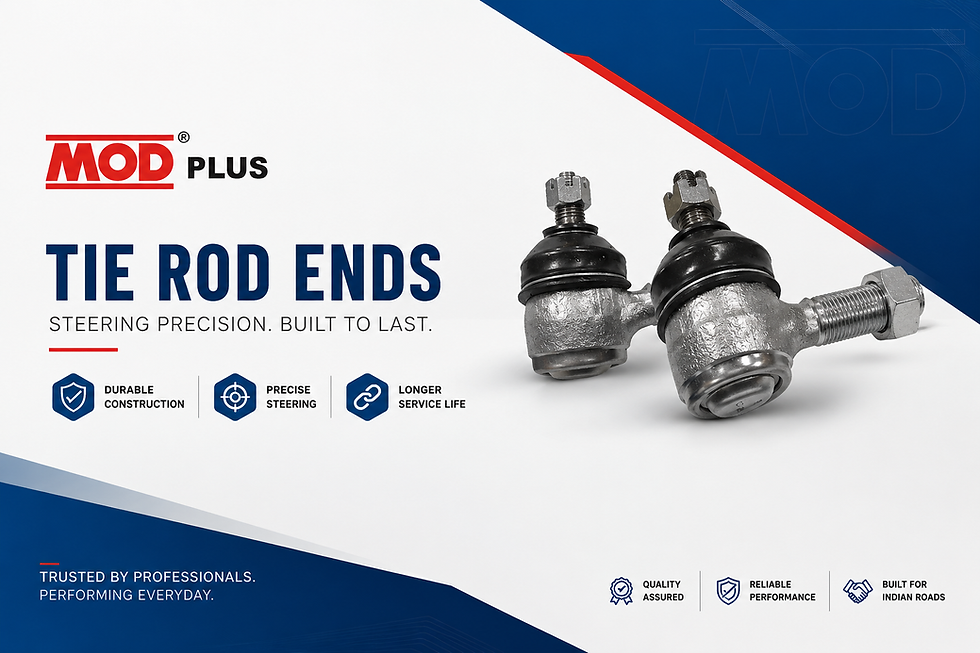
"Tie rod end" isn't just a phrase your mechanic uses anymore — it's a part you can ask about, inspect for, and replace with confidence. When it's time for a replacement, MOD Plus has been supplying OEM-grade steering components out of Sanjay Gandhi Transport Nagar, Delhi since 1978, with correct fitment across tractors, LCVs, and heavy commercial vehicles, distributed pan-India. Built from OEM-grade materials and engineered for Indian road and load conditions, MOD's tie rod end range is where to go for a replacement built to last, not just to fit.
Written by the MOD Plus Technical Team Reviewed for technical accuracy by the MOD Plus Technical Team.


Comments