

How to Check If Your Tie Rod End Is Worn: The 2-Minute DIY Test
Written by the MOD Plus Technical Team. Reviewed for technical accuracy by MOD Plus's parts and technical team, Sanjay Gandhi Transport Nagar, Delhi.

Table of Contents
If your tractor's steering feels loose while ploughing, or your Tata Ace wanders slightly on a straight village road instead of holding its line, a worn tie rod end is one of the first places to look. This 2-minute DIY test lets you check it yourself, right where the vehicle is parked — no ramp, no diagnostic tool, no trip to the dealer required. MOD Plus has supplied OEM-grade steering components pan-India since 1978, and this guide walks you through the same play-check a workshop mechanic uses, so you know exactly what you're dealing with before you spend a rupee.
What a Tie Rod End Does (and Why Wear Matters)
A tie rod end connects your steering linkage to the wheel hub, turning every movement of the steering wheel or tractor steering box into precise wheel movement. Once the ball joint inside wears, that connection develops play — the wheel can shift independently of your steering input, throwing off toe alignment and tyre wear. For the full breakdown of construction, materials, and failure modes, see MOD's complete tie rod end guide.
The 2-Minute DIY Test
You don't need a mechanic's toolkit for this — just a jack (or a helper to lift the axle) and two free hands. Here's the exact play-check a workshop mechanic uses, adapted for a tractor front axle or an LCV wheel:
Park on level ground and lock the wheels. Park the tractor or vehicle on firm, level ground, engage the handbrake or parking brake, and chock the wheel diagonally opposite the one you're testing — a couple of bricks or a large stone works fine in a field. Turn the steering so the front wheels point straight ahead.
Jack up the wheel you're testing. Place a jack under the front axle beam on a tractor, or the chassis or lower control arm on an LCV, and raise that wheel until it spins freely, a couple of inches clear of the ground. On a tractor, jack under the axle beam itself, not the tie rod or track rod — jacking under the linkage hides the very play you're trying to find.
Grip the tyre at 3 and 9 o'clock. Place your hands on the left and right edges of the tyre — the 3 o'clock and 9 o'clock positions on a clock face — not the top and bottom.
Rock the wheel in a steering motion. With both hands at 3 and 9 o'clock, rock the wheel back and forth as if you were steering it — push one edge away and pull the other toward you, without touching the steering wheel itself. You're not trying to spin the wheel; you're trying to flex the steering linkage between your hands and the steering arm.
Watch and feel the tie rod end for play. Keep your eyes on the tie rod end where it meets the steering arm, or rest a hand on it. Any knock, wobble, or visible movement in the ball joint while you rock the wheel means the tie rod end has play. On a tractor this is usually easiest to see at the track rod end near the front wheel hub; on an LCV, look where the tie rod end's ball stud meets the steering knuckle.
Cross-check at 12 and 6 o'clock. Move your hands to the top and bottom of the tyre and rock it in and out again. Play here points to a worn wheel bearing or ball joint, not the tie rod end — this comparison is what rules out a false positive.
Repeat on the other wheel and compare. Test the opposite front wheel the same way. A tie rod end in good condition shows next to no play; if only one side moves, that side is worn. If both sides show play, treat the vehicle as unsafe to drive until it's been looked at.
What You'll Feel or See If It's Worn
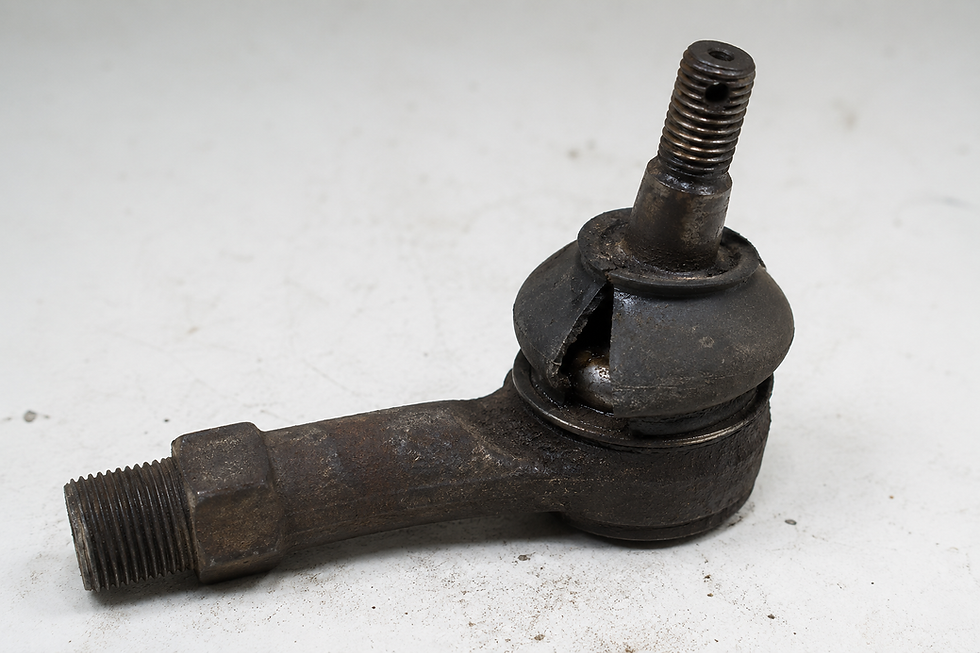
A worn tie rod end doesn't stay quiet for long. Here are the tie rod end symptoms that confirm it:
Play at the joint during the 3-and-9 o'clock test — you feel the ball joint knock or wobble before the wheel itself moves. This is the single clearest sign.
A clunk over bumps or ruts — a metallic knock from the front axle area when you drive over uneven field terrain or a pothole on a village road.
Steering play — noticeably more free rotation before the wheels respond, a classic sign of tractor steering play, especially at low speed while manoeuvring a loaded trolley.
Wandering or pulling — the tractor or LCV drifts off a straight line on its own, and you're constantly making small steering corrections just to hold a furrow or lane.
Uneven or feathered tyre wear — a scalloped wear pattern on the front tyre tread, different from the other side, because toe alignment has shifted.
Visible looseness — with the wheel off the ground, you can see the tie rod end shift at the joint as you rock it, sometimes with the dust boot torn or missing grease.
Any one of these on its own is worth investigating. Two or more together, and the tie rod end should move to the top of your list.
When to Replace vs. When to Monitor
Not every trace of play means an immediate roadside replacement, but steering is not a component to gamble on.
Monitor, don't ignore, if: the play is barely perceptible, there's no clunk on rough ground, tyre wear is still even, and you're due for a service soon anyway. Keep an eye on it over the next few hundred kilometres or field-hours and recheck.
Replace it if: you can see or feel distinct movement in the joint, there's an audible knock over bumps, the steering wheel has noticeably more free play than before, or tyre wear has already turned patchy. On a loaded trolley or a pickup carrying goods on the highway, that play gets worse under load — exactly when you need steering response the most.
When in doubt, treat it as a replace, not a monitor. Tie rod end replacement in India is a modest cost next to the alignment work, tyres, or accident repair that a failure further down the line can cause.
Common Mistakes That Cause a False Reading
A few habits throw off this test more than the tie rod end itself does:
Testing with the wheel still on the ground. Never test with the wheel still on the ground — the vehicle's weight loads the joint and hides the play.
Mistaking wheel bearing play for tie rod play. A bearing shows up at 12-and-6, not 3-and-9. Always run both checks before you conclude anything.
Confusing ball joint vs. tie rod end movement. Watch which specific joint moves as you rock the wheel — don't assume it's the tie rod end just because something clunked.
A loose hub nut or wheel nut. Check these are torqued down first; a loose nut mimics steering play and sends you chasing the wrong part.
Why Genuine Matters
The tie rod end is a load-bearing, safety-critical joint — it sits directly in the path between your hands and your front wheels. A duplicate part with an undersized ball stud, poor heat-treatment, or a loose-fitting socket can develop play again within weeks, right back where you started. MOD Plus tie rod ends are manufactured to OEM dimensions and tolerances, so the fit, the grease seal, and the steering feel match what the vehicle was built with.
FAQs
What does a worn tie rod end feel like while driving?
Mostly a vague looseness in the steering — the wheel feels like it has extra play before the vehicle actually turns, and the tractor or vehicle may wander slightly on a straight stretch, so you're making small corrections just to hold a line.
Can a worn tie rod end cause uneven tyre wear?
Yes. Once the joint develops play, the front wheel's toe alignment shifts out of spec, and the tyre wears unevenly — often a feathered or scalloped pattern across the tread instead of even wear.
What are other tie rod end symptoms besides a clunking noise?
Along with the clunk, watch for steering wheel play, a tractor or LCV that wanders or pulls to one side, feathered tyre wear, and visible movement at the joint when the wheel is off the ground.
Do I need to jack up the wheel to test the tie rod end?
Yes. With the wheel on the ground, the vehicle's weight loads the joint and hides the play. Jacking the wheel clear of the ground is what lets you feel the true amount of movement.
Can I do the 2-minute tie rod end test alone, or do I need a helper?
You can do it alone — grip and rock the tyre with both hands while watching or feeling the tie rod end yourself. A helper makes it easier, since one person can rock the wheel while the other focuses purely on watching the joint.
How much does tie rod end replacement cost in India?
It varies by vehicle and model, but a single tie rod end for most tractors and LCVs is an inexpensive part next to the labour, alignment, or tyre cost you'd pay if you kept driving on a worn one. Ask your MOD Plus dealer for the exact price for your model.
How long does a tie rod end replacement take?
On a tractor front axle or an LCV, a straightforward tie rod end swap usually takes a workshop under an hour, not counting the wheel alignment that should follow.
Does it matter if I use a genuine or duplicate tie rod end?
It matters more than most parts on the vehicle. A duplicate with loose tolerances or a poorly heat-treated ball stud can develop play again within weeks, and steering isn't where you want to gamble on part quality.
How can I make a tie rod end last longer?
Re-grease it on schedule if it has a grease nipple, get the front-end alignment checked whenever you replace tyres, and don't let a torn dust boot go unfixed — that's what lets grit and moisture into the joint and speeds up wear.
Do I need a wheel alignment after replacing a tie rod end?
Yes, always. Replacing the tie rod end changes the front-end alignment, specifically the toe setting, even if you counted threads while removing the old one. Skipping the alignment means uneven tyre wear and imprecise steering even with a brand-new part.
Shop Tie Rod Ends by Tractor & Vehicle Model
Sonalika
Swaraj
Swaraj tractor power steering jack rod (titled on MOD's live catalog as shown — flagged for review above)
Swaraj Mazda adjustable-type tie rod end (Swaraj Mazda LCV range)
John Deere
New Holland
Farmtrac
Mahindra Arjun
International B-275 / B-575
Eicher
Mahindra MKM / NST / Yuvo
Massey Ferguson
Light Commercial Vehicles
Tata Ace
Mahindra Bolero Pickup
Ashok Leyland Dost


Comments