

Steering Pulling, Wandering, or Clunking? Tie Rod Symptoms Explained
Written by the MOD Plus Technical Team. Reviewed for technical accuracy by MOD Plus's in-house team.
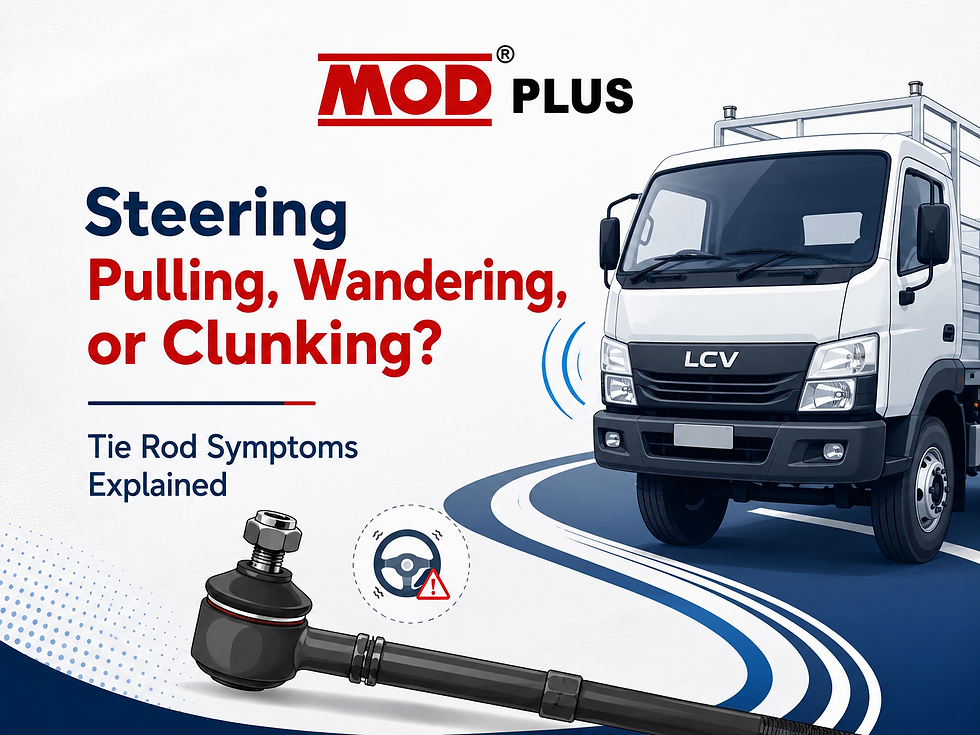
Table of Contents
Your tractor pulls hard to the right the moment you turn into a ploughed field. Your Tata Ace drifts across the lane on the highway at 70 km/h, needing constant correction to hold a straight line. Your Bolero Pickup clunks every time the front wheel drops into a rut near the mandi. Three different vehicles, three different jobs — and often the same underlying story: tie rod symptoms that build up slowly enough to get ignored, until they're not. MOD Plus has supplied OEM-grade steering components pan-India since 1978, and this guide, a companion to our complete tie rod end guide, breaks down exactly what each symptom feels like, why it happens, what else could be responsible, and how urgently you need to act.
Why Tie Rod Symptoms Get Ignored (and Why That's Risky)
Tie rod wear doesn't announce itself. It starts as a barely noticeable looseness that most drivers write off as "the road" or "the tyres." A tractor owner ploughing the same field every season adjusts to a slight pull without realising the axle geometry has shifted. An LCV driver covering 300+ km a day gets used to correcting a slow drift. That gradual adaptation is exactly what makes worn tie rod signs dangerous — by the time they're impossible to miss, the joint may already be close to failing outright.
Vehicle or Tractor Pulling to One Side
Pulling means the vehicle consistently drifts toward one side — left or right — even with the wheel held straight, or it takes constant counter-steering pressure to run true. This is different from wandering, which is inconsistent; pulling has a fixed direction that doesn't change trip to trip.
On a tractor, this often shows up first while ploughing: the implement drags to one side of the row, or the front wheels track unevenly across uneven field terrain even though the steering wheel sits centred. On an LCV like a Tata Ace or Bolero Pickup, it's most noticeable on a straight, flat highway stretch — the vehicle noses toward the shoulder unless you correct it.
A worn tie rod end causes this because it allows uncontrolled play in the steering linkage, which shifts the toe angle of one wheel relative to the other. But tractor pulling to one side isn't always the tie rod — uneven tyre pressure, a bent axle, or misaligned wheels can produce an identical feeling, so it's worth ruling those out too.
Mild pulling that only shows up under braking or on camber is worth monitoring. Constant, unmistakable pulling that requires real effort to counter-steer is a sign that shouldn't wait — it usually means the joint already has measurable play.
Wandering or Not Tracking Straight
Wandering feels different from pulling: instead of a steady bias in one direction, the vehicle drifts inconsistently — left, then right, then left again — and needs frequent small corrections just to hold a straight line. It's most obvious at higher speeds, which is why LCV and highway drivers notice it before tractor owners do.
On a loaded Ashok Leyland Dost or Mahindra Bolero Pickup running highway stretches, wandering shows up as a vague, floaty feeling through the steering wheel — the vehicle no longer tracks confidently even on a flat, straight road. On a tractor, it's less common on-road but can appear when moving from field to unpaved village road at higher gear.
This happens because worn tie rod ends introduce play that changes with every small steering input, rather than settling into one fixed offset. Before assuming it's the tie rod end, check tyre pressure and wheel bearing play, since both can produce a similar floaty feeling.
Wandering that appears only occasionally, at low speed, is usually an early sign. Wandering that's present consistently above 40–50 km/h, or worsens the longer you drive, points to more advanced wear and deserves a prompt inspection.
Clunking or Knocking Noise Over Bumps
Clunking is an impact sound, not a continuous feeling — a sharp knock you hear (and often feel through the floor or steering wheel) specifically when the front wheel hits a bump, pothole, or rut, or when you turn the wheel at low speed, like manoeuvring in a yard.
For tractors working ploughed or uneven field terrain, this is often the very first symptom drivers notice, since the front axle takes constant impact. For LCVs and pickups running unpaved village roads or broken city stretches, a clunking noise when turning at low speed — parking, reversing, tight turns — is the classic giveaway of a loose tie rod end joint.
The clunk happens because the ball-and-socket joint inside the tie rod end has worn enough to develop physical play, so the components knock against each other under load reversal. It's worth knowing that a similar knock can come from a worn ball joint, a loose stabiliser link, or worn suspension bushings, so a clunk alone doesn't confirm the tie rod end without inspection.
An occasional, faint clunk over sharp bumps is worth watching. A clunk that's become loud, frequent, or noticeable even over small potholes is one of the more urgent symptoms on this list, since it often means the joint is closer to failure than pulling or wandering alone would suggest.
Steering Wheel Vibration
Vibration is a continuous shake or buzz felt through the steering wheel, different from the sharp, one-off impact of a clunk. It's usually speed-related — it appears, worsens, or changes character as speed increases, most noticeable on an LCV or heavy vehicle running highway speeds.
Steering wheel vibration from a tie rod end tends to come from the play in the joint letting a wheel shimmy slightly as it rotates, especially once tyre wear has become uneven as a result. On tractors, this is less common at road speeds since tractors rarely run fast enough for it to stand out, but it can appear as a shudder through the wheel when transporting a loaded trolley on a paved road.
It's genuinely important to rule out other causes here: vibration is one of the least tie-rod-specific symptoms on this list, since wheel balancing, a bent rim, or an out-of-round tyre are far more common culprits for pure vibration on its own.
If vibration is mild and appears only at one specific speed, it may not be the tie rod end at all. If it's accompanied by looseness in the steering or a clunk over bumps, that combination is a stronger signal and should be inspected without delay.
Looseness or Excess Play in the Steering
This is the most direct symptom: the steering wheel has noticeable free play before the front wheels respond — you can turn it a few degrees with little to no effect on direction, especially near centre.
On a tractor, this often feels like the steering has gone "vague" compared to when it was new, particularly during slow manoeuvring at the head of a field. On an LCV, it shows up as a delay between turning the wheel and the vehicle actually changing direction.
Excess steering play happens because the ball stud inside the tie rod end has worn loose enough that steering input isn't transmitted immediately or precisely to the wheel. A worn ball joint or a loose steering gearbox can produce a similar feeling, so it's worth checking alongside the linkage itself, not the tie rod end in isolation.
Any noticeable free play in the steering wheel should be treated as urgent — it usually indicates the joint already has physical play you can feel, not just wear that's only beginning.
Uneven or Rapid Tire Wear
This isn't something you'll feel while driving — it shows up on inspection, as tyre tread wearing unevenly (often on the inner or outer edge of the front tyres) or wearing out noticeably faster than it should for the kilometres covered.
For a tractor, check the front tyres at the next service or tube change — uneven wear across the tread width, rather than a uniform pattern, is the tell. For an LCV or pickup covering daily highway kilometres, this often shows up first as a shorter-than-expected tyre life, well before the vehicle's normal replacement interval.
Uneven tire wear happens because a worn tie rod end lets the toe angle drift out of spec, so the tyre is dragged slightly sideways as it rolls, wearing the edge faster than the centre of the tread. Front-end alignment issues unrelated to the tie rod end, worn suspension components, and incorrect tyre pressure can all cause similar wear patterns, which is why a wheel alignment check is always worth doing alongside a tie rod inspection.
Uneven wear on its own isn't an emergency, but it's a strong, low-cost early warning — catching it early is far cheaper than waiting for a tyre replacement, a tie rod end, and an alignment all at once.
Tractor vs. LCV vs. Heavy Vehicle: Do Symptoms Differ?
The same worn tie rod end shows up differently depending on what it's fitted to, which is why owners of different vehicle types tend to notice different symptoms first.
Tractors: Field conditions mean clunking and pulling usually surface before vibration does, since tractors rarely run fast enough for vibration to stand out. Ploughing accentuates any pull, because the implement's drag amplifies small steering offsets.
LCVs and pickups (Tata Ace, Bolero Pickup, Ashok Leyland Dost): Wandering and vibration are usually noticed first, since these vehicles spend more time at sustained highway speed, where inconsistent tracking and shimmy are far more obvious.
Heavy and loaded commercial vehicles: Load changes everything. A tie rod end that feels fine empty can show clear play once the vehicle is loaded, since load increases force on the steering linkage. Clunking under load — a laden trolley or a loaded truck — tends to appear earlier and more severely than on an unloaded vehicle.
Across all three, the underlying wear is identical — only the operating conditions decide which symptom shows up first.
Quick Way to Confirm It's the Tie Rod
The most reliable way to confirm a tie rod end is worn is a raised-wheel play check: with the front wheel off the ground, grip it at opposite edges and rock it while a second person watches the joint for movement. Any play at all confirms wear.
The test takes about two minutes per side and doesn't require removing anything. We're publishing a dedicated step-by-step walkthrough of this test shortly — until then, if you feel any play when you rock the wheel, treat it as confirmed and get the joint inspected properly before your next long trip or field session.
How Urgent Is This? When to Stop and Get It Checked
Not every tie rod symptom means stop driving immediately, but a few combinations do.
Get it checked at your earliest convenience: mild, occasional pulling; slight uneven tyre wear noticed at a routine check; a faint clunk only over sharp bumps.
Get it checked within the next few days: consistent wandering above 40–50 km/h; a clunking noise when turning that's become frequent; steering vibration combined with any looseness.
Stop and get it inspected before driving further: noticeable free play in the steering wheel; a loud or worsening clunk on every bump; pulling severe enough that it takes real effort to hold a straight line, especially with a loaded trolley or cargo attached.
Steering is a safety-critical system, and a tie rod end that fails completely can mean a sudden, total loss of control on that wheel — one of the few situations on a vehicle where "I'll get to it next month" genuinely isn't worth the risk, particularly loaded or at highway speed.
Why Genuine Matters
A tie rod end lives under constant load-reversal stress, so the quality of the ball stud, socket, and boot materials directly decides how long it lasts and how much play develops before failure. Duplicate or low-grade parts often look identical on the shelf but wear into play far sooner, bringing these same symptoms back within months. For a component this closely tied to steering safety, OEM-grade fit isn't a luxury — it's the difference between a tie rod end replacement India buyers can trust for the long haul, and one they'll be doing again soon.
FAQ
Why does my tractor pull to one side when I'm ploughing?
Most often it's a worn tie rod end allowing the front wheel's toe angle to shift under load. Uneven tyre pressure or a bent axle can cause the same feeling, so it's worth checking those too before assuming it's the tie rod end.
What's the real difference between pulling and wandering?
Pulling is a constant bias toward one side that you have to counter-steer against. Wandering is inconsistent drift — the vehicle needs small corrections in both directions to hold a straight line, usually at higher speed.
Why does my vehicle clunk over bumps but drive fine otherwise?
A clunk over bumps usually means physical play has developed in the tie rod end's ball-and-socket joint. It can also come from a worn ball joint or loose stabiliser link, so an inspection is the only way to confirm which.
Is steering wheel vibration always a tie rod problem?
Not usually on its own — wheel balancing, a bent rim, or an out-of-round tyre are more common causes of pure vibration. It's more likely tie rod-related if it appears alongside looseness or clunking.
Is it safe to keep driving with worn tie rod signs?
Mild, occasional symptoms are usually safe to monitor for a short while. Noticeable steering play, a loud or worsening clunk, or severe pulling should be treated as urgent — a tie rod end can fail suddenly, causing a total loss of steering on that wheel.
How much does tie rod end replacement cost in India?
It varies widely by vehicle type, model, and whether one side or both need replacing, so it's best confirmed with your local mechanic or parts dealer against your specific make and model rather than a single number.
What's the difference between a tie rod end and a ball joint?
Both are ball-and-socket joints in the steering and suspension, but a tie rod end sits in the steering linkage and directly controls toe angle, while a ball joint connects the suspension to the steering knuckle and mainly handles vertical and lateral load.
Should I choose genuine or duplicate tie rod ends?
Genuine, OEM-grade parts use better ball stud and socket materials, so they hold tolerance longer under the same load-reversal stress. Duplicate parts are often cheaper upfront but tend to develop the same play-related symptoms again within months.
How can I prevent premature tie rod end wear on a tractor?
Regular greasing at the recommended interval, avoiding sudden full-lock turns under heavy load, and getting the front axle inspected at each service are the main ways to extend the life of the joint.
If any of these tie rod symptoms sound familiar, don't wait for a full failure to act. Browse MOD Plus's tie rod end range below for your tractor, LCV, or commercial vehicle, or get in touch with our team for help matching the right part to your model.
Shop Tie Rod Ends by Tractor & Vehicle Model
All links verified live against the MOD Plus catalog at the time of writing.


Comments