

Commercial Vehicle UJ Cross: The Complete Engineering & Buyer's Guide
By the MOD Plus technical desk — OEM-grade driveline component suppliers to India's commercial vehicle aftermarket since 1978, Sanjay Gandhi Transport Nagar, Delhi.

This guide covers UJ crosses for trucks, buses, pickups, tippers, tankers, trailers, mining and construction vehicles, and fleet applications. If you're looking for rotavator or PTO shaft crosses for tractors and agricultural implements, see our Rotavator Cross Complete Guide instead — that guide covers field-implement duty cycles in depth, while this one is written exclusively for on-road and off-highway commercial vehicles.
Quick Answer: What Is a Commercial Vehicle UJ Cross?
A UJ cross (universal joint cross, also called a spider, trunnion cross, or Cardan cross) is a forged-steel, four-armed component fitted inside the universal joints at each end of a truck's propeller shaft. It connects the gearbox output shaft to the rear axle differential through a needle-bearing arrangement that allows the propeller shaft to change angle — because the axle moves on its springs while the gearbox does not — while still transmitting the engine's full torque without interruption. In commercial vehicles it is the single component that lets a rigid driveline tolerate constant misalignment, frame flex, and suspension travel under continuous heavy load.
Table of Contents
What Is a UJ Cross?
A UJ cross is the load-bearing heart of a universal joint (also written U-joint, or in India frequently called a "cross" on its own, as in "change the cross"). Picture a plus-sign-shaped steel forging: four short, precision-ground arms — called trunnions — projecting at 90 degrees from a common center block, the cross body. Each trunnion is fitted with a hardened bearing cup containing a set of needle rollers, and each pair of opposite trunnions sits inside the forked ends (yokes) of the two shafts being joined.
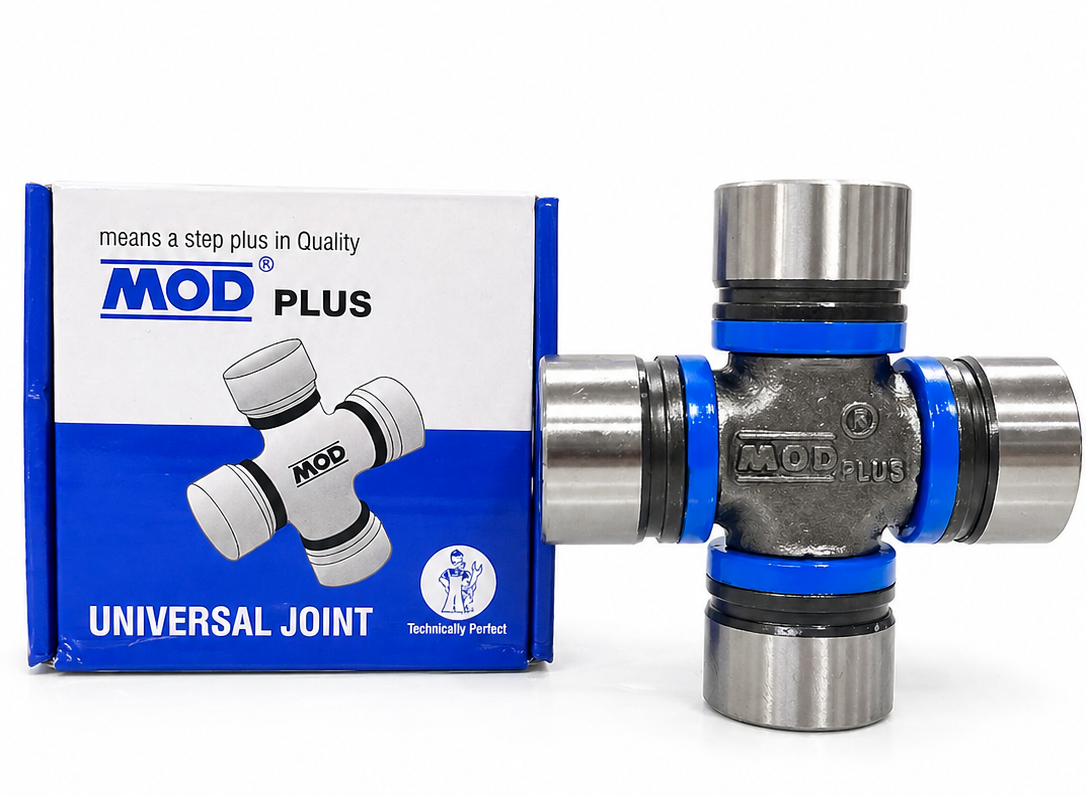
In a commercial vehicle, one yoke is welded or splined to the gearbox output / slip joint end of the propeller shaft, and the other is fixed to the pinion flange at the differential (or to the center bearing support on a two-piece shaft). The cross sits between them, pinned inside both yokes by its four trunnions. As the two shafts rotate together, the cross allows the drive angle between them to change continuously — a few degrees at idle, considerably more when the axle compresses over a pothole or the chassis twists on uneven ground — while never breaking the flow of torque from engine to wheel.
This is different from a flexible coupling or a rubber doughnut joint. A UJ cross is a rigid, metal-to-metal mechanical joint. It transmits torque with essentially zero elastic loss, which is exactly why it is used on commercial vehicles: trucks and buses cannot afford the torsional softness of a rubber joint when hauling 16, 25, or 40 tonnes.
It's worth being precise about vocabulary here, because the same word gets used loosely across the industry:
UJ cross / spider / trunnion cross — the four-armed steel component itself.
Universal joint (UJ) — the complete assembly: cross + two bearing cups + two yokes + retention hardware (circlips, straps, or U-bolts).
Propeller shaft (prop shaft / drive shaft) — the tube that connects the gearbox to the axle, with a UJ at each end (and sometimes a center support bearing on longer wheelbases).
Cross holder / yoke — the forked steel component the cross's trunnions sit inside; sold separately when only the yoke is worn.
MOD Plus stocks all of these as individual components — UJ crosses, yokes and yoke teeth, and cross holders and flanges — because a competent workshop rarely needs to replace a whole propeller shaft when only the cross has failed.
A Short History of the Universal Joint
The mechanism itself is centuries old. Its documented origins trace back to the Italian mathematician Gerolamo Cardano in the 16th century, who described the geometry of a joint that could transmit rotary motion between two non-aligned shafts — which is why the cross-and-yoke universal joint is still called a Cardan joint in engineering literature and in most European languages. The English physicist Robert Hooke refined the mechanical application in the 17th century, and in English-speaking engineering circles the joint is sometimes called a Hooke's joint for that reason.
The design remained a mechanical curiosity — used in instruments, clocks, and early machine tools — until the early automotive era. As soon as engineers moved the engine to the front of a vehicle and the driven wheels to the rear, they had exactly the problem the Cardan joint was built to solve: a gearbox output shaft that stays fixed in space, connected to an axle that moves up and down on its springs. Clarence Spicer's work on cross-and-yoke universal joints for automotive propeller shafts in the early 20th century is generally credited with turning the Cardan joint into a mass-manufactured, standardized automotive component — the ancestor of the SPR- and RSB-series bearing cross designs that are still referenced today, including on Indian aftermarket catalogues.
By the time commercial trucking scaled up through the mid-20th century, the needle-bearing cross-and-yoke universal joint had become the default solution for every rear-wheel-drive and multi-axle commercial vehicle on the planet, and it remains so today. Constant-velocity joints, flexible discs, and other alternatives exist and are used in specific applications (mostly light passenger cars and short front-drive shafts), but for the torque loads, shaft lengths, and duty cycles of trucks, buses, and tippers, the forged cross-and-yoke universal joint has never been meaningfully displaced. It is, in effect, 400-year-old geometry doing modern heavy-haulage work — which says as much about how good the original solution was as it does about how demanding the application still is.
The Commercial Vehicle Driveline, Explained
To understand why the UJ cross matters, it helps to walk the full power path from the engine to the road, the way a driveline engineer would look at a chassis drawing.
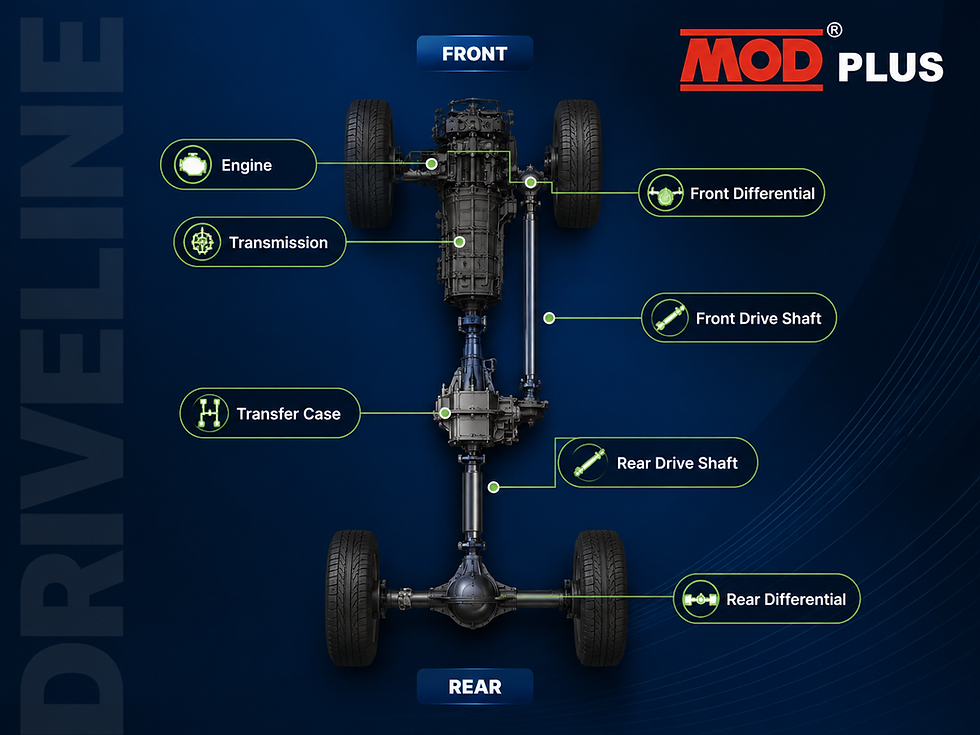
1. Engine. Produces rotating torque at the crankshaft.
2. Clutch. Engages and disengages that torque from the gearbox input shaft. (On automated and torque-converter transmissions this step is handled differently, but the function — controllable torque transfer — is the same.)
3. Gearbox (transmission). Multiplies torque through gear reduction and delivers it to an output shaft at a fixed position on the chassis frame.
4. Slip joint. A splined sliding joint immediately after the gearbox output, which allows the effective length of the propeller shaft to change slightly as the axle moves up and down (the arc of axle travel changes the distance between the gearbox and the differential, not just the angle).
5. Propeller shaft (front section, on longer chassis) → Center bearing. On trucks with a long wheelbase, a single-piece shaft would whip and vibrate at highway speed, so the shaft is split into two or three sections joined by additional universal joints, and supported at the split points by a rubber-mounted center bearing that carries the shaft's weight and isolates vibration from the chassis.
6. Propeller shaft (rear section) → UJ cross at each end. This is where our subject sits. Every section of a multi-piece shaft has a universal joint — and therefore a UJ cross — at both ends.
7. Differential (final drive). The pinion at the front of the differential housing receives torque from the rear-most universal joint, turns it 90 degrees through the crown wheel and pinion, and splits it between the two half-shafts.
8. Axle shafts and hub reduction (on many heavy trucks). Carry torque out to the wheel hubs, sometimes through a further planetary reduction at the hub itself for extra torque multiplication on tippers and mining trucks.
9. Wheels. Convert torque into tractive force against the road or terrain.
The UJ cross's job sits specifically at steps 6 (and step 5, on multi-piece shafts): it is the flexible, torque-carrying link between a gearbox that is bolted rigidly to the chassis and a differential that is bolted rigidly to an axle that moves independently on springs. Every time the truck goes over a bump, brakes hard enough to compress the front suspension and rock the chassis, corners hard enough to roll the body, or simply carries a payload heavy enough to compress the rear springs, the angle between the gearbox output and the differential pinion changes — and the UJ cross is what absorbs that change without losing torque transfer for even a fraction of a rotation.
What Does a UJ Cross Actually Do?
Stripped down to its core engineering functions, a commercial vehicle UJ cross performs five jobs simultaneously, every time the propeller shaft turns:
Torque transmission. It carries the full output torque of the engine and gearbox, in low gear under load this can be several thousand newton-metres on a loaded HCV, through four small bearing-supported trunnions. This is the primary structural load the cross is designed around.
Angular movement. It permits the propeller shaft to operate at a continuously changing working angle — typically a few degrees at rest, more under axle articulation — without interrupting torque flow. A single Cardan-type cross does this with a known side effect (velocity fluctuation twice per revolution, discussed below), which is why shaft geometry and phasing matter as much as the cross itself.
Suspension travel accommodation. As leaf springs or air suspension compress and rebound, the differential physically moves relative to the chassis-mounted gearbox. The UJ cross (working together with the slip joint) is what allows the driveline to keep functioning through that entire range of travel.
Frame flex and axle articulation absorption. Commercial vehicle chassis, especially ladder-frame trucks running off-highway, tippers on quarry roads, and multi-axle trailers, twist under load in ways a passenger car chassis never does. The UJ cross tolerates this twisting without transmitting damaging side loads back into the gearbox output bearing or the differential pinion bearing.
Shock absorption at the joint. Sudden loads — a wheel dropping into a pothole, a clutch engaged aggressively, a loaded tipper bouncing off uneven ground — arrive at the cross as torsional shock. A correctly specified cross, in the correct material and heat-treat condition, absorbs this shock elastically; an undersized or poorly heat-treated cross absorbs it as permanent deformation or fatigue cracking.
A useful way to think about the difference between a UJ cross doing its job well and doing it poorly: a healthy cross disappears into the background of the vehicle's operation completely. A driver or fleet manager should never be able to feel, hear, or notice it. Every symptom discussed later in this guide — clunk, vibration, shudder, grease weeping from the cap — is the sound of one or more of these five functions starting to fail.
Why Commercial Vehicles Are Harder on UJ Crosses Than Anything Else on the Road
Every wheeled vehicle with a rigid axle uses a UJ cross somewhere in its driveline, from a small pickup to a 40-tonne trailer combination. But the demands placed on a commercial vehicle cross are of a different order of magnitude than a passenger car, for five specific reasons.
Torque. A passenger car engine might produce 150–250 Nm at the crank. A loaded HCV diesel engine, after gear reduction in low ratios, can put several thousand newton-metres through the propeller shaft at the moment of pulling away fully loaded or climbing a grade. The cross has to carry all of it, every time, without yielding.
Duty cycle. A private car might run 15,000–20,000 km a year, much of it at light load. An Indian commercial vehicle in fleet service routinely runs 100,000–250,000+ km a year, close to fully loaded for most of those kilometres, often running two shifts a day with different drivers and minimal downtime between trips. The cumulative number of load cycles the cross sees over its service life is enormous.
Road and terrain conditions. Indian commercial vehicles do not operate exclusively on smooth national highways. Tippers and mining trucks run on unpaved haul roads and quarry tracks. Municipal and construction vehicles work off-road for a large share of their operating hours. Even long-haul highway trucking crosses stretches of poor surface, level crossings, potholed approach roads, and unmade yard surfaces at loading points. Every one of those events is a shock load transmitted directly through the propeller shaft and the cross.
Payload variability. A commercial vehicle runs empty on one leg and fully or over-loaded on the return leg, routinely. That means the working angle of the propeller shaft, and the load the cross carries, changes constantly across a single day's operation — very different from a private car that carries a broadly consistent load.
Shaft length and multiple joints. Long-wheelbase trucks, tippers with long chassis, and trailers often run two- or three-piece propeller shafts with a center support bearing, meaning two, three, or more UJ crosses in the driveline instead of one. Each one is a potential failure point, and a failure at any single cross stops the vehicle exactly the same way a gearbox failure would.
It's worth being explicit here about how this differs from the other major UJ cross application in the Indian aftermarket: agricultural PTO shafts and rotavator drivelines. A rotavator cross runs at far lower road speed but sees very high, very sudden torque spikes when the rotavator blades strike a stone or hard soil pocket — a completely different stress signature to a highway truck cross, which sees sustained high torque at speed with more gradual angular change. The metallurgical and dimensional requirements overlap, but the failure patterns and duty cycles are different enough that we've written about tractor and rotavator crosses separately in our Rotavator Cross Complete Guide and Rotavator Cross & Yoke Guide — this guide stays focused on trucks, buses, and other road-going and off-highway commercial vehicles.
Working Principle: Bearings, Trunnions and Load Path
Understanding how a UJ cross actually carries load makes it much easier to diagnose failures later, so it's worth walking through the mechanism in some detail.
The trunnion. Each of the cross's four arms is a precision-ground cylindrical pin. The trunnion's outer surface is the running surface for the needle bearing — it must be ground to a tight tolerance and to a specific surface finish, because the needle rollers run directly against it with no separate inner race in most designs.
The bearing cup and needle rollers. Each trunnion is fitted with a hardened steel cup, pressed into the yoke's bore, containing a full complement of needle rollers arranged around the trunnion's circumference. This needle-bearing arrangement is what allows the yoke to rotate around the trunnion with very low friction while carrying substantial radial load. A thrust washer or button at the base of the trunnion manages the axial (end-load) component.
Sealing. A seal at the open end of each bearing cup keeps grease in and contamination — dust, water, grit — out. This is one of the most failure-critical parts of the entire assembly in Indian operating conditions, discussed further in the Root Causes section below.
Lubrication path. Greasable crosses have a central grease nipple (zerk fitting) in the cross body, with internal galleries drilled through each trunnion arm to deliver grease to all four bearing cups from a single external point. Grease is pumped in until it purges visibly at each seal, confirming all four bearings have been reached.
Load distribution. Here is the part that is easy to miss: at any given instant in a UJ cross's rotation, it is not all four trunnions carrying equal load. Because the two yokes are offset at a working angle rather than perfectly in line, the load on each trunnion pair rises and falls as the joint rotates, twice per revolution. This is also the mechanical reason a single Cardan joint introduces a small cyclical variation in output speed even when input speed is perfectly constant — the greater the working angle, the greater this variation.
This is precisely why propeller shaft installation angle and the phasing of the yokes at each end of the shaft (keeping them aligned so that the velocity variations introduced by each joint cancel each other out across the shaft) is a specified engineering parameter, not a matter of convenience during assembly. An incorrectly phased shaft will vibrate even with two brand-new crosses fitted.
Engineering & Design Standards
A commercial vehicle UJ cross looks like a simple forging, but every dimension and process step is controlled, because the component operates at the intersection of high stress, continuous rotation, and long unattended service intervals — exactly the conditions where a small design shortcut turns into a field failure.
Forging. The cross starts life as a hot forging, not a casting and not a machined billet. Forging aligns the steel's internal grain flow along the shape of the trunnion arms, which gives the finished part significantly better fatigue and impact resistance than a part machined from bar stock, where the grain flow is cut across rather than following the load path. This is a genuine, measurable engineering difference, not a marketing claim — it's the reason every reputable driveline component manufacturer, OEM or aftermarket, forges rather than casts or machines-from-billet for this component.
Machining. After forging, the trunnion journals, the locating faces, and (where applicable) the circlip grooves are turned and ground to tolerance. The trunnion diameter and the bearing cup bore are matched pairs — this is why bearing cups are almost always supplied and fitted as a matched set with the cross, not mixed and matched between manufacturers.
Heat treatment. Discussed in detail in the Materials section below, but in design terms: the heat-treatment specification (case depth, surface hardness, core hardness) is chosen specifically to give a hard, wear-resistant running surface on the trunnion while keeping the core of the part tough enough to absorb shock without cracking. Get this balance wrong in either direction — too hard and brittle, or too soft and prone to wear — and the part fails prematurely, just through different mechanisms.
Grinding. The final trunnion surface finish directly affects needle bearing life. A trunnion that is not ground to the correct roundness and surface finish will show accelerated wear at the needle contact points regardless of how good the base material is.
Dynamic balancing. While the balancing of the complete propeller shaft assembly (not the cross alone) is what ultimately matters for high-speed vibration, the cross's dimensional consistency — trunnion-to-trunnion squareness, arm length uniformity — directly affects how well the finished shaft can be balanced.
OEM tolerances. For a UJ cross to be a true drop-in replacement, its bearing cup outer diameter, trunnion span (center-to-center across opposite trunnions), and overall cross height must match the original OEM specification closely enough to seat correctly in the existing yoke without forcing, shimming, or shortening — a theme we return to under Genuine vs Counterfeit below.
Materials and Metallurgy
The material specification of a UJ cross is not a minor spec-sheet detail — it is arguably the single biggest determinant of service life, and it's the area where low-cost replacement parts most often cut corners in ways that are invisible until the part is in service.
Commercial vehicle UJ crosses are manufactured from case-hardening alloy steels — internationally, grades in the 20MnCr5 / SAE 5120 / SAE 8620 family are typical for this component category, chosen specifically because they combine good forgeability with the ability to be case-carburized to a hard wear surface while retaining a tough, ductile core.
Carburizing and case hardening. The finished, machined cross is heated in a carbon-rich atmosphere, allowing carbon to diffuse into the surface layer of the steel. When the part is then quenched, the carbon-enriched surface transforms to hard martensite, while the core — which did not absorb significant additional carbon — remains a tougher, lower-carbon structure. The result is a part with a hard "shell" over a resilient core, which is exactly the property profile a trunnion needs: the running surface has to resist wear from thousands of hours of needle-bearing contact, while the body of the arm has to absorb shock loading without cracking.
Case depth. This is the thickness of that hardened surface layer, typically specified in fractions of a millimetre for a component this size. Case depth that is too shallow wears through in service, exposing the softer core to direct bearing contact and accelerating failure rapidly once it happens. Case depth that is excessive, or a core that has been over-hardened along with the case, produces a part that is brittle through its full cross-section and prone to sudden fracture under shock loading rather than gradual wear — often a worse failure mode on a moving vehicle because it can happen without much warning.
Surface and core hardness. Both are checked independently during quality control (typically via Rockwell hardness testing at the surface and on a sectioned sample for the core) because a part can pass a surface hardness check while having an incorrect or inconsistent core structure underneath.
Tempering. After hardening, a controlled tempering step relieves internal stresses from the rapid quench and fine-tunes the final hardness and toughness balance. Skipping or shortening this step is a common way low-cost manufacturing cuts cycle time at the direct expense of part life.
Wear and fatigue resistance. The combination of the right base alloy, correct case depth, and correctly executed heat treatment is what gives the finished cross its resistance to two distinct failure modes: gradual wear (metal loss at the trunnion-needle contact surface over many hours of operation) and fatigue (crack initiation and growth from repeated cyclic torque loading, eventually leading to sudden fracture). A cross can fail from either mechanism, and undersized or incorrectly heat-treated parts tend to fail faster from both.
How a UJ Cross Is Manufactured
A production-grade commercial vehicle UJ cross moves through a defined sequence of steps, and skipping or shortcutting any one of them is exactly how a part ends up looking correct on the shelf while failing early in service.
Raw material selection. Case-hardening alloy steel bar stock, certified to the correct chemical composition, is the starting point. This certification step is invisible in the finished part and is exactly where the cheapest counterfeit components diverge from genuine ones first.
Forging. Heated billets are hot-forged into the cross shape (or a near-net forging that is then machined to final form), aligning grain flow along the trunnion arms.
Turning. The trunnion journals, cross body faces, and locating features are turned to rough dimension on a lathe or multi-axis machining center.
Milling / drilling. Grease galleries are drilled through the body and arms on greasable designs; circlip grooves, if the design uses external circlip retention, are machined at this stage.
Heat treatment. Carburizing, quenching, and tempering, as described above, transform the machined blank into a part with the correct case and core properties.
Grinding. Trunnion surfaces are ground to final dimension, tolerance, and surface finish after heat treatment (grinding after hardening is standard practice, since the hardening process itself can introduce small dimensional shifts that must be corrected).
Inspection. Dimensional checks (trunnion diameter, span, squareness), hardness testing (surface and core), and visual/magnetic-particle inspection for forging or grinding defects.
Assembly. Bearing cups are packed with the correct grease quantity and needle-roller complement, seals are fitted, and the cups are pressed onto the trunnions as a matched set.
Testing. Sample-based functional testing — rotational smoothness, absence of play, grease retention under the seal — before the batch is released.
Packaging. Corrosion-protected packaging appropriate for aftermarket distribution and long dealer shelf life, with correct part-number labeling to prevent fitment errors at the counter.
Every one of these ten steps is a place where cost can be cut invisibly. The difference between a cross that runs for years and one that fails in months is almost never visible on the shelf — it's in steps 1, 5, and 7, which is exactly why sourcing from a manufacturer with a consistent, controlled process matters more for this component than for almost any other part in the driveline.
Types of Commercial Vehicle UJ Crosses
Not every UJ cross is interchangeable even within the same rough size class. The main variations a buyer or mechanic needs to recognize are:
By retention/locking method:
Internal (circlip) lock — the bearing cups are retained inside the yoke bore by circlips fitted in an internal groove. Common on many Tata, Ashok Leyland, and Eicher applications.
External lock — the bearing cups are retained by straps, plates, or U-bolts on the outside of the yoke. Common on heavier truck and older designs, and generally easier to service in the field without specialized circlip pliers.
Circlip design variants — some product lines (MOD's 4104EP for Leyland Tauras 2516/3516, for instance) are specifically manufactured in a circlip-retained configuration where the OEM design calls for it, as distinct from a strap-retained equivalent for a different chassis.
By lubrication design:
Greasable (grease-nipple) crosses — the standard design for most commercial vehicle applications, allowing periodic re-lubrication through a central zerk fitting during scheduled maintenance.
Greaseless (sealed-for-life) crosses — packed with a specified grease quantity at the factory and permanently sealed, used where scheduled greasing access is difficult or where a fleet specifically wants to eliminate a maintenance line item. These rely entirely on the seal quality and the initial grease fill being correct, since there is no opportunity to top up.
By duty rating:
Heavy-duty series — larger trunnion diameter and span, thicker cross-body section, specified for HCVs, tippers, tractor-trailers, and multi-axle rigid trucks running sustained high torque.
Standard/light-duty series — sized for LCVs, pickups, and vans where torque loads are proportionally lower.
By series/dimensional family: Indian commercial vehicle UJ crosses are commonly grouped by series designations that map to a specific trunnion diameter and span combination — for example the RSB-325, RSB-403, and RSB-490 series that appear repeatedly across Tata's medium and heavy truck range, each corresponding to a different chassis weight class and propeller shaft size. Matching series correctly matters as much as matching the vehicle model, because the same base chassis can carry different series across model years or trim levels.
By application-specific geometry: Some crosses are not simply a size variant but a genuinely different design for a specific OEM propeller shaft architecture — Spicer-type crosses (referencing the original Dana Spicer geometry standard still used as a design reference across the industry) versus other proprietary yoke geometries used by specific OEMs. This is why a part number reference to the vehicle model is not optional information at the parts counter — "UJ cross for Tata 1109" is not precise enough on its own when multiple distinct cross designs have been fitted to different Tata 1109 variants and build years.
Sizing, Series and Interchangeability
Because a UJ cross has to seat precisely inside an existing yoke and bearing cup bore, size is not approximate — it is measured to the millimetre, and the wrong size will either not fit at all or will fit poorly enough to fail early.
The two dimensions that matter most:
Trunnion (journal) diameter — the diameter of each arm where the needle bearing runs. This determines which bearing cup size is compatible.
Span (overall width across opposite trunnions) — the center-to-center distance across two opposite arms, which determines whether the cross fits between the yoke ears without binding or rattling.
Beyond these two, cup outer diameter, cup depth, overall cross height, and the retention method (circlip groove position, or absence of one for strap-retained designs) all have to match for a true drop-in fit.
How this shows up in real part numbering. On the MOD catalogue, and across the Indian aftermarket generally, you'll see designations like "57mm x 152mm" (trunnion diameter x span) attached directly to a part description — for example the 4113A, specified as 57mm x 152mm for Tata 4923 applications. This is the information a workshop should always cross-check against the old part before ordering a replacement, not just the vehicle model name, because the same model name can span multiple build years with different specified cross sizes.
Metric vs imperial legacy. Most current Indian commercial vehicle applications are metric, but older AMW, Bedford-derived, and some Leyland-heritage designs carry dimensional legacies from earlier imperial-based engineering. A workshop stocking for a mixed older/newer fleet needs to be alert to this rather than assuming every "similar-looking" cross is dimensionally identical.
Practical interchangeability rule. The safest way to confirm interchangeability is matching all of: (1) trunnion diameter, (2) span, (3) cup outer diameter, and (4) retention method. Matching only the vehicle model name, without checking these four dimensions against the part being replaced, is the single most common cause of an aftermarket cross being returned as "doesn't fit."
Vehicle Application Guide: Tata, Ashok Leyland, Eicher, BharatBenz, AMW, Volvo & More
Commercial vehicle UJ crosses are fitted across an enormous range of Indian and international OEM platforms. The table below maps common Indian commercial vehicle applications to the corresponding MOD Plus part numbers, drawn directly from the current MOD Plus Propeller Shaft & UJ Cross catalogue.
MOD Part No. | Application | Notes |
Eicher Canter N/M, Swaraj Mazda, Tata LPT/SFC 909/709 EX/407EX, LPK, Tipper | Long bearing cup design | |
Canter N/M, Swaraj Mazda, Canter 10.75 / 11.10 / 10.90 / 11.90, L/L Comet | ||
4122A | Tata 4928-S / Prima, Volvo SM-7 / SM-9 & Volvo 400 SPR 2045, RSB 590 | See UJ Cross category for current listing |
4122 | AMW Truck | See UJ Cross category for current listing |
Tata 4923, 57mm x 152mm, SPR 2055, RSB 620 | ||
4113 | AMW Truck 4923 / 4930 | See UJ Cross category for current listing |
4108 | Tata Novus (Spicer type), 1810 series | See UJ Cross category for current listing |
4104GL / 4104GP | Ashok Leyland 2214 / 3516 / 2516 / 3116 / 1616, Tata 2515 TC (EX) / 2518 | Front and rear variants |
Ashok Leyland Tauras 2516 / 3516 | Circlip design | |
4104P | Ashok Leyland Tusker, Leyland-Hino, Eicher 1612 | See UJ Cross category for current listing |
4104A | Tata 1109 / 909 BS-III | Spicer type |
Tata 1210 / 608 / 609 / 807 / 407 N/M, rear | ||
4203AP | Maruti Van | Inner lock |
4090P | Bedford J-4, Ashok Leyland 370, Shaktiman N/M | See UJ Cross category for current listing |
4090QA | Toyota Qualis / Tavera O/M | See UJ Cross category for current listing |
Front teeth, Tata 1109 / 909 BS-III | Yoke teeth component | |
Tata 1312 N/M, Tipper | Cross holder | |
Ashok Leyland 2516, Volvo, MAN | Long fork & teeth, Teflon-coated, 15" | |
Tata LPS 4928, LPTA 3138, LPK 528 L/L 3119N, BharatBenz 2523C / 2528C / 3128C | Cross holder |
This is a representative sample from an active catalogue of hundreds of SKUs across the Propeller Shaft range, not an exhaustive list — the full, current listing with every application variant is maintained on the live catalogue and downloadable Propeller Shaft PDF, since new fitments are added and specifications are revised as OEM chassis lines update. Always confirm the exact part number against your vehicle's chassis and build year before ordering — see the Sizing section above for why this matters.
A note on brand coverage. This range spans the OEM platforms most relevant to Indian commercial vehicle operators — Tata Motors (407, 608/609/807, 1109/909, 1210, 1312, 1613, 1616, 2515, 2516, 2518, 2525, 3118, 4018, 4923, 4928, LPT/LPK/LPS/LPTA series, Prima and Novus ranges), Ashok Leyland (2214, 2516, 3116, 3516, Tauras, Tusker, Hino-based models), Eicher (Canter, 1612 and related trucks), BharatBenz (2523C, 2528C, 3128C and related chassis), AMW, Volvo and MAN (via shared propeller shaft architecture on specific applications), Swaraj Mazda, and Bedford/Shaktiman-heritage platforms still common in older fleet stock. Buses, tippers, tankers, and trailers built on these same Tata, Ashok Leyland, and Eicher chassis cabs share the corresponding propeller shaft and UJ cross specification with the base truck chassis they're built on, so the same application table applies.
Symptoms of a Failing UJ Cross
A clicking or knocking noise on take-off, or when shifting between drive and reverse. This is the classic early symptom of trunnion-to-bearing play. As the needle bearings and trunnion surface wear, a small amount of rotational play develops, and that play produces an audible knock the instant torque direction changes or engages, since the worn surfaces shift against each other.
Vibration that increases with road speed. A worn or out-of-balance UJ cross introduces a cyclical disturbance into the propeller shaft's rotation. Because this disturbance scales with rotational speed, it typically presents as a vibration that is barely noticeable at low speed and becomes progressively worse as the vehicle accelerates — often felt through the floor, the seat, or the gear lever before it's audible.
Shudder on hard acceleration. Distinct from steady-state vibration, a shudder specifically under load — pulling away heavily loaded, or accelerating hard from low speed — points toward advanced trunnion wear or a cross that has developed enough play to momentarily lose smooth engagement under peak torque.
Grease leakage or visible weeping at the bearing cup seals. This is frequently the first visible sign, well before any noise or vibration develops, and it should never be treated as cosmetic. A seal that is weeping grease is also a seal that is letting contamination in, which accelerates every subsequent failure mode.
Rust staining around the bearing cups. Often accompanies seal failure, and indicates water ingress has already reached the needle bearings — a strong signal that failure is progressing even if noise and vibration haven't yet become noticeable to the driver.
Bearing seizure. In advanced failure, a bearing cup can seize solid on its trunnion. When this happens, the trunnion itself — not the bearing — starts to rotate inside the yoke bore, rapidly wearing an oval shape into a component that was never designed to rotate there. This is one of the failure modes that can escalate from "annoying noise" to "shaft comes apart" in a surprisingly short distance if ignored.
Excessive play, checked by hand. With the propeller shaft stationary and the parking brake applied (or wheels chocked, transmission in neutral), gripping the shaft on either side of a universal joint and attempting to rock it should reveal no perceptible movement in a healthy joint. Any detectable clunk or play is a failing cross, discussed further in the Inspection Guide below.
Featured-snippet answers to the most common versions of this question:
Can you drive with a bad UJ cross? Not safely, and not for long. A UJ cross in the early noise/vibration stage will continue to function for a limited distance, but the failure is progressive, not stable — continued operation accelerates wear on the trunnion, the mating yoke, and often the gearbox output bearing and differential pinion bearing as the resulting vibration and shock loading spreads. In the worst case, a cross that seizes or breaks apart in operation can release the propeller shaft to whip and strike the underside of the vehicle or the road surface, which is a genuine safety hazard, not just a mechanical inconvenience.
How much play is acceptable in a UJ cross? In practice, none that is perceptible by hand-checking the method described above. Any detectable radial or rotational play at the joint indicates worn needle bearings or a worn trunnion and should be treated as a replacement item, not a "monitor and see" item, given how quickly wear accelerates once it starts.
Root Causes of UJ Cross Failure
Understanding why crosses fail is what separates a workshop that replaces the same cross twice a year from one that fixes the actual problem once.
Lack of lubrication or missed greasing intervals. By far the single most common root cause. Needle bearings running dry, even briefly, generate heat and surface damage that no amount of subsequent greasing can reverse.
Contamination — water and dust ingress through a failed seal. India's operating environment (monsoon flooding on roads, dust on unpaved routes, high-pressure washing at depots) is genuinely harder on seals than fair-weather operation elsewhere. Once a seal fails, contaminated grease grinds against the needle bearings like a lapping compound rather than lubricating them.
Overloading. Running consistently above rated payload increases torque through the entire driveline, and the UJ cross — sized for the vehicle's rated torque, not an arbitrarily larger one — wears and fatigues faster under sustained overload than its design life anticipates.
Poor quality steel or incorrect heat treatment in the component itself. Covered in detail in the Materials and Genuine vs Counterfeit sections — this is a root cause that originates before the part is ever fitted, and no amount of correct maintenance afterward can compensate for it.
Improper fitment. A cross that has been forced into a yoke it doesn't precisely match, shimmed to make up a size mismatch, or fitted with mismatched (non-set) bearing cups will wear unevenly from the day it's installed, regardless of the part's own quality.
Misalignment. Incorrect propeller shaft installation angle, incorrect yoke phasing (discussed in the Working Principle section), or a bent shaft tube all impose loads on the cross beyond what its design anticipates, even when the cross itself is a correct, quality part.
Corrosion. Standing water, road salt exposure on certain routes, and long idle periods (common for seasonal agricultural-transport vehicles or vehicles laid up between contracts) allow surface corrosion to develop on the trunnion or inside the bearing cup, which then acts as an abrasive once the vehicle returns to service.
Overspeed / driveline resonance. Operating a propeller shaft at or near its critical speed (the rotational speed at which the shaft's natural vibration frequency is excited) — which can happen after an incorrect gearing change, an incorrect shaft length replacement, or simply prolonged high-speed running on a shaft that was already borderline out of balance — dramatically accelerates wear at every joint in that shaft.
Inspection Guide (Step-by-Step)
A proper UJ cross inspection takes a few minutes and should be part of every scheduled service, not just a response to a reported noise.
Position the vehicle safely. Park on level ground, apply the parking brake, chock the wheels, and — if working underneath — support the vehicle on rated axle stands, never on a jack alone.
Visually inspect each universal joint along the full length of the propeller shaft for grease staining, rust streaking, or visible damage to the bearing cup seals.
Check for grease purge. On a greasable cross, confirm that the last greasing cycle produced visible fresh grease at all four seals — a seal that never shows purge may be blocked internally, which is its own failure risk.
Grip the shaft on both sides of each joint (one hand on the shaft tube, one hand on the yoke or flange at the other side of the joint) and attempt to rotate them in opposite directions by hand. Any perceptible clunk or rotational play indicates trunnion or bearing wear.
Check for radial play by gripping the yoke ears on either side of the cross and attempting to rock them up and down and side to side relative to each other. Perceptible movement here indicates worn needle bearings.
Inspect the center bearing (on multi-piece shafts) for perished rubber mounting, play in the bearing itself, or noise when the shaft is rotated by hand.
Check propeller shaft balance weights for signs of having come loose or fallen off, which would indicate the shaft has been running out of balance.
Road test, if a noise or vibration was reported, noting at what speed range and under what load condition the symptom appears, since this narrows down whether the issue is joint wear, balance, or driveline angle.
Record findings against the vehicle's service history, particularly for fleet vehicles, so that a cross replaced under warning signs today can be checked against expected wear intervals at the next service.
Preventive Maintenance & Lubrication Schedule
Greasing interval. As a general guideline for commercial vehicles in regular service, propeller shaft universal joints should be greased at every scheduled service interval — commonly every 8,000–10,000 km or every three months, whichever comes first, though operators running consistently on unpaved, dusty, or waterlogged routes should shorten this interval, since contamination risk (not just running hours) is what drives seal and bearing wear in Indian conditions. Always follow the specific OEM or component manufacturer's recommended interval for your exact vehicle and application, since torque rating, seal design, and duty cycle all shift the ideal interval.
Grease type. Use a lithium-complex or lithium-EP (extreme pressure) grease rated for the load and temperature range of the application, applied until fresh grease visibly purges at all four bearing seals — confirming grease has actually reached every trunnion, not just been pumped into the fitting.
Visual and play inspection. Should be carried out at every service, following the Inspection Guide above, regardless of whether a symptom has been reported — the entire value of preventive maintenance on this component is catching wear before it produces a noticeable symptom.
Fleet inspection scheduling. For fleet operators, tying UJ cross inspection to an existing scheduled event (oil change interval, statutory fitness inspection, tyre rotation) rather than treating it as a separate standalone task is the most reliable way to ensure it doesn't get skipped during high-utilization periods.
Replacement scheduling, not just reactive replacement. High-mileage, high-utilization fleet vehicles benefit from tracking cross replacement against a target service-life interval (informed by the fleet's own failure history) rather than waiting for every individual failure to be caught by symptom-based inspection — this is expanded on in the Fleet Maintenance section below.
Replacement Procedure
Replacing a commercial vehicle UJ cross is routine workshop work, but it has enough torque-critical and alignment-critical steps that it's worth walking through the professional method, and the mistakes that most commonly turn a routine job into a comeback.
1. Support and remove the propeller shaft. Mark the relationship between the shaft and both flanges (a paint or scribe mark across each joint) before disassembly, so the shaft goes back in exactly the same rotational orientation — this preserves the factory balance of the assembly and the phasing between joints on a multi-piece shaft.
2. Remove the retaining hardware — circlips, straps, or U-bolts, depending on the design — and press the bearing cups out of the yoke, typically using a bearing press or a purpose-made UJ removal tool rather than improvised methods that risk damaging the yoke ears.
3. Remove the old cross and thoroughly clean the yoke bores of any corrosion, old grease, or debris before fitting the new cross.
4. Fit the new cross with its matched bearing cups, ensuring each cup is fully seated and square in its bore — a cup that goes in slightly cocked will bind and fail almost immediately, and can also make the retaining hardware impossible to seat correctly, which is often the actual cause of a "new part, still knocking" comeback.
5. Fit new retaining hardware. Reusing old circlips or straps that have already taken a compression set is a false economy on a component this cheap relative to a comeback job — always fit new retention hardware with the new cross.
6. Torque all retaining hardware to the specified value. Under-torqued strap or U-bolt retention is a common and entirely preventable cause of early failure, since it allows the bearing cup micro-movement in its bore under load.
7. Grease the new joint fully before returning the vehicle to service, purging visible fresh grease at all four seals.
8. Reinstall the shaft using the marks made in step 1, restoring original phasing and balance orientation.
9. Road test to confirm the noise or vibration that prompted the replacement is resolved, and that no new noise has been introduced by the reassembly.
Common mistakes to avoid: forcing an incorrectly sized cross into a yoke it doesn't properly match (see Sizing section); failing to mark and restore original shaft orientation, which can reintroduce vibration even with a perfect new part; reusing worn or corroded retaining hardware; under-torquing retention fasteners; and skipping the initial full greasing before the vehicle returns to service.
Safety note. A propeller shaft under a loaded commercial vehicle is a substantial, rotating, torque-carrying component. Work should always be carried out with the vehicle properly supported on rated stands (never a jack alone), with the parking brake applied and wheels chocked, and with the transmission confirmed to be in neutral or park before any work begins on a joint that could otherwise rotate under its own weight or residual driveline tension.
Fleet Maintenance Strategy
For a workshop managing a handful of vehicles, reactive replacement — fix it when it fails or shows symptoms — is often adequate. For a fleet operator running dozens or hundreds of commercial vehicles, UJ cross management is a genuine cost-control discipline, not just a mechanical task.
Inspection intervals tied to utilization, not just calendar time. A vehicle running two shifts a day on unpaved haul roads accumulates driveline wear far faster than one running a single daily highway round trip, even over the same calendar period. Fleets that schedule UJ cross inspection purely by calendar interval, rather than by actual kilometres or engine hours, systematically under-inspect their hardest-worked vehicles.
Inventory planning. Because a UJ cross failure is a road-call, not a scheduled-downtime event, fleets running a mixed chassis roster (Tata, Ashok Leyland, Eicher, BharatBenz, AMW in various proportions) benefit from stocking the correct cross and cup sets for their specific fleet composition rather than trying to source a match reactively after a breakdown — the Vehicle Application Guide above is intended as a starting reference for exactly this kind of stock planning.
Downtime reduction. A vehicle off the road for a UJ cross failure is not earning freight revenue, and depending on where the failure occurs relative to the depot, it may also require a recovery vehicle and driver time beyond the repair itself. The entire economic case for preventive UJ cross maintenance rests on the fact that a scheduled, planned replacement during routine service costs a fraction of what an unplanned road-call failure costs, once downtime, recovery, and secondary damage are accounted for — expanded on directly below.
Fleet economics of standardization. Fleets that standardize on a single trusted UJ cross supplier across their full chassis mix reduce the inventory complexity, training overhead, and fitment-error risk that comes from sourcing crosses reactively from whichever counter has stock on a given day.
The Real Cost of a UJ Cross Failure
A UJ cross is a low-cost component relative to almost anything else in a commercial vehicle's driveline. The cost of its failure, however, is not limited to the part price, and fleet operators who evaluate UJ cross quality purely on unit cost are usually looking at the wrong number.
Downtime. A vehicle stopped by a UJ cross failure is off the road until it is recovered, diagnosed, and repaired — during which it earns nothing and may still be accruing driver wages, lease or loan costs, and insurance.
Roadside breakdowns. Unlike a scheduled service item, a UJ cross that fails in operation typically fails without much warning to a driver who hasn't been trained to notice early symptoms, meaning the failure frequently happens away from the depot, sometimes in locations that make recovery slow and expensive.
Secondary damage. A cross that seizes or breaks apart in operation can damage the propeller shaft tube, the yoke it was running in, the gearbox output seal and bearing, and in serious cases the underside of the vehicle itself if a shaft comes loose while rotating. What would have been a low-cost planned replacement becomes a much larger repair bill.
Lost freight and customer delays. For a fleet operating on contracted delivery schedules, an unplanned breakdown doesn't just cost the repair — it costs the missed delivery window, the customer relationship impact, and often the cost of arranging alternative transport to complete the job.
Repair cost comparison. A planned UJ cross replacement during scheduled service is a routine, low-cost job. The same failure addressed as an emergency roadside or on-highway breakdown — recovery vehicle, out-of-hours labour, secondary component damage, missed schedule — is reliably several times the cost, and that multiple is the entire economic argument for the preventive maintenance discipline described above.
Genuine vs Counterfeit UJ Crosses
The Indian aftermarket for high-turnover driveline components like the UJ cross unfortunately attracts counterfeit and sub-standard parts, precisely because the part is small, low-cost, and visually difficult to distinguish from a quality equivalent without cutting it open or hardness-testing it. Knowing what to look for protects both a workshop's reputation and a fleet's uptime.
Poor machining tolerance. A counterfeit or low-quality cross often shows visible tool marks, inconsistent trunnion diameter across the four arms, or a rough surface finish that a genuine, correctly ground part will not have. Run a finger and, where possible, a caliper across all four trunnions — noticeable inconsistency between arms is a red flag.
Cheap or uncertified steel. Invisible without material testing, which is exactly why it's the most common corner cut. The only real protection here is sourcing from a manufacturer whose material certification and process control you can trust, rather than trying to visually inspect your way to an answer at the counter.
Weak or inconsistent bearings. Needle rollers that are inconsistent in size or hardness, or a bearing cup with a poorly finished bore, will produce a joint that feels rough or notchy when rotated by hand even before it's fitted to a vehicle — a legitimate pre-fitment check worth doing.
Poor seals. Compare seal fit and material quality directly against a known-good genuine part where possible; a seal that looks visibly thinner, softer, or less precisely molded is a strong indicator of a corner-cut component overall, since sealing is usually one of the more visibly compromised elements on counterfeit parts.
Inferior grease fill. On sealed/greaseless designs particularly, the quality and quantity of the factory grease fill is entirely invisible until the part is in service — and by then, the only remedy is another failure and another replacement.
Counterfeit packaging. Counterfeiters increasingly replicate legitimate brand packaging closely. Buying only through an authorized distributor or directly from the manufacturer is a more reliable protection than trying to visually authenticate packaging at the counter.
The pattern that ties all of this together: counterfeit and low-quality UJ crosses very rarely fail on day one. They look and feel like a normal part when fitted, often run acceptably for weeks or a few months, and then fail well short of the service life a genuine, correctly manufactured part would deliver — which is exactly what makes them expensive in the total-cost sense discussed in the Cost of Failure section above, even though they're cheaper at the counter.
How to Choose the Right UJ Cross
Match OEM compatibility precisely. Confirm vehicle make, model, chassis variant, and — where the same model spans multiple cross specifications across build years — the build year, against the specific part number, not just the model name. The Vehicle Application Guide and Sizing sections above explain why this level of precision matters.
Verify material and heat-treatment quality. Where possible, buy from a manufacturer who can speak specifically to their steel grade and heat-treatment process (see Materials section), not just a generic "heavy duty" claim on the packaging.
Choose an established manufacturer with a track record, rather than the lowest listed price — for the reasons covered in the Genuine vs Counterfeit and Cost of Failure sections, unit price is a poor predictor of total cost for this specific component.
Confirm testing and quality control practices — dimensional inspection, hardness testing, and functional testing as described in the Manufacturing Process section are the difference between a part that is "probably fine" and one that is verified fine.
Ask about warranty. A manufacturer confident in their material and process quality will generally stand behind the part; the absence of any warranty, or a very short one, on a component with this failure profile is itself informative.
Check inventory and dealer support. For a workshop or fleet, the ability to reliably source the exact same part again — not a close approximation from a different supplier next time — matters for consistency across a mixed vehicle fleet, and is a genuine practical factor in choosing a supplier, not just a sales consideration.
Why Fleet Owners and Workshops Choose MOD Plus
MOD Plus has been supplying driveline, steering, and transmission components to India's commercial and agricultural vehicle aftermarket since 1978, operating out of Sanjay Gandhi Transport Nagar, Delhi — one of the country's largest hubs for commercial vehicle spare parts distribution. That history matters less as a marketing point and more as a practical one: a manufacturer with decades of continuous production in this specific component category has accumulated the kind of field failure data, OEM fitment knowledge, and process discipline that simply cannot be replicated by a new entrant, however well-capitalized.
OEM-grade quality as a manufacturing discipline, not a slogan. The forging, heat-treatment, and machining standards described throughout this guide — correct alloy selection, controlled carburizing and case depth, ground trunnion finish, matched bearing cup sets — are the standards MOD Plus's UJ cross range is built to, because they are the standards that actually determine whether a cross survives Indian commercial vehicle duty cycles.
Precision engineering and consistent metallurgy across the full range, so that a workshop or fleet sourcing crosses for a mixed Tata, Ashok Leyland, Eicher, and BharatBenz roster gets the same process discipline and material quality regardless of which specific application they're ordering.
Reliable fitment, built on the same OEM-tolerance discipline discussed in the Engineering & Design section — a genuine drop-in replacement rather than a part that needs to be forced, shimmed, or modified to fit.
Extensive inventory and wide application coverage. As the Vehicle Application Guide above demonstrates, the range spans light commercial vehicles through heavy trucks, tippers, and buses across every major Indian OEM platform, alongside the related yoke and teeth, cross holder and flange, and sleeve bottle components that a propeller shaft workshop needs alongside the cross itself.
Fast dispatch and dealer network reach, serving distributors and workshops across India, not just the Delhi region — MOD Plus products are distributed nationwide from the Sanjay Gandhi Transport Nagar base.
Decades of aftermarket-specific expertise. Unlike a manufacturer supplying only original equipment lines, MOD Plus's entire business is built around the aftermarket's specific needs: broad cross-brand compatibility coverage, availability of individual components (cross, yoke, or holder separately, rather than only complete assemblies), and the kind of technical support that helps a workshop correctly identify the right part for an older or less common chassis variant.
For readers who want the fuller picture of MOD Plus as a company — its full product range across propeller shaft components, tie rod ends, steering parts, rotavator parts, and transmission components — see our complete MOD Plus brand guide or About Us page. And if your driveline work extends into the steering system, our Steering Cross Assembly guide covers the closely related steering cross components — including the Steering Parts range — in the same depth as this guide covers propeller shaft crosses.
Checklists: Inspection, Maintenance and Buying
Commercial Vehicle UJ Cross Inspection Checklist
Visual check for grease staining or rust at all bearing cup seals
Confirm grease purge at all four seals on the most recent greasing
Hand-check for rotational play/clunk at every joint on the shaft
Hand-check for radial play between yoke ears at each cross
Inspect center bearing (multi-piece shafts) for play, noise, or perished mounting
Check balance weights are intact and securely attached
Road test and note speed/load conditions of any reported noise or vibration
Record findings against vehicle service history
Preventive Maintenance Checklist
Grease every scheduled service interval (typically 8,000–10,000 km / 3 months, adjusted for duty cycle)
Use correct-grade lithium-complex/EP grease, purged visibly at all seals
Shorten interval for vehicles running unpaved, dusty, or waterlogged routes
Include UJ cross inspection in every scheduled service, not as a standalone task
Track replacement against fleet-specific service-life data, not just reactive failure
Buying Checklist
Confirm exact vehicle make, model, chassis variant, and build year
Cross-check trunnion diameter, span, and retention method against the old part
Verify manufacturer can speak to steel grade and heat-treatment process
Buy matched bearing cup sets, not mixed components
Purchase through an authorized distributor to avoid counterfeit risk
Confirm warranty terms
Fit new retaining hardware (circlips/straps) alongside the new cross, not reused hardware
Summary and Key Takeaways
A commercial vehicle UJ cross is a small, forged-steel component doing a job that nothing else in the driveline can do: keeping torque flowing without interruption between a fixed gearbox and a constantly-moving axle, through every pothole, payload change, and gradient a truck, bus, tipper, or trailer encounters. Its apparent simplicity is deceptive — correct material selection, case-hardening depth, precision machining, and matched-tolerance assembly are what separate a cross that quietly outlasts the vehicle's service life from one that generates a roadside breakdown within months.
For fleet owners and workshops, the practical takeaways are straightforward: grease on schedule and shorten that schedule for harsh duty cycles, inspect for play at every service rather than waiting for a reported symptom, match replacement parts on dimensional specification rather than model name alone, and treat unit price as a poor proxy for total cost on this specific component, given how much the failure cost of a cheap cross typically exceeds the price difference against a quality one.
MOD Plus has supplied this component category to India's commercial vehicle aftermarket since 1978, and the Commercial Vehicle UJ Cross range — alongside the related yoke, cross holder, and tie rod end ranges — is built on exactly the engineering standards this guide has walked through. Explore the current UJ Cross catalogue, or reach out via the contact page for fitment help on an application not listed above.
Frequently Asked Questions
1. What is a UJ cross? A UJ cross (universal joint cross, or spider) is a four-armed forged-steel component fitted inside a propeller shaft's universal joints. It connects the gearbox output to the axle differential, allowing torque to pass between them even as the angle between the two constantly changes.
2. How does a UJ cross work? Each of its four trunnion arms sits inside a needle-bearing cup pressed into a yoke, with opposite pairs of trunnions engaging the two shafts being joined. This lets the joint pivot and change angle while still transferring full rotational torque from one shaft to the other.
3. What is the difference between a UJ cross and a universal joint? The cross is the internal four-armed component; the universal joint is the complete assembly — cross, bearing cups, seals, yokes, and retaining hardware — that bolts or slots into the propeller shaft.
4. What is a propeller shaft cross used for? It's the component inside a truck or bus propeller shaft's universal joints that allows the shaft to keep transmitting engine torque to the differential while its working angle changes with suspension travel, frame flex, and load.
5. How long does a UJ cross last? Service life depends heavily on duty cycle, lubrication discipline, and part quality, but a correctly specified, genuine cross that is greased on schedule and inspected regularly typically lasts multiple years of commercial service. Overloading, missed greasing, and contamination from a failed seal are the main factors that shorten this significantly.
6. Why do truck UJ crosses fail? The leading causes are missed or inadequate lubrication, water and dust contamination through a failed seal, overloading beyond rated payload, incorrect fitment or shaft phasing, and — for lower-quality parts — inadequate steel grade or heat treatment from manufacture.
7. Can you drive with a bad UJ cross? Not safely for any distance. Once wear or play develops, failure is progressive rather than stable, and in the worst case a cross that seizes or fractures can release the propeller shaft to whip loose while rotating, which is a genuine road safety hazard, not just a drivability issue.
8. How much play is acceptable in a UJ cross? Effectively none. Any perceptible clunk or rotational/radial play when hand-checking a stationary joint indicates worn needle bearings or a worn trunnion and should be treated as needing replacement.
9. How often should a truck's UJ crosses be greased? As a general guideline, at every scheduled service — commonly every 8,000–10,000 km or three months — with shorter intervals for vehicles running dusty, unpaved, or waterlogged routes. Always confirm the interval specified for your exact vehicle and application.
10. What grease should be used on a UJ cross? A lithium-complex or lithium-EP (extreme pressure) grease rated for the load and operating temperature of the application, applied until fresh grease visibly purges at all four bearing seals.
11. What causes truck driveline vibration? Common causes include a worn or out-of-balance UJ cross, an out-of-balance propeller shaft, incorrect shaft installation angle, incorrect yoke phasing between joints on a multi-piece shaft, a worn center bearing, or a bent shaft tube.
12. What causes propeller shaft vibration specifically? Propeller shaft vibration is most often caused by loss of dynamic balance (from a worn joint, damaged tube, or lost balance weight), or by the shaft's working angle exceeding its designed range, which amplifies the natural velocity variation a Cardan-type joint introduces at higher angles.
13. What are the symptoms of universal joint failure? Knocking or clicking on take-off or gear changes, vibration that worsens with road speed, shudder under hard acceleration, grease leakage at the bearing seals, rust staining around the cups, and perceptible play when hand-checked.
14. How do I inspect a UJ cross for wear? With the vehicle safely supported and the parking brake applied, visually check for grease staining or rust at the seals, hand-check for rotational play by gripping the shaft on either side of each joint, and check for radial play by rocking the yoke ears against each other. See the full step-by-step Inspection Guide above.
15. How is a UJ cross replaced? The propeller shaft is removed after marking its orientation, the old cross's bearing cups are pressed out, the yoke bores are cleaned, the new matched cross and cup set is fitted and retained with new hardware torqued to specification, the joint is fully greased, and the shaft is reinstalled in its original marked orientation before a road test. Full detail is in the Replacement Procedure section above.
16. Can I replace just the UJ cross, or do I need a new propeller shaft? In the large majority of cases, only the cross (and its matched bearing cups) needs replacement — the shaft tube itself is a separate, much longer-lived component. A full shaft replacement is only needed if the tube, yoke, or splines are themselves damaged.
17. What size UJ cross do I need? Size is defined primarily by trunnion diameter and span (center-to-center distance across opposite trunnions), along with bearing cup outer diameter and retention method. Always cross-check these dimensions against the part being replaced, not just the vehicle model name — see the Sizing section above.
18. Are UJ crosses interchangeable between different truck brands? Sometimes, where two OEMs share the same propeller shaft series and dimensional specification, but never assume this without checking trunnion diameter, span, and retention method — many models that look similar externally use different cross specifications.
19. What is the difference between internal lock and external lock UJ crosses? Internal (circlip) lock designs retain the bearing cups with circlips fitted inside the yoke bore; external lock designs use straps, plates, or U-bolts on the outside of the yoke. The correct type is dictated by the OEM yoke design, not a matter of preference.
20. What is a greaseless UJ cross? A UJ cross design that is packed with grease and sealed at the factory, without a grease nipple for periodic re-lubrication. Used where scheduled greasing access is difficult, relying entirely on seal integrity and correct initial fill quality for its service life.
21. What material are UJ crosses made from? Case-hardening alloy steels — internationally, grades in the 20MnCr5 / SAE 5120 / SAE 8620 family are typical — chosen for their combination of forgeability and the ability to be carburized to a hard wear surface while retaining a tough core.
22. Why are UJ crosses forged rather than cast? Forging aligns the steel's internal grain flow along the shape of the trunnion arms, giving significantly better fatigue and impact resistance than a cast or machined-from-billet part, where grain flow is cut across rather than following the load path.
23. What is case hardening and why does it matter for a UJ cross? Case hardening (typically via carburizing and quenching) creates a hard, wear-resistant surface layer on the trunnion while the core remains tougher and more impact-resistant. This combination lets the part resist both wear at the bearing contact surface and cracking under shock load.
24. How do I know if a UJ cross is genuine or counterfeit? Warning signs include visibly inconsistent machining across the four trunnions, a rough or notchy feel when rotated by hand before fitment, visibly poor seal quality compared to a known genuine part, and packaging bought outside authorized distribution channels. Material and heat-treatment quality, the biggest factor, is generally not visible without testing — buying from a trusted manufacturer is the most reliable protection.
25. Why do cheap UJ crosses fail faster even if they look the same? The differences that matter most — steel certification, case depth, core hardness, tempering — are internal and invisible on the shelf. A cheap cross frequently looks and even runs normally for a period before failing well short of the service life a correctly manufactured part delivers.
26. What is the cost of ignoring early UJ cross symptoms? Continued operation with a failing cross accelerates wear on the joint itself and can spread damage to the mating yoke, gearbox output bearing, and differential pinion bearing, turning a low-cost planned replacement into a much larger repair — before even accounting for downtime, roadside recovery, and missed delivery schedules.
27. How does UJ cross failure differ between trucks and rotavators? Truck UJ crosses see sustained high torque at speed with gradually changing angles; rotavator and PTO crosses run at much lower speed but face sudden torque spikes when the implement strikes resistance in the soil. The dimensional and metallurgical fundamentals overlap, but the specific failure signatures differ — see our dedicated Rotavator Cross Complete Guide for the agricultural application.
28. What is a Tata UJ cross? A general term for the UJ crosses fitted across Tata Motors' commercial vehicle range — from the 407 and 1109 platforms through the 1210, 1312, 1613, 2515/2516/2518, 4923/4928, and Prima and Novus heavy truck ranges — each requiring a specific part number matched to the chassis and build year rather than one universal "Tata cross." See the Vehicle Application Guide above for specific mappings.
29. What is an Ashok Leyland UJ cross? UJ crosses fitted to Ashok Leyland's commercial vehicle range, including the 2214, 2516, 3116, 3516, Tauras, and Tusker platforms, along with Leyland-Hino-based models — again spanning multiple distinct part numbers by chassis and series.
30. What is a BharatBenz UJ cross? UJ crosses and related cross holders fitted to BharatBenz commercial vehicle chassis such as the 2523C, 2528C, and 3128C, which in several applications share propeller shaft architecture with corresponding Tata heavy truck platforms.
31. What is an Eicher UJ cross? UJ crosses fitted to Eicher's truck range, including the Canter and 1612 platforms, among others — see the Vehicle Application Guide above for specific part mappings.
32. Does Force Traveller use a UJ cross? Yes — like other LCV and van-based commercial platforms, Force Traveller and comparable light commercial vehicles use a propeller shaft with universal joints at each end, sized to the lighter torque loads of that vehicle class rather than a heavy-truck series.
33. What is the difference between a UJ cross and a CV (constant velocity) joint? A UJ cross (Cardan-type joint) introduces a small cyclical velocity variation as its working angle increases, which is why phasing between joints on a shaft matters. A true constant-velocity joint is designed to eliminate that variation entirely. Commercial vehicle propeller shafts almost universally use cross-and-yoke universal joints rather than CV joints, because of the torque capacity, simplicity, and serviceability the cross-and-yoke design offers at truck torque and shaft-length scales.
34. What is a center bearing and how does it relate to the UJ cross? On longer-wheelbase trucks, the propeller shaft is split into two or more sections to avoid whip at high speed, and a rubber-mounted center bearing supports the shaft at the split point. Each additional shaft section adds its own universal joints — and therefore its own UJ crosses — to the driveline.
35. Why does my truck vibrate more at highway speed? Because the disturbance introduced by a worn, out-of-balance, or incorrectly phased joint scales with rotational speed, symptoms that are barely noticeable at low speed often become pronounced as road speed — and therefore propeller shaft rotational speed — increases.
36. What is yoke phasing and why does it matter? Phasing is the rotational alignment between the yokes at each end of a multi-joint propeller shaft, set so that the velocity variation introduced by one joint is cancelled out by the next rather than compounding. Incorrect phasing after a repair can cause vibration even with two brand-new, correctly sized crosses fitted.
37. Can overloading a truck damage the UJ cross? Yes. Running consistently above rated payload increases sustained torque through the entire driveline, and the UJ cross — sized to the vehicle's rated torque — wears and fatigues faster than its design life anticipates under persistent overload.
38. How do fleet operators reduce UJ cross-related breakdowns? By scheduling inspection and greasing against actual utilization (kilometres or engine hours) rather than calendar time alone, stocking correct application-matched crosses for their specific chassis mix in advance, and tracking replacement against fleet-specific service-life history rather than relying purely on reactive, symptom-triggered replacement.
39. Who manufactures UJ crosses in India? UJ crosses for the Indian commercial and agricultural vehicle aftermarket are manufactured by a number of domestic component makers with varying process standards; MOD Plus has manufactured and supplied this component category since 1978 from Delhi, covering a wide range of commercial vehicle, tractor, and rotavator applications — see the UJ Cross category for the current range.
40. What is the best UJ cross for a commercial vehicle? The "best" UJ cross is the one that is dimensionally correct for your exact chassis and build year, manufactured from certified case-hardening alloy steel with correctly controlled heat treatment, supplied with a matched bearing cup set, and sourced from a manufacturer with a consistent, verifiable process — rather than simply the lowest-priced option carrying the right vehicle name on the box. See the How to Choose section above.
41. Where can I buy genuine commercial vehicle UJ crosses in India? Through an authorized distributor or directly from the manufacturer, to avoid the counterfeit risk discussed above. MOD Plus's current range is browsable at modspareparts.com/ujcross, with dealer and distributor enquiries handled via the contact page.
42. Does a UJ cross need to be replaced in pairs (both ends of the shaft)? Not automatically — each joint should be assessed on its own inspection findings. However, on a shaft that has run long enough for one cross to fail, the other joint has typically seen equivalent duty cycle and wear, so many workshops and fleets choose to inspect (and often replace) both ends together to avoid a second comeback shortly afterward.
This guide is maintained by the MOD Plus technical desk and updated as OEM chassis specifications evolve. For fitment questions on an application not covered above, or for dealer and distributor enquiries, contact MOD Plus directly.


Comments