

MOD Plus: The Complete Guide to India's Driveline, Steering and Agricultural Spare Parts Brand
By the MOD Plus — driveline, steering and agricultural spare parts specialists since 1978

Quick Answer — What Is MOD Plus? MOD Plus (MOD Spare Parts) is a Delhi-based supplier of OEM-grade aftermarket spare parts for commercial vehicles and agricultural machinery, founded in 1978 at Kashmere Gate. The brand's range covers propeller shaft components, universal joint crosses, steering parts, tie rod ends, rotavator parts, clutch and brake plates, transmission couplings and JCB parts, supplied from its warehousing and distribution facility at Sanjay Gandhi Transport Nagar, Delhi.
Table of Contents
Introduction
Walk through any commercial vehicle spare parts market in India — Kashmere Gate in Delhi, the transport nagars that ring the capital, or the tractor-parts bazaars serving the country's agricultural belt — and one thing becomes obvious quickly: the driveline and steering aftermarket runs on relationships built over decades, not on marketing claims made overnight. MOD Plus is one of the names that has been part of that landscape since 1978.
This guide exists to answer, in one place, the questions that mechanics, fleet owners, dealers, distributors, agricultural equipment users and procurement teams actually ask about the brand: What does MOD Plus make? Where is it based? What vehicles and machines does its range cover? How are the parts engineered, and how should a buyer choose correctly between the hundreds of part numbers in the catalogue? We have written it the way a senior engineer would explain the brand to a new distributor — factually, with the specific product families named, and without the inflated claims that are unfortunately common in this industry.
If you already know MOD Plus and simply need a part number, the fastest routes are the Propeller Shaft, Tie Rod End, Rotavator Parts, Steering Parts, Clutch & Brake Plate, Transmission Parts and JCB Parts catalogues. If you want to understand the brand first — its history, its engineering philosophy, and how its product range fits together as a system — read on.
The Story of MOD Plus
MOD Plus traces its roots to 1978, when the business began operating out of Kashmere Gate — for generations the heart of Delhi's commercial vehicle spare parts trade, and still one of the largest concentrations of automotive parts dealers in North India. Starting a spare parts operation in that market meant competing daily on a very simple metric: whether the part fitted correctly and lasted, because a market built on repeat trade and word of mouth does not forgive a supplier who gets that wrong.
Over more than four decades, the business grew alongside the two industries it has always served: India's commercial vehicle fleet and its agricultural machinery base. Both sectors expanded enormously over that period — the national highway freight network, the growth of multi-axle trucking, and the mechanisation of Indian farming all created sustained demand for dependable driveline, steering and power-transmission components. MOD Plus grew with that demand rather than against it, and what began as a Kashmere Gate operation has evolved into a business supported by a dedicated warehousing and distribution facility at Sanjay Gandhi Transport Nagar, Delhi-110042 — one of Asia's largest dedicated transport and logistics hubs, and a fitting home for a company whose products keep that same transport ecosystem moving.
Today, the name on the catalogue covers propeller shaft components, universal joint crosses, tie rod ends, steering cross assemblies, rotavator parts, clutch and brake plates, transmission couplings, and a dedicated range for JCB construction equipment. The throughline across four and a half decades has not been diversification for its own sake — it has been staying close to one core competence: precision-fit drivetrain, steering and braking components for vehicles and machinery that cannot afford downtime.
The brand line that appears across the MOD Plus catalogue sums up that history in five words:
MOD Plus — Dependable Performance. Every Time.
Vision and Mission
Every long-running spare parts brand eventually has to answer a question that has nothing to do with any individual product: what is it actually trying to be? For MOD Plus, that answer is expressed in two linked statements.
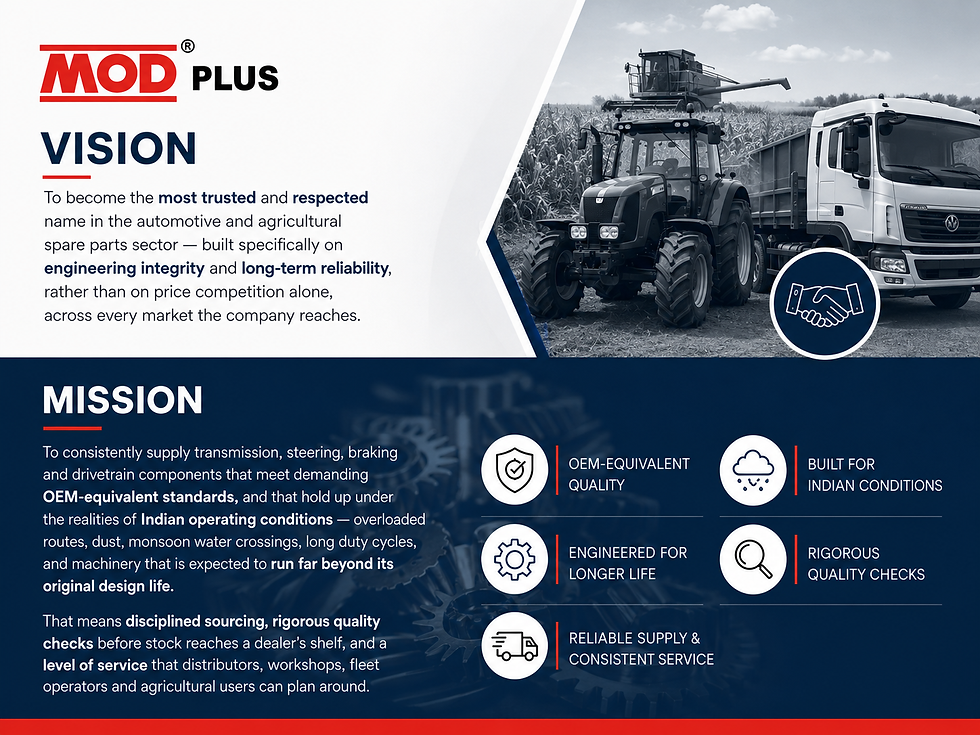
It is worth being precise about what these statements do and do not claim. They are not a warranty document, and they are not a certification. They are a stated operating philosophy — and the rest of this guide is really an explanation of how that philosophy shows up in the product range itself.
Engineering Approach of MOD Plus
Spare parts for driveline, steering and braking systems occupy an unforgiving category of engineering. Unlike a trim part or an interior fitting, a UJ cross, a tie rod end or a steering cross assembly is a torque-critical or safety-critical component: it either transmits the exact load it was designed for, or it fails — and failure in this category rarely fails gently.
MOD Plus's product descriptions across the catalogue consistently emphasise a small set of engineering attributes, repeated part after part: OEM-grade quality, precision engineering, and heavy-duty construction. Those are not abstract slogans in this context — they map onto specific, checkable characteristics of a driveline or steering component:
Dimensional accuracy. A universal joint cross, a splined yoke, or a steering cross assembly has to match the mating component's dimensions almost exactly. A UJ cross that is a fraction of a millimetre out on trunnion diameter will either bind in the bearing cup or introduce play that shows up as vibration and clunking within a few thousand kilometres.
Material selection appropriate to the load. Forged steel is the standard material for the highest-stress components in this category — UJ crosses, yokes, tie rod ends and steering cross assemblies — because forging aligns the steel's grain structure with the direction of load, giving it far better fatigue resistance than a cast or machined-from-bar equivalent under repeated shock loading.
Heat treatment matched to the application. The trunnion surfaces of a UJ cross and the ball stud of a tie rod end both rely on a hardened surface layer to resist wear from constant articulation, while retaining a tougher core to resist fracture under shock load. Getting this balance wrong in either direction — too soft, or too brittle — is one of the most common failure points in low-quality replacement parts.
Protective finishing where the application demands it. A recurring feature across the MOD Plus propeller shaft range is the availability of teflon-coated slip joint and long fork variants alongside standard versions. PTFE coating on a splined slip joint reduces friction during the telescoping action of the joint and improves corrosion resistance — genuinely useful in agricultural, construction and coastal-route applications where mud, moisture and grit are constant.
Sealing and protection details. Dust covers, oil seals and grease points are specified individually against each application rather than as an afterthought — visible in how many long fork and centre bearing listings in the catalogue are offered "with dust cover," "with dust cover and oil seal," or in coated and uncoated pairs for the same base part.
None of this is exotic. It is, in fact, the unglamorous, checklist-driven side of driveline engineering — and it is precisely the side that gets skipped by the lowest-cost, lowest-quality tier of the aftermarket, which is why it is worth stating plainly rather than assuming it is obvious.
Industries MOD Plus Serves
MOD Plus's catalogue structure reflects the two industries the business was built around, plus one adjacent sector it has expanded into over time.
Agricultural Machinery
Indian agriculture depends on mechanised power transmission at a scale that is easy to underestimate — every rotavator, every tractor-drawn implement connected through a PTO-driven gearbox, and every tractor's own steering and clutch system relies on components in the same families MOD Plus stocks. The Rotavator Parts range — covering spring yokes, half yokes, shearing bolt yokes and UJ crosses across 27mm to 38mm cross sizes for brands including Shaktiman, Sonalika and Mahindra Gyrovator — sits alongside a Tie Rod End range built for tractor power steering systems from Sonalika, John Deere, Swaraj, New Holland and Mahindra's Arjun, Novo and Yuvo ranges, plus a Clutch & Brake Platerange covering tractor clutch and brake applications.
Commercial Vehicles
Trucks, buses and light commercial vehicles form the second core market. The Propeller Shaft category — the largest single section of the MOD Plus catalogue — covers UJ crosses, yokes, cross holders, long forks and complete assemblies for Tata Motors, Ashok Leyland, Eicher and BharatBenz vehicles, including specific coverage for the RSB 325, 403, 490, 590 and 690 driveline series used across Tata's medium and heavy truck range. The Steering Parts category (steering cross assemblies) and the Transmission Parts category (gear couplings, differential couplings and flanges) extend that same coverage into steering and gearbox-to-differential linkages for Tata Sumo, Tata 1312/1613/2515/2516/2213, Mahindra Marshal/Commander/Bolero and Ashok Leyland's L/L Tusker and Taurus ranges.
Heavy and Construction Equipment
MOD Plus's JCB Parts range extends the same driveline expertise to construction machinery, with UJ crosses, reverse yokes, coupling flanges and cross holders specified for the JCB 3DX backhoe loader — one of the most widely used pieces of construction equipment on Indian sites.
Workshops, Dealers and Fleet Operators
Underneath all three sectors is a fourth, connecting layer: the workshops, mechanics, distributors, wholesalers, retailers and fleet maintenance teams who actually select and fit these parts every day. MOD Plus's catalogue structure — organised by vehicle make and model rather than generic descriptions — is built around how this audience actually searches for parts: by what is written on the old component they are replacing.
Why Precision Matters in Driveline and Steering Parts
It is worth pausing on why this category of spare parts is held to a tighter standard than, say, a body panel or a trim clip.
A propeller shaft rotates at anywhere from a few hundred to several thousand RPM and carries the vehicle's full engine torque, often through shock loads far higher than steady-state torque when a wheel hits a pothole or a driver engages the clutch aggressively under load. A steering tie rod end is the last link between the driver's steering input and the direction the wheels actually point — a failure here is not an inconvenience, it is a loss-of-control event. A rotavator's PTO-drive yoke and cross transmit the tractor's power take-off torque into soil that can vary from soft loam to compacted clay within the same field, generating sudden load spikes that the joint has to absorb without failing.
In every one of these cases, the cost of an undersized, poorly heat-treated, or dimensionally inaccurate component is not just a shorter service life — it is a higher chance of failure at the worst possible moment: loaded, on the highway, or mid-season in the field. That is the underlying reason the specification detail in the MOD Plus catalogue — spline type, coating, bearing number, cross size, lock type — is treated as essential information rather than fine print.
Understanding the Systems MOD Plus Parts Belong To
To choose correctly from any driveline or steering catalogue, it helps to understand how the systems these parts belong to actually work. This section gives the essentials; MOD Plus has published dedicated, in-depth guides for several of these systems, linked at the end of each section for readers who want the full technical detail.
Automotive Driveline Systems
A driveline's job is to carry rotational power from the gearbox to the wheels (or, in agricultural machinery, from the tractor's power take-off to a driven implement) across a gap that is neither fixed in distance nor fixed in angle, because suspension travel and implement position both change constantly during operation. Two mechanisms make this possible:
The universal joint (UJ cross) — a cruciform component with four trunnion arms, each riding on needle roller bearings inside a bearing cup — allows the shaft to change angle without losing torque transmission.
The slip joint, a splined sliding section, allows the shaft's effective length to change as the distance between the two ends varies.
A propeller shaft assembly combines a shaft tube, yokes at each end, a UJ cross (or two, on longer shafts with a centre bearing), and — where fitted — a slip joint, dust covers and an oil seal. MOD Plus's full technical breakdown of this system, including a part-by-part anatomy, RSB series explanation, failure diagnosis tables and a maintenance schedule, is available in Propeller Shaft – The Complete Guide by MOD Plus.
Commercial Vehicle Steering Systems
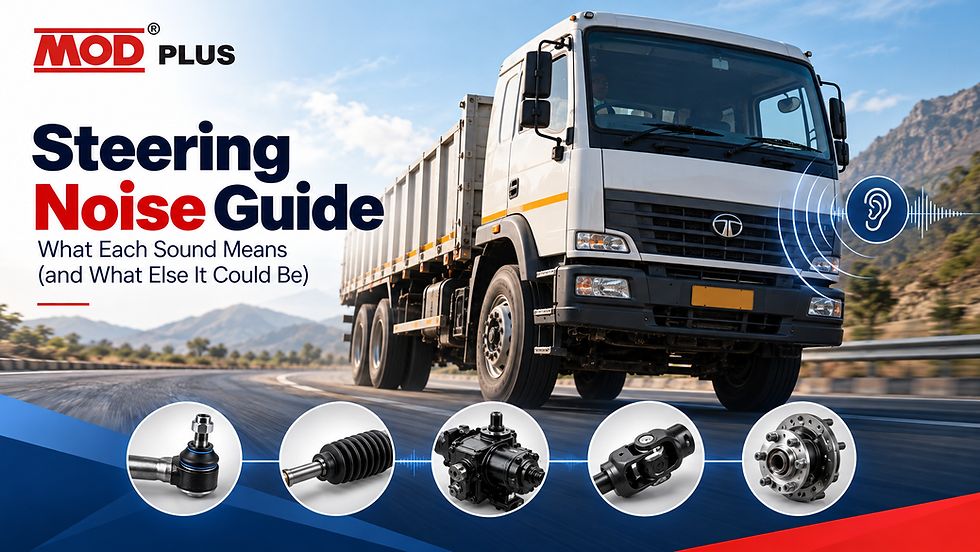
A vehicle's steering system connects the driver's steering wheel input to the pivoting angle of the front wheels through a chain of mechanical linkages: the steering box or rack, a draglink, the tie rod (also called a track rod), and the tie rod end (or track rod end) at each end of it, which is a ball-and-socket joint allowing the linkage to articulate as the suspension moves and the wheels turn. A worn tie rod end introduces play into this chain, which shows up as wandering, uneven tyre wear, and — in advanced cases — a genuine loss of steering precision. Heavier commercial vehicles add a steering cross assembly — effectively a UJ-cross-based universal joint within the steering column or shaft itself — where the steering shaft, like a propeller shaft, has to accommodate an angle change between the steering box and the column. MOD Plus's dedicated deep dive — covering anatomy, construction, failure symptoms, an inspection checklist and a buying guide — is available in The Complete Guide to Tie Rod Ends.
Agricultural Power Transmission (PTO and Rotavator Drivelines)
A tractor's power take-off (PTO) shaft delivers rotational power from the tractor's own gearbox to an attached implement — most commonly, in the rotavator context, into the implement's own input gearbox. That connection point is where MOD Plus's rotavator range operates: spring yokes, half yokes and shearing bolt yokes, paired with a UJ cross, form the joint between the PTO drive and the rotavator's gearbox input shaft. The "shearing bolt" design is a deliberate safety feature — a sacrificial bolt engineered to shear before an overload event can damage the tractor's PTO shaft or gearbox, protecting far more expensive components at the cost of a low-cost replaceable part. MOD Plus's two dedicated guides on this system are Best Rotavator Yoke in India: The Complete Guide to Spring Yokes, Half Yokes & Shearing Bolt Yokes and Rotavator Cross Complete Guide.
The Complete MOD Plus Product Portfolio
The table below summarises the full MOD Plus range as structured on the website, with the specific component families and representative vehicle coverage for each category.
Product Category | Key Components | Representative Vehicle / Machine Coverage |
UJ crosses, yokes & teeth, cross holders & flanges, sleeve bottles, long forks & yokes, complete shaft assemblies, inter-axle shafts, centre bearings | Tata (RSB 325/403/490/590/690 series), Ashok Leyland Taurus, Eicher Canter/Galaxy, BharatBenz, Volvo, MAN | |
Jack rods/piston rods (power steering), track rods, T.R. ends & assemblies, ball joints, draglink kits | Sonalika, John Deere, Swaraj, New Holland, Mahindra Arjun/Novo/Yuvo, International/Balwan | |
UJ crosses (27mm–38mm), spring yokes, half yokes, shearing bolt yokes, triangular tube sets | Shaktiman, Sonalika, Mahindra Gyrovator, Maschio, Tata 1210 | |
Steering cross assemblies | Tata Sumo, Tata 1312/1613/2515/2516/2213/207/Xenon, Mahindra Marshal/Commander/Armada/Bolero, Force Toofan/Trax | |
Clutch plates, pressure plates, clutch sets, steel/oil plates, brake plates | Mahindra Bolero/MDI/Marshal, Tata 207/407/609/709, Force Toofan/Cruiser, Escort, Sonalika/Swaraj tractors | |
Gear couplings, differential couplings, companion flanges, pinion flanges, clutch forks, input shafts | Ashok Leyland L/L Tusker/Taurus/ZF/Cargo, Tata 4018/2518, Max Pickup | |
UJ crosses, reverse yokes, coupling flanges, cross holders | JCB 3DX |
Propeller Shaft Components

This is the largest single category in the MOD Plus catalogue, spanning dozens of catalogue pages. Within it, the site further organises into five focused sub-ranges: Universal Joint Cross, Yoke & Teeth, Cross Holders & Flanges, Sleeve Bottle and Long Fork & Yokes. The RSB classification system — RSB 325 through RSB 690 — is the primary reference framework buyers use to identify the correct long fork or complete assembly for a given Tata truck, with higher numbers indicating larger joints built for higher torque capacity.
Tie Rod Ends and Steering Linkage
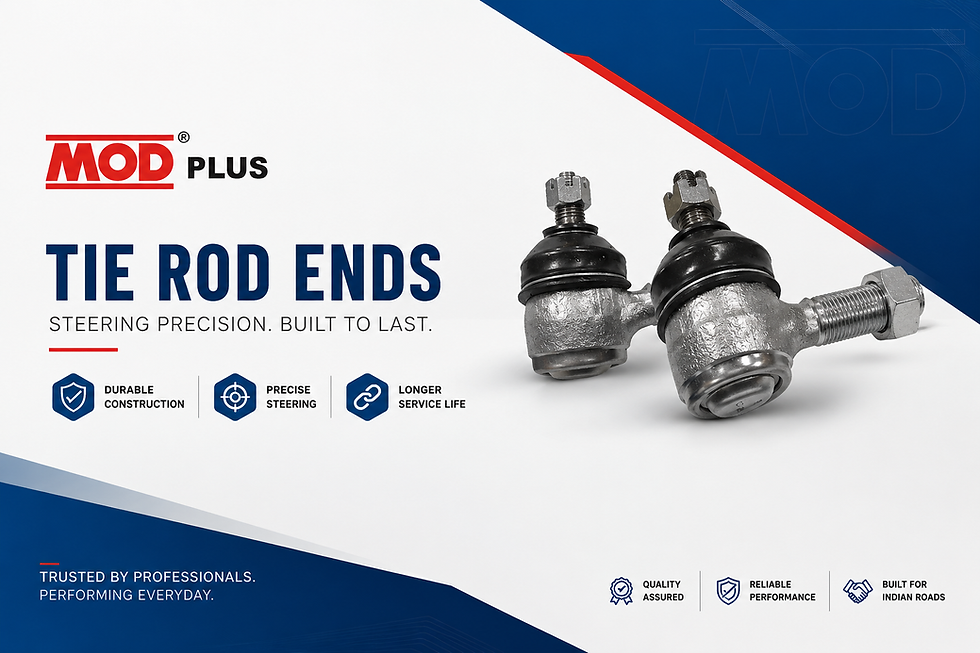
The tie rod end range is built specifically around tractor power steering systems, where jack rods (piston rods), track rods and ball joints connect the steering cylinder to the front axle's steering arms. Because tractor steering geometry varies significantly between manufacturers — and even between models from the same manufacturer — this category is organised strictly by make and model rather than by generic part type.
Rotavator and PTO-Drive Components
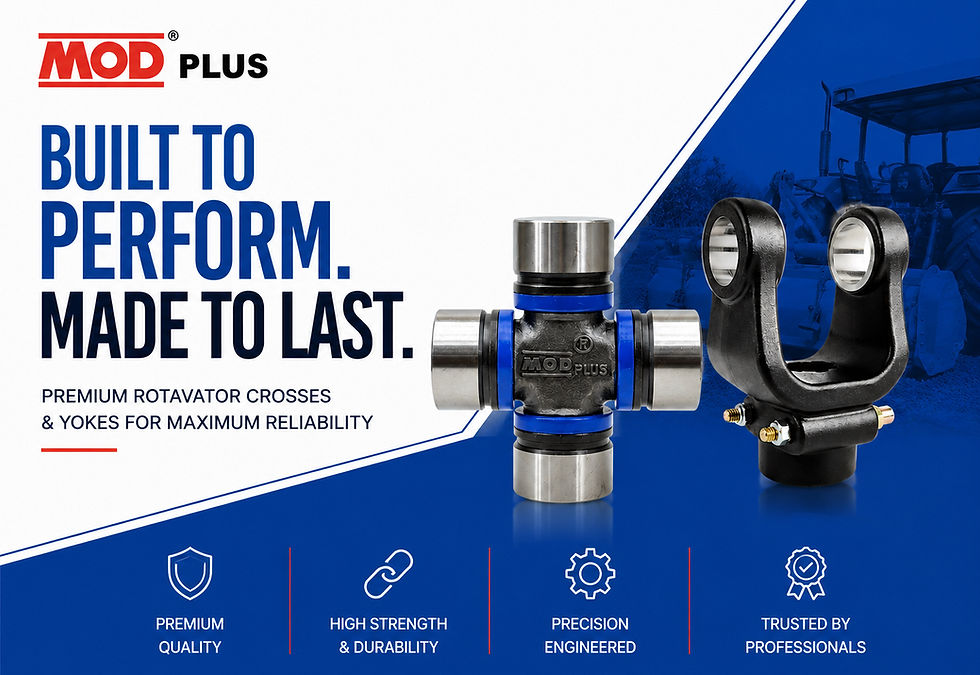
The rotavator range is where MOD Plus's agricultural focus is most visible. Spring yokes, half yokes and shearing bolt yokes are offered in matched pairs with specific UJ cross sizes, and further split by lock type (inner lock vs outer lock) and bore configuration — detail that matters because a mismatched lock type or bore will not seat correctly on the mating shaft even when the cross size is correct.
Steering and Transmission Couplings
Two related but distinct categories cover the driveline between a commercial vehicle's gearbox and its axles: the Steering Parts range of steering cross assemblies, and the separate Transmission Parts range of gear couplings, differential couplings and companion/pinion flanges — the components that connect a gearbox output or differential input to its mating shaft via a serrated or splined interface.
Clutch and Brake Plates
This range covers the friction and pressure components of a vehicle's clutch assembly — clutch plates, pressure plates and complete clutch sets — alongside brake plates for drum-brake applications, spanning both commercial vehicles and tractors.
JCB Parts
A more recent addition to the catalogue, extending the same UJ-cross-based driveline expertise from trucks and tractors into construction equipment, specifically the JCB 3DX platform.
How Driveline and Steering Components Are Made
Understanding, at a basic level, how a component like a UJ cross or a tie rod end moves from raw material to finished part helps explain why dimensional and material quality genuinely separate one supplier's output from another's.
Material selection. High-stress components — crosses, yokes, ball studs — begin as an appropriate grade of steel selected for the torque and shock-load requirements of the application. This is the single most consequential decision in the entire process: a steel grade with insufficient carbon content or alloying will not respond correctly to subsequent heat treatment, no matter how well the rest of the process is executed.
Forging. For the highest-load components, forging — shaping the heated steel under compressive force rather than removing material by machining alone — aligns the internal grain flow of the metal with the part's geometry. This is what gives a forged UJ cross or yoke meaningfully better fatigue resistance under repeated shock loading than an equivalent part machined from cast stock.
Precision machining. After forging, the part is machined to its final dimensions — bore diameters, trunnion diameters, spline profiles and mounting faces all have to fall within tight tolerances, because these components mate with parts from other manufacturers (the vehicle's own gearbox, axle or steering box) and have no room for cumulative error.
Heat treatment. Case hardening or through-hardening (depending on the component and its wear surfaces) is applied to achieve the correct balance between a hard, wear-resistant surface and a tough, fracture-resistant core. This step is applied after the part's rough geometry is established, and its parameters — temperature, duration, quench method — are specific to each component's steel grade and cross-section.
Protective coating, where specified. For components exposed to moisture, mud and corrosive road-salt environments — most visibly, the teflon-coated slip joints and long forks across the propeller shaft range — a coating stage follows heat treatment and final machining.
Quality inspection. Before any component reaches stock, dimensional checks against the specified tolerances, and visual/material inspection for defects such as porosity, machining steps or surface roughness on bearing and trunnion surfaces, are essential gatekeeping steps — the same checks a buyer should apply informally when inspecting a part at the counter (see the buying checklist below).
For engineers and technically minded readers who want a standards-based frame of reference for this kind of component engineering, driveline and universal joint dimensional standards are commonly discussed in the SAE J-series of standards published by SAE International, and general mechanical tolerancing principles are covered under the ISO Geometrical Product Specifications framework published by ISO. These are cited here as general engineering context for readers, not as certifications held by MOD Plus.
OEM vs Aftermarket: What Actually Matters
"OEM vs aftermarket" is usually framed as a binary choice, and that framing misses the actual question a buyer should be asking. The distinction that matters is not where a part was bought — it is whether the part meets the same material specification, dimensional tolerance and manufacturing discipline as the original component it replaces, regardless of the label on the box.
Factor | OEM | Quality Aftermarket | Economy Aftermarket |
Material grade | OEM specification | Equivalent to OEM | Frequently below standard |
Heat treatment | Full | Full | Often insufficient or skipped |
Dimensional tolerance | Tight | OEM-equivalent | Loose, inconsistent |
Protective coating | Optional / model-dependent | Available where relevant | Rarely available |
Bearing / bushing quality | OEM grade | OEM-equivalent | Variable |
Price point | Highest | Below OEM | Lowest, but shortest life |
Real-world service life | OEM-rated | Comparable to OEM | Frequently much shorter |
Economy-grade components in this category — particularly UJ crosses, tie rod ends and steering cross assemblies — routinely cut corners in exactly the places that do not show up on a visual inspection at the counter: lower-carbon steel that will not heat-treat correctly, inadequate or skipped heat treatment, inconsistent bearing quality, and loose dimensional tolerances that only become apparent once the part is under load. The consequence is not just a shorter service life — for a torque-critical or safety-critical component, it is a materially higher risk of premature or sudden failure.
MOD Plus's positioning across its catalogue and blog content is consistently framed around this same standard: components manufactured or sourced to specifications intended to match OEM material grades, tolerances and heat treatment, rather than being priced down by cutting those specific corners.
Choosing the Right MOD Plus Spare Part
Because driveline and steering components are dimensionally exact rather than "close enough" parts, a systematic approach to identification prevents both wasted time and — more importantly — an unsafe fitment.
Buying Checklist
Step | What to Confirm |
1. Vehicle or machine identification | Exact make, model, and series/variant — not just "Tata truck" or "tractor" |
2. Original part reference | RSB series, part number, or measurement from the original component if available |
3. Application-specific spline/lock type | Full spline vs half spline; inner lock vs outer lock; thin vs thick spline |
4. Size specification | UJ cross size (e.g. 27mm, 30mm, 38mm), bore diameter, bearing number |
5. Coating requirement | Standard vs teflon-coated, based on operating environment (dry highway vs wet/muddy/coastal) |
6. Assembly vs component | Whether a standalone component (e.g. cross only) or a complete assembly is required |
7. Seals and covers | Whether dust cover and/or oil seal are required or already integrated |
8. Quantity and lead time | Single replacement vs fleet stocking vs bulk/dealer order |
Inspection Checklist (At the Counter)
Bearing and trunnion surfaces should be uniformly smooth, with no visible machining steps, roughness or porosity.
Splines should have consistent, uniform tooth depth with no visible casting or machining flaws.
Any bore that mates with a shaft should be precisely round — oval distortion indicates a manufacturing defect.
Dust covers should be supple rather than brittle, and should hold their shape without collapsing.
Grease nipples, where fitted, should be fully seated and undamaged.
For a full, application-specific walkthrough of this process for propeller shaft components, tie rod ends, and rotavator crosses and yokes, see the dedicated guides linked in the Where to Go Next section below.
Maintenance Best Practices
Correctly specified parts still need correct maintenance to reach their designed service life. A short summary of the essentials, applicable across most of the MOD Plus range:
Maintenance Task | Typical Interval — Commercial Vehicle | Typical Interval — Agricultural |
Grease UJ crosses / PTO crosses | Every 10,000 km | Every 100 working hours |
Inspect dust covers and seals | Every 10,000 km | Every 100 working hours |
Check tie rod end / linkage play | Every service interval | Every 100 working hours |
Check spline wear (slip joints) | Every 25,000 km | Every 250 working hours |
Torque check on yoke/flange bolts | Every 25,000 km | Every 250 working hours |
Full driveline/steering overhaul | Every 150,000 km | Every 1,000 working hours |
The recurring theme across every category — propeller shafts, tie rod ends, rotavator crosses — is that neglected lubrication and contamination through a damaged dust cover or seal are the two most common preventable causes of premature failure in Indian operating conditions, where dust, monsoon water crossings and overloading are routine stresses that a well-maintained component tolerates far better than a neglected one.
Dealer Network, Bulk Orders and Distribution
MOD Plus operates from its warehousing and distribution facility at Sanjay Gandhi Transport Nagar, Delhi — a location chosen deliberately for its position within one of India's major transport and logistics hubs, enabling consistent inventory availability and efficient dispatch to distributors, wholesalers, retailers, workshops and fleet operators.
The business actively works with distributors and dealers across India, and welcomes enquiries from businesses looking to add MOD Plus's range to their own product line.
It is also set up to support wholesale, distributor and fleet bulk orders, along with supply to buyers beyond India's borders as part of its broader trade relationships. Product-specific PDF catalogues — covering the full range, plus dedicated Tie Rod End, Rotavator and JCB Parts catalogues — are available for download directly from the site, making it straightforward for a distributor or workshop to review the complete part-number list before placing an order.
The Future of MOD Plus
The trends shaping MOD Plus's core markets are the same trends shaping Indian transport and agriculture more broadly: continued growth in multi-axle and heavy commercial vehicle freight, sustained mechanisation of farming operations as rotavators and other PTO-driven implements become standard rather than optional equipment, and a construction equipment sector that keeps expanding alongside India's infrastructure build-out. Each of these trends increases, rather than decreases, the installed base of vehicles and machinery that need dependable driveline, steering and transmission spare parts over their working lives.
For a company built on staying close to a small number of product families rather than diversifying broadly, the practical implication is straightforward: continuing to expand coverage within propeller shaft, steering, rotavator and transmission components for the vehicle and machinery models Indian operators actually run — a strategy visible already in the recent extension of the catalogue into JCB construction equipment parts, alongside its long-standing commercial vehicle and agricultural core.
Conclusion
MOD Plus is, at its core, a specialist: a Delhi-based spare parts supplier that has spent more than four decades inside one specific, technically demanding corner of the automotive and agricultural aftermarket — driveline, steering, braking and transmission components — rather than trying to be a generalist supplier of everything. That specialisation shows up in the depth of the catalogue: dozens of pages of propeller shaft coverage organised by RSB series, rotavator yokes split by lock type and bore size, and steering cross assemblies mapped precisely to individual vehicle variants.
For a mechanic trying to match a worn part, a fleet manager building a stocking matrix, or a distributor evaluating a new supplier relationship, the practical takeaway is this: identify your vehicle or machine precisely, use the make-and-model organisation of the MOD Plus catalogue to narrow down the correct part family, and cross-check the specification details — size, spline type, coating, lock type — against the original component before ordering.
Where to Go Next on the MOD Plus Site
About MOD Plus — company history, vision and mission in full
Propeller Shaft – The Complete Guide by MOD Plus — full technical deep dive: anatomy, RSB series, failure diagnosis, maintenance schedule
The Complete Guide to Tie Rod Ends — construction, symptoms of failure, inspection checklist, buying guide
Best Rotavator Yoke in India: Spring Yokes, Half Yokes & Shearing Bolt Yokes — full rotavator yoke guide
Rotavator Cross Complete Guide — how to choose, maintain and replace rotavator UJ crosses
Propeller Shaft Components | Universal Joint Cross | Yoke & Teeth | Cross Holders & Flanges | Sleeve Bottle | Long Fork & Yokes
Contact MOD Plus — enquiries, dealership and bulk orders
Frequently Asked Questions
1. What is MOD Plus?
MOD Plus is a Delhi-based supplier of OEM-grade aftermarket spare parts for commercial vehicles and agricultural machinery, founded in 1978. Its range covers propeller shaft, steering, rotavator, clutch and brake, transmission and JCB construction equipment components.
2. What does MOD Plus stand for or mean as a brand?
MOD Plus is the trading name under which the company markets its spare parts range; the brand line used across its catalogue is "MOD Plus — Dependable Performance. Every Time," reflecting its positioning on consistency and OEM-grade quality.
3. Where is MOD Plus located?
MOD Plus's warehousing and distribution facility and head office are located at Sanjay Gandhi Transport Nagar, Delhi-110042. The company's roots are in Delhi's Kashmere Gate automotive spare parts market, where it was founded in 1978.
4. What products does MOD Plus manufacture and supply?
MOD Plus's catalogue spans propeller shaft components (UJ crosses, yokes, cross holders, long forks), tie rod ends and steering linkage parts, rotavator parts, steering cross assemblies, clutch and brake plates, transmission couplings and flanges, and a dedicated JCB parts range.
5. What vehicle brands does MOD Plus cover?
The catalogue covers Tata Motors, Ashok Leyland, Eicher, BharatBenz and Force commercial vehicles; Mahindra, Sonalika, Swaraj, New Holland, John Deere and International tractors; Shaktiman and Maschio rotavators; and JCB 3DX construction equipment.
6. What industries does MOD Plus serve?
MOD Plus primarily serves the commercial vehicle aftermarket and the agricultural machinery sector, with an additional range for construction equipment (JCB parts). Its customer base includes distributors, wholesalers, retailers, workshops, fleet operators and agricultural equipment users.
7. What is a MOD Plus UJ Cross?
A MOD Plus UJ (universal joint) cross is a forged, precision-machined cruciform component with four needle-roller-bearing trunnions, used at each end of a propeller shaft or PTO driveline to allow the shaft to articulate while continuing to transmit torque.
8. What are MOD Plus propeller shaft components used for?
They transmit rotational torque from a vehicle's gearbox to its differential (or, in a rotavator, from the tractor's PTO to the implement's gearbox), accommodating changes in angle and length as the suspension or implement position moves.
9. Does MOD Plus supply parts for tractors as well as trucks?
Yes. The Rotavator Parts, Tie Rod End and Clutch & Brake Plate categories all include dedicated coverage for tractor applications from Sonalika, Swaraj, Mahindra, New Holland and John Deere, alongside the primarily truck-focused Propeller Shaft, Steering Parts and Transmission Parts categories.
10. What is the difference between MOD Plus's Steering Parts and Transmission Parts categories?
Steering Parts covers steering cross assemblies — the universal joints within a vehicle's steering column. Transmission Parts covers gear couplings, differential couplings and companion/pinion flanges — the components linking a gearbox output or differential input to its mating shaft.
11. Are MOD Plus parts OEM parts or aftermarket parts?
MOD Plus parts are aftermarket spare parts, positioned and engineered to OEM-equivalent material specifications, dimensional tolerances and heat treatment rather than being sold as original manufacturer parts.
12. How do I know which MOD Plus part fits my vehicle?
Identify the exact vehicle make, model and variant, note the RSB series or original part number if available, and match the specification (spline type, size, coating, lock type) shown in the MOD Plus catalogue against your original component. The category pages are organised by vehicle make and model to make this process straightforward.
13. Does MOD Plus offer teflon-coated components?
Yes, teflon-coated variants are available across much of the propeller shaft range, particularly long fork and slip joint assemblies, offering improved corrosion resistance and reduced friction for vehicles operating in wet, muddy or coastal conditions.
14. Can I buy MOD Plus parts in bulk as a distributor or fleet operator?
Yes. MOD Plus supports wholesale, distributor and fleet bulk orders from its Delhi warehousing facility. Enquiries can be made directly through the contact page.
15. How do I become a MOD Plus dealer?
Businesses interested in stocking the MOD Plus range can enquire through the contact page to discuss dealership and distribution opportunities.
16. Does MOD Plus provide product catalogues?
Yes. MOD Plus publishes downloadable PDF catalogues covering the full product range, as well as dedicated catalogues for Tie Rod End, Rotavator Parts and JCB Parts, available from the homepage and relevant category pages.
17. What should I check when inspecting a driveline or steering part before buying? Check that bearing and trunnion surfaces are smooth with no machining steps or porosity, that splines have consistent tooth depth, that any mating bore is precisely round, and that dust covers are supple rather than brittle or cracked.
18. How often should propeller shaft and rotavator UJ crosses be greased?
As a general guideline, commercial vehicle UJ crosses benefit from greasing roughly every 10,000 km, and agricultural PTO crosses roughly every 100 working hours — though this should always be checked against the specific vehicle or implement manufacturer's recommendation.
19. Does MOD Plus supply spare parts for construction equipment?
Yes, through its JCB Parts range, which covers UJ crosses, reverse yokes, coupling flanges and cross holders for the JCB 3DX platform.
20. How can I contact MOD Plus for a specific part enquiry?
MOD Plus can be reached by phone or WhatsApp at +91-96714 51179 (or +91-92158 67193, +91-99585 53348, +91-84060 10618), by email at modspareparts@gmail.com, or via the enquiry form on the contact page. Business hours are Monday to Saturday, 10:00 AM to 5:00 PM.


Comments