

Best Rotavator Yoke in India: The Complete Guide to Spring Yokes, Half Yokes & Shearing Bolt Yokes by MOD Spare Parts
By the MOD Spare Parts technical desk — driveline and PTO component specialists since 1978
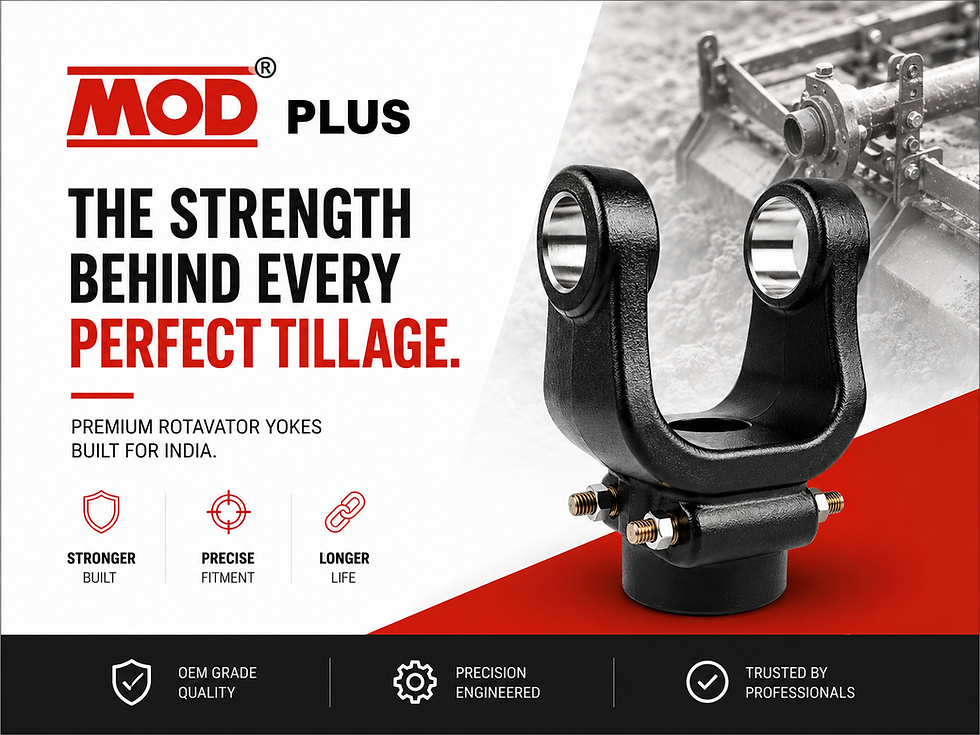
Quick Answer — What is a Rotavator Yoke? A rotavator yoke is a forged steel driveline component that connects the PTO shaft to the rotavator's gearbox via a universal joint (UJ) cross. It transmits the tractor's rotational power to the implement, absorbing shock and misalignment while the machine works through uneven soil.
Table of Contents
Introduction
Ask any experienced tractor mechanic what actually keeps a rotavator turning in the middle of a field, and the answer is rarely the engine. It is a small forged component sitting quietly inside the PTO driveline — the rotavator yoke.
A rotavator is only as reliable as its weakest driveline component, and across Indian farms, from the wheat belts of Punjab and Haryana to the cotton fields of Maharashtra and the paddy tracts of Tamil Nadu and Andhra Pradesh, that weak point is very often a poorly forged, under-machined, or incorrectly heat-treated yoke. Farmers rarely think about the yoke until it fails mid-season, and by then the damage has usually spread — to the UJ cross, the triangular tube, and sometimes the gearbox input shaft itself.
This guide is written for everyone who depends on that decision going right: dealers stocking spares for the season ahead, workshop mechanics diagnosing a vibrating PTO line, and farmers trying to work out why their rotavator keeps losing drive. We will cover what a rotavator yoke is, how it works, the different types manufactured for the Indian market, why they fail, how to inspect and maintain them, and how to choose the correct one — with MOD Spare Parts' own rotavator yoke range used as a real, verifiable reference throughout.
MOD has been manufacturing driveline, steering, and braking components for India's commercial vehicle and agricultural machinery aftermarket since 1978. That is not a regional claim — MOD's rotavator yoke range, along with its UJ crosses, propeller shaft components, and tie rod ends, is built to serve dealers and farm equipment retailers across India, not a single state or city. The goal of this guide is the same goal MOD applies to manufacturing: give you the complete, technically accurate picture, so you can make the right call the first time.
What Is a Rotavator Yoke?
A rotavator yoke is a forged steel fork-shaped component that forms one half of a universal joint assembly inside a rotavator's PTO driveline. It cradles the UJ cross at one end and connects — via a splined bore, plain bore, or triangular tube — to the tractor's PTO shaft or the rotavator's gearbox input shaft at the other.
In plain terms: power leaves the tractor's PTO shaft, travels down the shaft, and needs to change angle slightly to reach the rotavator gearbox, because the tractor and the implement are never perfectly aligned. The yoke, working together with the UJ cross, is what allows that power to keep moving smoothly even at an angle. Without it, there is no connection between "engine power" and "blades turning in the soil."
What does a PTO Yoke do? A PTO yoke transmits rotational torque from the tractor's power take-off shaft to an implement's gearbox, while accommodating the constantly changing angle between the tractor and the implement. It does this by holding the universal joint cross securely in a forged fork, allowing the cross to pivot as the shaft rotates.
Why Rotavator Yokes Matter So Much in Indian Field Conditions
Indian fields are rarely flat or uniform. A rotavator yoke has to cope with:
Hard, dry soil in the early Rabi season and sticky, wet clay after monsoon tillage
Buried stones, roots, and debris that create sudden shock loads
Long, continuous duty cycles during sowing and harvesting windows, when a breakdown cannot wait
Constant vibration transmitted back from the rotavator blades through the gearbox
Because the yoke sits at the exact point where torque, angle change, and shock load all meet, its quality has an outsized effect on how long the entire driveline lasts.
How a Rotavator PTO Yoke Works

The rotavator's power transmission path typically runs like this:
Tractor PTO shaft → PTO yoke → UJ cross → mating half yoke or triangular tube → rotavator gearbox → side gears → blades
At each yoke, the arms of the UJ cross sit inside bearing cups housed in the yoke's fork. As the shaft spins, the cross pivots inside both yokes simultaneously, which is what lets the driveline transmit full torque even when the tractor and implement are not in a straight line. A locking mechanism — either an inner lock or outer lock design, depending on the yoke — keeps the yoke correctly seated on the shaft or shear pin so it cannot walk off under vibration.
This is also where a shearing bolt yoke earns its keep: it is deliberately engineered with a sacrificial shear pin so that, if the rotavator blades strike a buried rock or an overload occurs, the pin snaps before the gearbox, PTO shaft, or tractor spline is damaged. It is a safety valve for the entire driveline, and it is one of the most misunderstood — and most frequently under-specified — components in the aftermarket.
Types of Rotavator Yokes
Not every rotavator yoke does the same job. MOD's own rotavator parts range illustrates the range of designs actually used across Indian rotavator platforms:
Yoke Type | Primary Function | Typical Features |
Spring Yoke | Absorbs shock loads from sudden impacts (stones, roots, blade jams) | 6-teeth splined engagement, inner or outer lock, paired with a 38mm cross |
Half Yoke (Triangle Input) | Connects the PTO shaft to the rotavator's triangular tube / implement side | Big-hole or small-hole bore variants, inner or outer lock, triangle profile |
Shearing Bolt Yoke | Protects the driveline via a sacrificial shear pin under overload | 6-teeth engagement, inner or outer lock, supplied as complete units or as separate upper/lower parts |
Solid / Plain Bore Yoke | Direct, rigid connection where shock absorption is handled elsewhere in the line | Available in multiple bore sizes (30mm, 35mm, 46mm dia) with inner or outer lock |
Triangular Tube Set | Transfers drive along the implement-side shaft to the gearbox input | Supplied as a complete tube set or as a large tube component only |
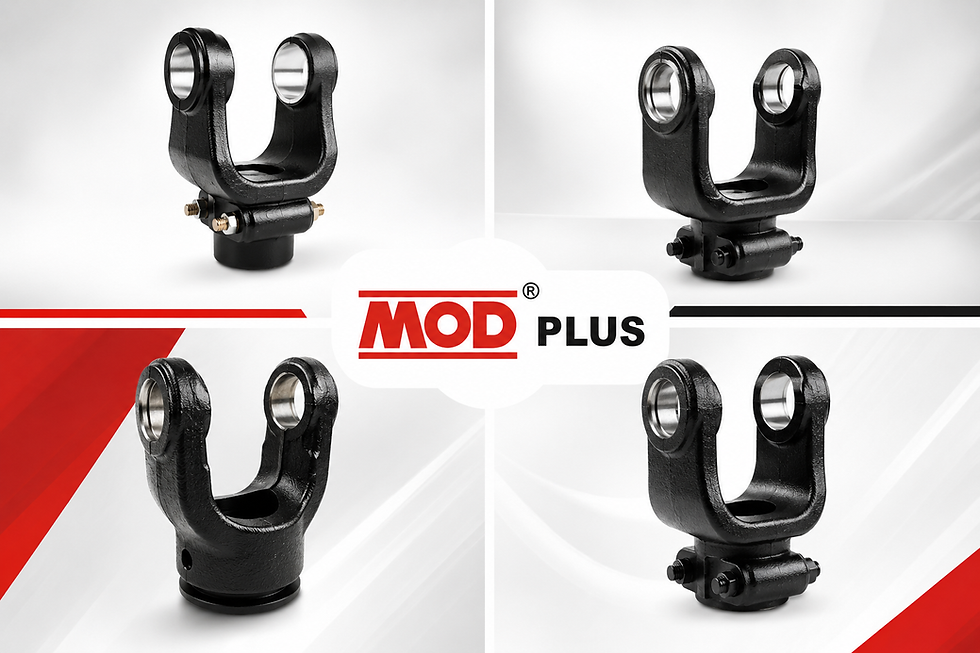
Spring Yoke
The spring yoke is fitted where the driveline benefits from a degree of shock absorption between the tractor's PTO output and the rest of the implement shaft. MOD manufactures this in both inner-lock and outer-lock configurations to suit different rotavator platforms.
Half Yoke
A half yoke is exactly what it sounds like — one half of the universal joint pairing, engineered specifically for the triangular tube side of the driveline. MOD's half yoke range covers both big-hole and small-hole input variants, in inner-lock and outer-lock forms, so a workshop can match the correct bore and locking style rather than forcing a near-fit part.
Shearing Bolt Yoke
The shearing bolt yoke is arguably the most safety-critical yoke in the entire rotavator driveline. Because Indian fields regularly hide stones and roots below the surface, a shearing bolt yoke's sacrificial pin is what prevents a single impact from turning into a cracked gearbox housing or a bent PTO shaft. MOD supplies both complete shearing bolt yokes and the individual upper and lower components separately, which matters for workshops that only need to replace the worn half rather than the entire assembly.
Solid / Plain Bore Yoke
Where the driveline design calls for a rigid, non-shearing connection, MOD's solid rotavator yoke range is machined in multiple bore diameters, again offered in both inner-lock and outer-lock forms to match the gearbox or shaft it is mating with.
Triangular Tube Set
The triangular tube carries drive along the implement side of the shaft. MOD supplies this as a complete set and as an individual large tube component, for workshops replacing only the damaged section rather than the full assembly.
Rotavator Yoke Construction & Materials
A rotavator yoke has to survive constant cyclic loading, shock impact, and exposure to dust, mud, and moisture — often for years without a full driveline overhaul. That is why the fundamentals of construction matter more here than in almost any other agricultural spare part:
Forged body — Forging aligns the steel's internal grain structure along the shape of the part, which gives the yoke far greater fatigue resistance than a component simply cut or cast to shape.
Splines and bore — Precisely machined to seat correctly on the mating shaft, minimising the play that leads to vibration and premature wear.
Locking mechanism — Inner-lock or outer-lock design, holding the yoke securely on the shaft under vibration.
UJ cross seat — Machined bearing seats that must be dimensionally accurate to within tight tolerances, or the cross will not sit correctly and will wear unevenly.
Heat treatment — Hardening the surface for wear resistance while keeping the core tough enough to absorb shock without becoming brittle.
Surface finishing — Precision grinding of contact surfaces to reduce friction and heat build-up during continuous operation.
Rotavator yokes are manufactured from forged alloy steel, chosen specifically for its balance of strength and toughness. A yoke that is under-hardened wears quickly; one that is over-hardened without a tough core becomes brittle and prone to cracking under shock loads. Getting that balance right through correct heat treatment is one of the clearest differences between an OEM-grade aftermarket yoke and a poorly made copy.
How MOD Manufactures Rotavator Yokes
MOD's rotavator yoke production follows a quality-controlled sequence rather than a shortcut-driven one:
Forging — Steel billets are forged into the rough yoke shape, aligning grain flow for maximum fatigue strength.
CNC machining — Bores, splines, fork faces, and bearing seats are machined to precise tolerances.
Heat treatment — Controlled hardening and tempering to achieve a hard, wear-resistant surface with a tough, impact-absorbing core.
Grinding and surface finishing — Contact surfaces are ground for a smooth fit against the UJ cross and mating components, reducing friction and heat.
Quality inspection — Dimensional checks before the part is cleared for packing and dispatch.
This is the same discipline MOD applies across its broader driveline range — UJ crosses, propeller shaft components, and tie rod ends — because a rotavator's reliability depends on every component in the chain being built to the same standard, not just the part that happens to be visible.
Common Causes of Rotavator Yoke Failure
Cause | How It Happens |
Wear and fatigue | Cumulative cyclic loading over years of operation, accelerated by poor lubrication |
Overloading | Running the rotavator beyond its rated PTO torque or working excessively hard soil |
Misalignment | Incorrect PTO shaft angle between tractor and implement, stressing the yoke unevenly |
Lack of lubrication | Dry contact between the UJ cross and yoke bearing seats increases friction and heat |
Incorrect installation | Wrong bore, spline count, or lock type forced into place, creating uneven stress |
Corrosion | Moisture and mud entering through failed seals or worn locking mechanisms |
Dust ingress | Abrasive contamination accelerating wear at the cross-yoke interface |
Shock loads | Sudden impact from buried stones, roots, or blade jams |
Poor-quality replacements | Under-forged, under-machined, or incorrectly heat-treated aftermarket copies |
A failure in one component rarely stays isolated. A worn or cracked yoke typically damages the UJ cross next, then transmits stress further up or down the driveline. In the middle of a sowing or harvesting window, that chain reaction is what turns a small maintenance item into a full day's lost work.
Symptoms of a Worn Rotavator Yoke
How do I know if my rotavator yoke is worn? Worn rotavator yokes typically show excessive vibration during operation, a knocking or clunking noise from the PTO line, visible play or backlash when the shaft is rocked by hand, spline wear, surface cracks, or rust around the locking mechanism. Any of these signs warrants immediate inspection.
Symptom | Likely Cause |
Excessive vibration during operation | Worn splines, bearing seat wear, or misalignment |
Knocking or clunking noise | Backlash between the yoke and UJ cross |
Visible looseness / backlash | Worn bore, worn cross bearing caps, or a failed lock |
Spline wear or rounded teeth | Prolonged use, poor lubrication, or overloading |
Surface cracks | Fatigue, shock loading, or a brittle (poorly heat-treated) yoke |
Rust on the locking mechanism | Water or mud ingress through a failed seal |
Noticeable power loss to the blades | Slippage at a worn spline or failing UJ cross |
Uneven wear pattern on the fork | Persistent misalignment between tractor and implement |
Premature UJ cross failure | A worn yoke bearing seat placing uneven load on the cross |
What causes PTO yoke failure? PTO yoke failure is most commonly caused by a combination of overloading, misalignment, inadequate lubrication, and the use of low-quality forged or heat-treated replacement parts. Shock loads from stones or roots in the soil accelerate failure in yokes that are already under-specified for the job.
Inspection Checklist
Before every peak season, and periodically during heavy use, check:
[ ] Visible cracks anywhere on the yoke fork or body
[ ] Play or backlash when the shaft is rocked by hand
[ ] Condition of the locking mechanism (inner lock / outer lock) — does it seat firmly?
[ ] Spline or tooth wear at the engagement point
[ ] Rust or discolouration suggesting water ingress
[ ] Grease condition and presence of contamination (grit, mud, water)
[ ] Alignment between the tractor PTO shaft and the rotavator input
[ ] Condition of the mating UJ cross and bearing caps
[ ] Tightness of any retaining bolts, pins, or shear bolts
[ ] Overall noise and vibration during a short test run
Maintenance Schedule
Interval | Maintenance Task |
Before every season | Full visual inspection, greasing, and PTO alignment check |
Every 40–50 operating hours | Re-grease the UJ cross and yoke bearing seats |
Every 100 operating hours | Check for backlash, spline wear, and locking mechanism condition |
After any impact or jam | Inspect the shearing bolt yoke and shear pin immediately |
End of season / storage | Clean, grease, and store the rotavator with the PTO shaft supported to avoid bend |
How long does a Rotavator Yoke last? With correct installation, regular greasing, and proper alignment, a quality forged and heat-treated rotavator yoke typically lasts several seasons of normal agricultural use. Service life is shortened significantly by poor lubrication, misalignment, overloading, or the use of low-quality aftermarket parts.
Installation & Lubrication Best Practices
Always match the bore diameter, spline/tooth count, and lock type (inner or outer) exactly to the mating shaft and cross — never force a near-fit part into place.
Grease the UJ cross and bearing seats before and after installation, and at every scheduled interval; dry running is one of the fastest routes to premature wear.
Check PTO shaft alignment between the tractor and the rotavator before starting work — persistent misalignment stresses the yoke unevenly even when the part itself is high quality.
Torque any retaining bolts or pins to the correct specification; an under-tightened lock is as damaging as a worn one.
After fitting a shearing bolt yoke, confirm the shear pin is the correct rated type for the implement — an incorrect substitute either shears too easily or fails to protect the driveline at all.
Store spare yokes in a dry environment; corrosion on an unused part can compromise fitment before it is ever installed.
How to Choose the Correct Rotavator Yoke
Selecting the right rotavator yoke comes down to matching several dimensions precisely rather than buying "a yoke that looks about right." Before ordering, confirm:
Bore size — MOD's solid yoke range alone spans 30mm, 35mm, and 46mm diameter options; the wrong bore simply will not seat correctly.
Lock type — Inner lock or outer lock. This is not interchangeable; it must match the mating shaft's design.
Spline / tooth count — 6-teeth configurations are common across MOD's spring and shearing bolt yokes; confirm the count matches your gearbox or shaft.
UJ cross size — Most of MOD's rotavator range is built around a 38mm cross; the yoke's cross seat must match the cross you are using.
Yoke type — Spring yoke, half yoke, shearing bolt yoke, solid yoke, or triangular tube, depending on where in the driveline the part sits and what function it needs to perform (shock absorption vs. rigid drive vs. overload protection).
Implement compatibility — Confirm the yoke's design matches your rotavator platform's PTO input and triangular tube profile before purchase.
Which rotavator yoke is best? There is no single "best" rotavator yoke for every rotavator — the correct choice depends on bore size, lock type, spline count, and UJ cross size matching your specific driveline. What matters universally is that the yoke is properly forged, precisely machined, and correctly heat-treated, regardless of type.
OEM vs Aftermarket Rotavator Yokes
Factor | OEM | Quality Aftermarket (e.g. MOD) | Low-Quality Aftermarket |
Material | Forged alloy steel | Forged alloy steel | Often cast or under-forged |
Heat treatment | Controlled, consistent | Controlled, consistent | Inconsistent or skipped |
Machining tolerance | Tight | Tight | Loose, causing early play |
Availability | Often limited, longer lead times | Wide availability, faster replacement | Variable |
Price | Highest | Competitive, OEM-grade quality | Lowest, but shortest service life |
Fitment accuracy | Guaranteed | Verified against genuine spec | Frequently inconsistent |
The real comparison that matters to a dealer or farmer is not "OEM vs aftermarket" in the abstract — it is quality-controlled aftermarket vs. uncontrolled aftermarket, since OEM parts are frequently unavailable quickly in rural and semi-urban markets. A properly forged, machined, and heat-treated aftermarket yoke from a manufacturer with decades of driveline experience closes that gap without the downtime.
The Complete MOD Rotavator Yoke Range
All of the following are genuine, currently listed products from MOD's Rotavator Parts category:
Part Code | Product | Type |
R-9 | Spring Yoke (6-T) Inner Lock Sonalika, 38mm Cross | Spring Yoke |
R-9A | Spring Yoke (6-T) Outer Lock Shaktiman, 38mm Cross | Spring Yoke |
R-9B | Half Yoke Input Big Hole, Outer Lock Shaktiman (Triangle), 38mm Cross | Half Yoke |
R-9B1 | Sonalika Half Yoke Input, Inner Lock Triangle, 38mm Cross | Half Yoke |
R-9C | Half Yoke Input Small Hole, Outer Lock Shaktiman Triangle, 38mm Cross | Half Yoke |
R-9C1 | Sonalika Half Yoke Input Small Hole, Inner Lock Triangle, 38mm Cross | Half Yoke |
Rotavator Yoke 35mm Bore Plain Type, Inner Lock, 38mm Cross, Sonalika | Solid / Plain Bore Yoke | |
R-9D1 | Rotavator Yoke 35mm Bore, Outer Plain Type | Solid / Plain Bore Yoke |
R-9D2 | Sonalika Rotavator Yoke 30mm Small Bore, Inner Lock, Plain Type | Solid / Plain Bore Yoke |
Rotavator Yoke 30mm Small Bore, Outer Lock | Solid / Plain Bore Yoke | |
R-9E | Rotavator Yoke Solid, Inner Lock (Sonalika), 38mm Cross, 46mm Dia | Solid Yoke |
R-9E1 | Rotavator Yoke Solid, 46mm Dia, Outer Lock | Solid Yoke |
Shearing Bolt Yoke, 6-Teeth, Outer Lock Shaktiman, 38mm Cross | Shearing Bolt Yoke | |
R-9F1 | Shearing Yoke Upper Only (Outer Lock) | Shearing Bolt Yoke (component) |
R-9F2 | Shearing Yoke Lower Part with Balls | Shearing Bolt Yoke (component) |
Shearing Bolt Yoke, 6-Teeth, Inner Lock Sonalika, 38mm Cross | Shearing Bolt Yoke | |
R-9H | Rotavator Triangular Tube Set (14") Shaktiman | Triangular Tube Set |
Triangular Tube, Large, Only | Triangular Tube (component) | |
4050R | UJ Cross Rotavator, 38mm (8 Lock), Tata 1210 | Complementary UJ Cross |
Every yoke in this range is paired to work with MOD's own UJ Cross range, so dealers and workshops can source a complete, correctly matched driveline repair from a single supplier rather than mixing components from multiple sources — one of the most common causes of premature failure covered earlier in this guide.
For the wider catalogue of agricultural and commercial vehicle components MOD supplies, see the full Rotavator Parts category and the complete All Products range.
Why MOD Is India's Trusted Rotavator Yoke Supplier
MOD Spare Parts has been manufacturing propeller shaft, driveline, steering, and braking components since 1978. That kind of continuity in the aftermarket business does not happen by serving one region — it happens by consistently supplying dealers, workshops, and agricultural equipment retailers across the country with parts that fit correctly and last.
What that translates to for anyone sourcing a rotavator yoke:
Precision engineering — Every yoke is forged, CNC-machined, heat-treated, and ground to consistent tolerances, not produced to a "close enough" standard.
Wide product range — From spring yokes and half yokes to shearing bolt yokes, solid yokes, and triangular tube sets, MOD covers the driveline configurations actually used across Indian rotavator platforms, rather than a narrow selection.
Consistent, quality-controlled manufacturing — Dimensional checks before dispatch, so fitment is predictable order after order.
Nationwide availability — MOD supplies dealers and distributors well beyond any single city or region, supporting bulk orders and dealer stocking programmes for the agricultural season ahead.
Decades of driveline expertise — Rotavator yokes are engineered alongside MOD's UJ crosses, propeller shaft components, and tie rod ends, with the same manufacturing discipline applied across the entire product range.
Value for money — OEM-grade quality at a price point that supports both individual workshop replacements and bulk dealer stocking.
Farmers, workshops, and dealers across India choose MOD rotavator yokes for the same reason they choose MOD's UJ crosses and propeller shaft components: consistent fitment, dependable materials, and a manufacturer that stands behind the driveline as a complete system — not just a single part.
Frequently Made Buying Mistakes
Matching by appearance instead of specification. Two yokes can look almost identical while differing in bore size, lock type, or spline count.
Ignoring the lock type. Inner-lock and outer-lock designs are not interchangeable — this is one of the most common return-and-replace mistakes reported by workshops.
Buying the shearing bolt yoke without confirming the correct shear pin rating. An incorrect pin either shears prematurely or fails to protect the gearbox at all.
Replacing only the yoke after a failure, without inspecting the UJ cross. A worn cross paired with a new yoke often fails again within a short period.
Choosing the lowest price without checking forging and heat treatment quality. The cheapest yoke is rarely the cheapest option over a full season of use.
Skipping alignment checks after installation. A correctly specified yoke fitted to a misaligned driveline will still wear prematurely.
Frequently Asked Questions
1. What is the difference between a spring yoke and a shearing bolt yoke?
A spring yoke absorbs shock loads through its design without a sacrificial component, while a shearing bolt yoke uses a deliberate shear pin that snaps under excessive load to protect the rest of the driveline from damage.
2. What is a half yoke used for in a rotavator?
A half yoke connects the triangular tube side of the driveline to the universal joint cross, forming one half of the yoke pair needed to transmit power to the rotavator gearbox.
3. How do I know which bore size my rotavator yoke needs?
Measure the mating shaft diameter directly, or check your rotavator's service documentation. MOD's solid yoke range, for example, is available in 30mm, 35mm, and 46mm diameter options to match different platforms.
4. What does "inner lock" and "outer lock" mean on a rotavator yoke?
These refer to the locking mechanism's position relative to the yoke body, determining how the part secures onto the mating shaft. The two types are not interchangeable and must match your existing driveline configuration.
5. Can I fit a Shaktiman-type yoke to a Sonalika-type rotavator, or vice versa? No. Lock type, bore, and spline configuration differ between platforms. Always match the yoke specification to your specific rotavator's driveline rather than assuming cross-compatibility.
6. How often should a rotavator yoke be greased?
As a general guide, re-grease the yoke and UJ cross every 40–50 operating hours, and always before and after any period of storage.
7. What causes a rotavator yoke to crack?
Cracking is typically caused by fatigue from prolonged cyclic loading, sudden shock impacts, or brittleness from incorrect heat treatment during manufacturing.
8. Is a rotavator yoke the same as a UJ cross?
No. The yoke is the forked component that holds the UJ cross in place; the UJ cross is the four-armed pivot that allows the driveline to transmit torque at an angle. They work together but are separate, individually replaceable parts.
9. How do I check for wear in a rotavator yoke without removing it?
Rock the shaft by hand at the joint to feel for backlash, listen for knocking during a short test run, and visually inspect for surface cracks or rust around the locking mechanism.
10. What is a triangular tube, and does it need replacing separately from the yoke?
The triangular tube carries drive along the implement side of the shaft. It is a separate component from the yoke and can wear or bend independently, so it should be inspected and replaced on its own merits.
11. Why does my rotavator vibrate even after I replaced the yoke?
Vibration after a yoke replacement is usually caused by a worn UJ cross that was not replaced at the same time, incorrect PTO shaft alignment, or a mismatched bore or lock type.
12. Are aftermarket rotavator yokes as reliable as OEM parts?
A properly forged, machined, and heat-treated aftermarket yoke from an established manufacturer can match OEM-grade reliability, provided the specification is correctly matched to your driveline.
13. What spline or tooth count is standard on MOD's spring and shearing bolt yokes?
MOD's spring yoke and shearing bolt yoke range is manufactured with a 6-teeth engagement configuration, paired with a 38mm UJ cross.
14. Can a shearing bolt yoke be repaired, or does it need full replacement? MOD supplies the shearing bolt yoke's upper and lower sections separately, so a workshop can replace only the worn or sheared component rather than the entire assembly, where applicable.
15. What is the safest way to store spare rotavator yokes during the off-season?
Store them clean, greased, and in a dry environment to prevent corrosion, which can affect fitment and locking mechanism function before the part is ever installed.
16. Does MOD supply rotavator yokes in bulk for dealers and distributors?
Yes. MOD supports bulk ordering and dealer stocking programmes for its full rotavator parts range ahead of peak agricultural seasons.
17. What size UJ cross is used across most of MOD's rotavator yoke range?
The majority of MOD's rotavator yoke range is engineered around a 38mm cross, with the solid yoke series also available with a 46mm diameter option.
18. How do I find the correct MOD yoke for my rotavator?
Confirm your rotavator's bore size, lock type, spline count, and UJ cross size, then match these against MOD's Rotavator Parts range, or contact MOD directly for guidance.
Conclusion
A rotavator yoke rarely gets much attention until the day it fails — and on that day, it becomes the only thing standing between a finished field and a lost afternoon. Understanding the types of yokes available, how they are built, why they wear, and how to match the correct specification is what separates a workshop or farmer who replaces this part once a season from one who replaces it, and the components it damages on the way out, every few weeks.
MOD Spare Parts has built its rotavator yoke range — spring yokes, half yokes, shearing bolt yokes, solid yokes, and triangular tube sets — on the same forging, machining, and heat-treatment discipline it applies across its entire driveline catalogue, for dealers, workshops, and farmers across India.
Explore MOD's complete Rotavator Yoke range, request dealer pricing, or enquire about bulk orders:
External Refrences
Bureau of Indian Standards (BIS) publications on agricultural tractor PTO and power tiller specifications
ICAR / Central Institute of Agricultural Engineering (CIAE) technical papers on rotavator and power tiller driveline components
Tractor OEM service manuals (Sonalika, Shaktiman implement documentation) for PTO shaft specification cross-reference


Comments