

Genuine vs. Duplicate UJ Cross: A 5-Point Check Before You Buy
Jump to a check: Point 1: Weight and Material Feel · Point 2: Finish, Machining, and Surface Quality · Point 3: Stamping, Markings, and Part Number Clarity · Point 4: Seal, Cup, and Grease Nipple Quality · Point 5: Articulation and Movement Test
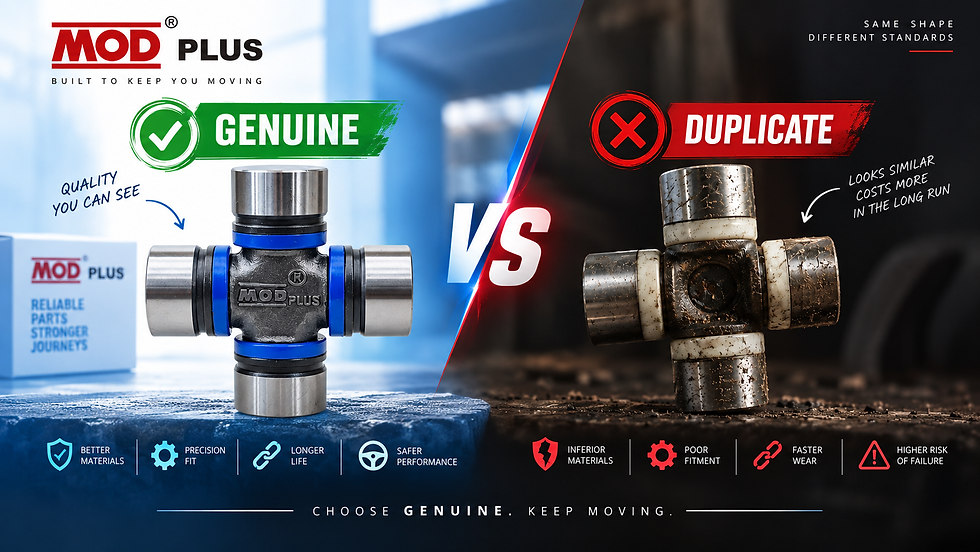
A genuine vs duplicate UJ cross question is one every serious buyer eventually asks — usually right after paying ₹300 to ₹1,200 for a part with no way to know for certain if it's genuine until it's sitting inside a working propeller shaft, under load, on a highway or in a field. That's the real anxiety behind most UJ cross purchases in India's aftermarket: duplicate spare parts India-wide are common enough that fleet owners and workshop mechanics have all heard a story about one failing early, sometimes with expensive consequences.
At MOD Plus, we've supplied propeller shaft components out of Sanjay Gandhi Transport Nagar, Delhi since 1978, and this guide gives you a practical, hands-on check you can run yourself before you commit to a supplier.
Why Counterfeit UJ Crosses Are a Real, Common Problem
Propeller shaft crosses are small, low-glamour, high-turnover parts, and that combination makes them an easy target for duplication. A UJ cross sits hidden inside the shaft assembly, so most buyers never get a genuine universal joint cross next to a counterfeit UJ cross to compare — they only find out which one they got when it fails, or doesn't.
Because these parts move in high volumes across a fragmented distribution chain — from manufacturer to distributor to dealer to workshop — packaging and outer markings can be copied far more easily than the forged steel and precision machining inside. That gap is exactly what duplicate spare parts India suppliers exploit: a box, a label, and a part number that look right on a counter, at a lower price than genuine stock.
This isn't a reason to panic over every purchase. Most UJ crosses sold in India's aftermarket are legitimate. But it's a real enough problem — for tractor owners, LCV fleets, and workshop mechanics alike — that a five-minute physical check before you pay is worth doing every time. It's a small habit that protects aftermarket authenticity as much as it protects your vehicle.
For general fitment and sizing guidance, MOD Plus has a separate engineering and buyer's guide covering commercial vehicle UJ cross selection in detail — Commercial Vehicle UJ Cross buyer's guide
Point 1: Weight and Material Feel
Pick the UJ cross up before you do anything else. A genuine cross is made from forged steel, which packs a dense, uniform grain structure into a compact shape — and that density has a feel to it the moment you hold it.
A genuine cross typically feels noticeably heavier for its size due to solid forged construction, while a duplicate often feels lighter or hollow. This isn't about hitting an exact number on a scale; it's about the immediate sense that the metal has real mass behind it.
If you have a genuine sample from a previous order, or your supplier can provide one, hold the two side by side — one in each hand — and compare. The difference is usually obvious within a few seconds, especially across crosses of the same size and application.
No reference sample handy? Tap the arm of the cross gently with a metal tool, like the back of a screwdriver, and listen. Forged steel of the right grade tends to give a clear, solid ring. A cheaper cast substitute or thinner-gauge steel often sounds duller or tinnier — a subtle but real difference once you've heard both.
A basic kitchen or parcel scale can also help if you're comparing multiple crosses of an identical part number and size against each other; a piece that reads meaningfully lighter than the rest of the batch is worth a closer look using the remaining four checks in this guide, rather than treated as a standalone red flag.
Point 2: Finish, Machining, and Surface Quality
Turn the cross over in your hand and look closely at the four arms — these are the journals where the bearing cups sit — along with the body connecting them.
On a genuine cross, all four journals feel uniformly smooth to the touch with no casting seams, and any rough patch or uneven finish is a red flag. Genuine forging-and-machining leaves a consistent surface: no ridges where mould halves met, no pitting, no patchy plating.
Run a clean finger or a soft cloth along each journal. A cloth that snags or a finger that catches on a ridge usually means poor machining — a classic sign of a rushed or cheap duplicate. Look under strong light, ideally daylight or a torch held at a low angle, for hairline seams running along the arms; these are casting marks that shouldn't exist on a properly forged and finished part.
Check the black-oxide or plating finish across the whole cross too. It should be even in colour and texture. Blotchy patches, flaking coating, or small areas of bare, dull metal peeking through often point to a lower manufacturing standard — even if the overall shape and dimensions look correct.
None of this requires special equipment. It's the same kind of close, patient look a mechanic gives any part before fitting it — just applied specifically to the surfaces a duplicate manufacturer is most likely to cut corners on.
Point 3: Stamping, Markings, and Part Number Clarity
Every genuine cross should carry a clear part number and, in most cases, a brand or manufacturer mark — stamped or laser-etched into the metal, not printed onto a sticker that can fall off.
A genuine part number is deep-stamped and sharp-edged; if it's shallow, smudged, or doesn't match any catalog listing, treat it as suspect. Depth matters as much as legibility here — a mark that's barely visible or fades out at the edges usually means it was pressed quickly, with less care than a genuine manufacturing process would apply.
Run a fingernail lightly across the stamped characters. On a genuine mark, you'll feel a real groove — a clear rise and fall as your nail moves across each digit. A shallow, duplicate-style stamp often feels almost flat, more like a light scuff than an actual impression.
Cross-checking the part number against your supplier's catalog or invoice is itself a fast UJ cross quality check, and it alone catches a surprising number of duplicate spare parts India cases, because counterfeiters sometimes copy the general look of a stamping without using a number that corresponds to any real listed cross.
Also check placement and font consistency if you're comparing multiple units from the same claimed source — genuine parts from one manufacturer are stamped the same way, in the same spot, every time. Variation in position or lettering style across a batch that's supposed to be identical is worth questioning.
Point 4: Seal, Cup, and Grease Nipple Quality
The bearing cups and seals are where a UJ cross does its actual work, holding the needle roller bearings in place and keeping grease in and dirt out — so this is not a place to skip a close look.
The seal should sit perfectly flush with no gap, and the grease nipple should thread in smoothly with zero wobble.On a genuine cross, the seal — usually a metal case with a rubber lip — is pressed in evenly all the way round the cup's edge.
Press gently on the edge of each seal with a fingertip, moving around the full circumference. It should feel uniformly seated, without one side sitting higher or looser than the rest. A seal that looks crooked, or where you can see a visible gap or thin sliver of daylight between the seal and the cup, points to a poor-fitting duplicate.
Spin the grease nipple by hand. It should turn in with steady, even resistance and sit centred and solid once seated — no wobble, no grinding, no sense that it's cross-threaded. A nipple that wiggles at the base, sits off-angle, or feels loose in the housing is a common weak point on lower-quality duplicates, since it's a small part that's easy to fit carelessly during assembly.
Also glance at the rubber itself where visible — genuine seals tend to look and feel supple rather than thin, brittle, or already slightly perished straight out of the packet.
Once a cross is confirmed genuine and fitted, keeping it greased on schedule matters just as much as the part itself- UJ Cross Greasing Schedule
Point 5: Articulation and Movement Test
This is the check that brings everything together, because it tests how the cross actually behaves in motion — which is, after all, its entire job.
The cross should move with even, consistent resistance across its whole range, with zero perceptible play in any direction. With the cross fitted into its yoke, or a bench sample with cups attached, gently articulate it through its full range of motion by hand, in every direction it's designed to move.
Pay attention to how the resistance feels as you move through the range. It should stay smooth and consistent from one extreme to the other — no gritty patches, no sudden stiff spots, no grinding sensation transmitted into your fingers. Uneven resistance — smooth in one plane, stiff or notchy in another — usually means the needle rollers or the cup-to-journal fit isn't within proper tolerance, a common shortcut in duplicate manufacturing.
Next, hold the cross still and gently rock the yoke ends in different directions — up, down, and side to side — feeling specifically for looseness or "slop" rather than smooth rotation. A genuine cross, correctly matched cup to journal, shouldn't have any perceptible play. Any wobble you can feel with light hand pressure, before you've even applied real load, is a strong sign the fit is off — whether from a duplicate cross, a mismatched cup, or both.
Do this test even on parts that pass the first four checks. It's the one that most directly mirrors real-world use.
A Quick Summary Checklist: Genuine vs Duplicate UJ Cross
Short on time? Run through these five checks before you pay for any UJ cross:
Weight and feel — genuine forged steel feels noticeably heavier and denser; duplicates often feel light or hollow.
Finish and machining — all four journals should be uniformly smooth, with no casting seams or rough patches.
Stamping and part number — look for a deep, sharp-edged stamp that matches a real catalog number.
Seal, cup, and grease nipple — the seal should sit flush with no gap; the nipple should thread in without wobble.
Articulation — movement should be smooth and consistent, with zero perceptible play in any direction.
If a cross fails more than one of these, don't fit it — flag it with your supplier before it goes anywhere near a vehicle.
For the fuller picture of how propeller shafts and their components fit together, see MOD's propeller shaft category guide- Propeller Shaft Guide.
Why Sourcing From an Established Supplier Removes the Guesswork
Running this five-point check takes a few minutes, and it's worth doing with any new or unfamiliar source. But the real fix for counterfeit UJ cross risk isn't a better inspection routine — it's not needing to inspect every single piece in the first place.
That's the practical case for sourcing from an established, quality-consistent supplier. MOD Plus has been distributing propeller shaft components — UJ crosses, yokes, cross holders and flanges, sleeve bottles, and sliding fork assemblies — out of Sanjay Gandhi Transport Nagar, Delhi since 1978, supplying tractor, LCV, and heavy commercial vehicle applications to buyers across every state in India.
When a supplier has controlled sourcing and quality standards consistently for decades, the genuine universal joint cross you get in your tenth order matches the one you got in your first — no batch-to-batch guessing, no need to run this checklist on every carton that arrives. That consistency is what lets a fleet owner or a small dealer stop worrying about individual pieces and focus on running vehicles instead.
If you've just used this guide to inspect a batch and found it wanting, that's usually the moment to start asking where else you could be sourcing from.
FAQ
Can a duplicate UJ cross still work for a while before it fails?
Yes, and that's what makes duplicates dangerous. Many run fine for a few thousand kilometres before the needle rollers or seal wear out faster than a genuine part would, often failing without warning under load.
Is a lower price always a sign of a duplicate UJ cross?
Not always — genuine prices vary by application and specification. But an unusually low price compared to the standard rate for that specific cross size and vehicle type is a reasonable trigger to run the checks in this guide before you buy.
What's the difference between a duplicate and a genuine aftermarket UJ cross?
A genuine aftermarket UJ cross is manufactured to match OEM-grade specifications and sold honestly as an aftermarket part. A duplicate or counterfeit UJ cross is made to imitate a specific brand's packaging or markings while cutting corners on material and machining.
Can I run these checks without any tools at all?
Yes. All five checks in this guide rely on your hands, eyes, and basic judgement — hefting the part, feeling the finish, reading the stamping, checking the seal, and articulating the joint. None require a lab or specialised equipment.
Does a correct-looking part number guarantee the cross itself is genuine?
No. Duplicate manufacturers sometimes copy the visible part number and stamping style closely. Treat stamping clarity as one data point among the five checks, not proof on its own.
Should I trust the outer packaging to judge authenticity?
Packaging is easy to copy and tells you very little on its own. Always open the box and check the physical part against the five points in this guide rather than relying on the wrapper.
Do these checks differ for tractor, LCV, and heavy commercial vehicle UJ crosses?
The five checks apply the same way across tractor, LCV, and heavy commercial applications. Only the size of the cross and cup changes, not the underlying signs of genuine forged construction versus a duplicate.
What should I do if I think I've already installed a duplicate UJ cross? Watch for early symptoms like vibration, clicking, or excess play at the joint, and plan to inspect or replace it at the next convenient service rather than waiting for it to fail on the road.
How often should I re-check parts from a supplier I already trust? Once you've verified a supplier is consistent — genuine part after genuine part, order after order — you can run a lighter spot-check rather than the full five-point routine every single time.
Are duplicate UJ crosses illegal to sell in India?
Selling parts that copy a genuine brand's markings without authorisation is a form of spare parts fraud and can raise legal issues for the seller. As a buyer, though, your best protection is still the physical checks in this guide — you shouldn't have to rely on legal recourse after a part has already failed in the field.
Shop Genuine UJ Cross Parts by Vehicle Type
Utility Vehicles & Pickups
Part No. | Application | Cup Dia (mm) | Cross Length (mm) |
Jeep Diesel, Marshal, Commander Utility, Pickup, Bolero, Scorpio Maxximo, L/L Dost | 27.00 | 81.80 | |
Jeep, Bolero, Sumo Spicer, Cruiser O.E. type (greaseless) | 27.00 | 81.80 | |
Ambassador L/L Stg. Cross Assy. | 23.85 | 61.20 | |
Tata 407, Tata Mobile 206, Sierra, Estate, Sumo O/M | 30.00 | 81.80 | |
Sumo Spicer, 207 DI Cruiser, with clamp & bolt | 27.00 | 81.80 | |
Matador/Trax (outer lock) | 30.00 | 81.80 | |
Tata 407 Turbo Front, Chevrolet/Allwyn Nissan Xylo, Scorpio N/M | 30.00 | 92.00 |
Tata Commercial Range
Part No. | Application | Cup Dia (mm) | Cross Length (mm) |
Tata Ace O/M (inner lock) | 23.80 | 35.25 | |
Tata Magic N/M (outer lock) | 22.00 | 55.00 | |
Tata Ace Mega N/M HT (outer lock) | 23.80 | 58.80 | |
Tata 1210, 608, 609, 807, 407 N/M rear | 38.00 | ||
Tata 1210, 1109 (greaseless) | 38.00 | ||
Tata 1109 (EX), Tata 407 Pickup, JCB-3DX | 34.92 | 106.35 | |
Tata 1312, 1516, 1510, 1612, 2213, 2416 (Turbo), 2515 TC (EX) | 46.00 | 69.00 | |
Tata 1312, 1612 (greaseless) | 46.00 | 69.00 | |
Tata 2515 EX (cup dia 42mm), Tata Euro-2, RSB 325 | 42.00 | 120.00 | |
Tata 2515 EX, Tata Euro-2, RSB 325, small cup (O.E. type) | 42.00 | 120.00 | |
Tata 1613 Turbo, 2515 Hywa, RSB type, RSB 403 (single roller) | 42.00 | 129.00 | |
Tata 4018 circlip type, Tata 3118, RSB-490 (single roller) | 48.00 | 135.00 | |
4054CPL | Tata 4018 circlip type, Tata 3118, RSB-490 (single roller, greaseless) | 48.00 | 135.00 |
Tata 2515, 1623, AL 3518, SPR 2040 | 47.68 | 135.10 | |
4054EPL | Tata 2515, 1623, AL 3518, SPR 2040 (greaseless) | 47.68 | 135.10 |
Tata 4018 Patti type (Spicer type), AMW (Truck), Mahindra Navistar | 49.20 | 154.50 |
Leyland, AMW & Eicher Trucks
Part No. | Application | Cup Dia (mm) | Cross Length (mm) |
Bedford J-4, Leyland 370, Shaktiman N/M | 39.68 | 115.40 | |
Tata 1109/909 BS-III (Spicer type) | 34.92 | 126.00 | |
Leyland Tusker (MSL type), Leyland-Hino, 1612, Eicher Truck 20.16 Jumbo | 34.92 | 126.00 | |
Leyland Tauras 2516, 3516 (circlip design) | 47.64 | 135.00 | |
Leyland 2214, 3516, 2516, 3116, 1616, Tata 2515 TC (EX) rear, Tata 2518 (EX) Hywa, Eicher Galaxy 3025 (Spicer type) | 41.28 | 126.00 | |
Same range as 4104GP (Spicer type) | 41.28 | 126.00 | |
Canter N/M, Swaraj Mazda, Canter 10.75/11.10/10.90/11.90, L/L Comet Junior, L/L Iveco (Cargo) 709/909, Tata 407 Turbo rear, Cab King Mahindra | 30.20 | 106.30 | |
Eicher Canter N/M, Swaraj Mazda, Tata LPT/SFC 909/709 EX/407EX/LPK Tipper, A-L Cargo 709/909, with long bearing cup | 30.20 | 106.30 |
Heavy Truck & RSB Series
Part No. | Application | Cup Dia (mm) | Cross Length (mm) |
Tata Novus (Spicer type), 1810 series | 49.300 | 191.00 | |
AMW Truck 4923/4930 | 57.00 | 144.00 | |
Tata 4923, 57mm x 152mm, SPR 2055, RSB 620 | 57.00 | 152.00 | |
AMW Truck | 52.00 | 133.00 | |
Tata 4928-S-Prima, Volvo SM-7, SM9 & Volvo 400, SPR 2045, RSB 590 | 52.00 | 147.00 | |
4054FP | U.J. Cross, RSB-585 series | 48.00 | 152.00 |
UJ Cross RSB-592 | 57.00 | 147.00 |
Cars & Vans
Rotavator UJ Cross Size Reference Table
MOD Part Number | Cross Size | Type | Compatible Applications |
38mm (8-Lock) | Standard grease type | Shaktiman Rotavator, Tata 1210 | |
38mm | Greaseless (sealed) | Rotavators requiring maintenance-free cross | |
35×94mm | Standard | Mahindra Rotavator | |
30×92mm | Standard | Maschio Rotavator | |
30×82mm | Standard | Mini Rotavator | |
27mm | Standard | Smaller rotavator applications |
Ready to Source With Confidence?

Browse genuine UJ cross parts by vehicle type below, or get in touch with the MOD Plus Technical Team directly for help matching the right cross to your tractor, LCV, or heavy commercial application — pan-India dispatch from our Delhi warehouse.


Comments