

UJ Cross Greasing Schedule: The Maintenance Routine That Actually Extends Life
Written by the MOD Plus Technical Team. Reviewed for technical accuracy by MOD Plus's in-house technical team.
Table of Contents
A rotavator cross that "looked fine" seized mid-season — a story every workshop mechanic in a mandi town has heard, and more than a few have lived through firsthand. The bearing didn't wear out gradually; it simply stopped taking grease months earlier, and nobody noticed until the joint locked mid-field. That's what a missing UJ cross greasing scheduleactually costs — not a slow decline, but a sudden stop at the worst possible time. MOD Plus has supplied OEM-grade propeller shaft and UJ cross components across the Indian aftermarket since 1978, and the pattern repeats: it's rarely the part that fails first, it's the maintenance around it.
This guide gives you a specific, usage-based schedule, the correct greasing procedure, and the mistakes that quietly damage crosses. For how the shaft and cross work together, see MOD's Propeller Shaft — The Complete Guide.
Why UJ Cross Maintenance Gets Overlooked (and What It Actually Costs You)
Most owners don't skip greasing on purpose. A propeller shaft is tucked underneath the vehicle or implement, out of sight during normal operation, and a UJ cross gives almost no warning before it fails — it runs quietly right up until it doesn't. Compare that to a tyre losing pressure or a warning light on a dashboard, and it's easy to see why propeller shaft care gets forgotten.
There's also confusion about whose job it is. On a farm, the rotavator often gets greased "whenever someone remembers," usually right before a big job rather than on any real interval. On an LCV or truck fleet, greasing frequently falls to whichever driver or helper happens to be free that week, with no logged schedule and no consistency between vehicles. Neither approach is really universal joint cross maintenance — both are guesswork dressed up as upkeep.
The cost of that guesswork isn't gradual wear you can budget for. It's downtime you can't plan around: a seized cross mid-ploughing during a narrow sowing window, a truck pulled off a highway route with a locked driveline, a workshop bill that ends up covering not just the cross but the yoke and bearing it damaged on its way out. A part costing a few hundred rupees, ignored, routinely turns into a multi-thousand-rupee repair and a missed delivery or missed field day.
What Greasing Actually Does: The Mechanics of Wear Prevention
A UJ cross — sometimes sold as a spider kit — isn't a simple pivot. It's four needle roller bearing assemblies packed into the trunnions of the cross, each carrying the full torque load as the joint articulates through its operating angle. Every rotation, those needle rollers roll and slightly slide against the trunnion surface and bearing cup around them. That's where wear actually happens, thousands of times an hour.
Grease does two distinct jobs, not one. First, it maintains a film of lubricant between the needle rollers and trunnion so metal never contacts metal directly — without it, dry-running wear sets in within hours of hard use, not months. Second, it physically flushes contaminants — dust, water, abrasive grit — out past the seals every time fresh grease is pumped in. On Indian roads and fields, that second function often matters more than the first: dust ingress, not lubrication alone, is what turns a well-designed bearing into scrap metal.
This is also why UJ cross lubrication has to be repeated, not treated as a one-time fitting step. Grease breaks down under heat and mechanical working, and the protective film it forms thins with every cycle of the joint. A cross greased once at installation and never again starts running dry from the inside well before any external sign shows up — which is exactly why a fixed schedule matters more than waiting to see or hear a problem.
Sealed-for-Life vs. Serviceable: Know Which Kind of Cross You Have
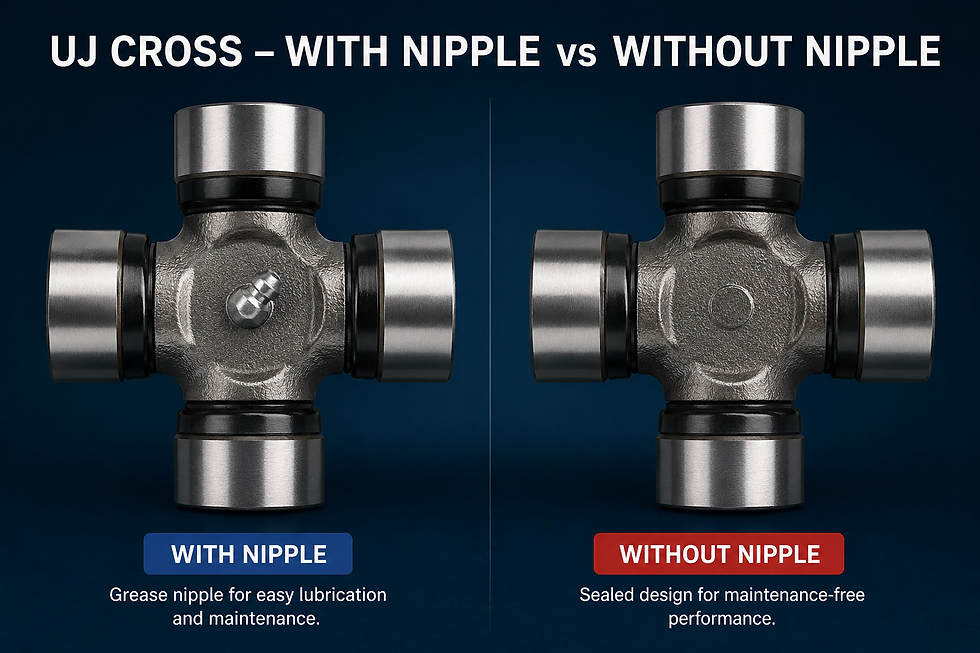
Before you can set a greasing schedule, you need to know which kind of cross is actually fitted — because one type accepts grease and one doesn't.
A serviceable cross has a grease nipple on one of the four trunnions, usually visible once you wipe away surface dirt. Grease injected there travels through internal channels to reach all four bearing cups, which is why correct technique matters as much as the interval itself. Most rotavator PTO crosses, tractor propeller shaft crosses, and a large share of LCV and truck crosses in the Indian aftermarket are serviceable by design, precisely because local operating conditions — dust, water crossings, heat — demand periodic re-lubrication rather than a one-time fill.
A sealed cross has no nipple. It's factory-packed with a permanent grease fill and sealed to keep that fill in and contaminants out for its service life. You cannot and should not attempt to grease one — there's no path in, and forcing grease at a non-existent nipple point, or drilling one, defeats the seal design entirely. If your cross has no nipple, your maintenance is inspection for play and seal integrity, not a greasing interval.
Check the trunnions on all four points before assuming either way — some crosses are greaseable on one axis only. MOD's Complete Guide to UJ Cross goes deeper into manufacturing and fitment differences between the two designs if you want the fuller technical picture; here, the interval is what matters most.
The Right UJ Cross Greasing Schedule by Usage Type
Intensity, dust exposure, and operating angle all differ enormously across applications, which is why a single "grease it every few months" rule fails almost everyone. Use these as your baseline and tighten the interval whenever conditions run harsher than typical.
Rotavator / PTO shaft use
Rotavator PTO shafts see some of the hardest duty-cycle exposure of any UJ cross application in Indian agriculture — MOD's earlier look at the rotavator UJ cross's role in agricultural power explains why this specific joint absorbs so much stress. For greasing:
Grease before every day of continuous rotavator operation during peak ploughing or puddling — PTO shafts run at high RPM under constant load, and field dust is the fastest contaminant source of any application here.
At minimum, grease every 20-50 hours of actual running time, not calendar days, since rotavator use is seasonal and bunched into short, intense windows.
After any wet-field or waterlogged-soil operation, grease again immediately regardless of hours run, since water ingress displaces grease fast.
Tractor with trolley (field and short-road use)
Grease every 100–150 km of trolley use, or weekly during active haulage periods, whichever comes first.
A loaded trolley on uneven field roads puts more angular stress through the cross than steady highway driving does, even at lower speeds.
LCV driveline (city and short-haul use)
Grease every 5,000 km or every three months, whichever comes first, for typical city and short-haul LCV duty.
Stop-start city driving with frequent tight turns increases articulation angle and cycle count more than steady running does.
Heavy truck (long highway routes)
Grease every 10,000–15,000 km, or roughly every service interval, for consistent highway running.
Cut that interval in half for trucks regularly running overloaded, on poor road stretches, or through monsoon conditions — load and surface quality affect a cross more than raw distance alone.
These are starting points, not fixed law. A cross running through a dust-heavy stretch or a hard monsoon needs attention sooner than the calendar suggests, whatever the application.
Step-by-Step: How to Grease a UJ Cross Correctly
Getting the interval right doesn't help if the technique is wrong. Follow this sequence every time, whether you're under a rotavator PTO shaft or a truck driveline.
Clean before you grease. Wipe all accumulated dirt and old grease off the cross body and away from the nipple before connecting a grease gun — pushing dirt into the joint along with fresh grease defeats the purpose entirely.
Confirm it's serviceable. Check that the cross has a visible nipple before proceeding; if it doesn't, stop here and see the sealed-versus-serviceable section above.
Seat the grease gun coupler fully onto the nipple so grease doesn't spray sideways and waste pressure, and pump in slow, steady strokes rather than fast bursts.
Watch all four cups, not just the nipple end. Correct greasing purges old grease and contaminants out at the seal of each of the four bearing cups in turn — stop the moment grease appears anywhere, and the far cups likely haven't been flushed at all.
Articulate the joint while greasing where possible. Move the shaft or implement through its range of motion during or immediately after greasing so fresh grease distributes across the full bearing surface, not just the entry point.
Wipe off the purged grease once all four cups show fresh grease emerging — leftover grease on the outside collects dust and grit, which then works its way back toward the seals.
Recheck for smooth articulation. A properly greased cross should move freely through its full angle with no roughness or tight spots; if you feel resistance, inspect further before returning it to service.
Skipping step four is the single most common shortcut in propeller shaft greasing — and the reason a lot of "regularly greased" crosses still fail early, because only one of the four bearing points was ever actually reached.
Signs You've Gone Too Long Without Greasing
A dry-running cross gives some warning before it seizes completely, though not much. Catch these early and a proper greasing and inspection can usually save the part; miss them and you're looking at a full replacement, often along with the yoke it damaged on the way out.
Dry, gritty resistance when you try to articulate the joint by hand, instead of smooth, even movement through its full range — this is usually the clearest early sign.
A faint knocking or clicking at low speed or low load, which tends to disappear as speed increases and vibration masks it.
Visible discoloration or dried, crumbly grease at the nipple or cup seals instead of soft, fresh-looking grease.
A slight but noticeable vibration through the shaft or implement that wasn't there before, especially at specific RPM ranges.
If you're already hearing a persistent knock, feeling a rhythmic vibration tied to shaft speed, or noticing real play in the joint by hand, greasing alone won't fix it at that point — that's a diagnose-and-replace situation, not a maintenance one, and worth having a workshop confirm before you put the machine back to heavy use.
Common Greasing Mistakes That Actually Cause Damage
Some greasing habits are worse than skipping the interval entirely, because they actively damage the joint while looking like diligence.
Using the wrong grease type or consistency. General-purpose grease that isn't rated for high heat and dust breaks down faster under Indian summer conditions, leaving the bearing running dry again within weeks of a "fresh" greasing. A lithium-complex or calcium-sulfonate grease rated for high-temperature, water-resistant service is the right baseline for most cross bearing kit grease needs here.
Over-greasing. Pumping well past the point where fresh grease appears at all four cups doesn't add protection — it builds pressure that can blow out seals, which then lets contaminants in faster than before. More grease isn't a substitute for the right interval.
Greasing without articulating the joint. Injecting grease into a static, unmoving cross only lubricates whatever sits directly in its path. Move the joint through its range during or right after greasing so grease reaches the load-bearing surfaces of all four trunnions.
Missing one or more cups entirely. This is the single most damaging habit on this list — stopping the moment any grease appears, rather than confirming all four cups purge. A cross "greased regularly" but only ever reached at one or two points fails just like one never greased at all.
Ignoring a nipple that won't take grease. A nipple that suddenly resists grease usually signals a blocked channel or an already-failing bearing — not something to force past with more pressure.
Missing cups is worth repeating on its own: it creates the illusion of maintenance while leaving three-quarters of the bearing surface exactly as dry as if no one had ever touched it.
Good Maintenance Still Needs Good Parts
Even a textbook greasing schedule can't compensate for a cross that was never built to spec. Soft or inconsistently heat-treated steel wears at the trunnions faster than lubrication can protect against, loose-tolerance bearing cups let contaminants past the seal regardless of how carefully you grease, and mismatched dimensions put uneven load through the joint from the day it's installed. Maintenance and part quality solve two different problems — one doesn't substitute for the other.
This is also where a poor-quality or mismatched cross shows up fastest: not on day one, but a few months into an otherwise correct greasing routine, once the underlying material or tolerance issue finally catches up with it. MOD's crosses are manufactured to OEM-grade specification precisely so that the greasing schedule in this guide actually delivers the extended service life it's designed to — the maintenance only pays off if the part underneath it was built to last in the first place.
FAQ
How often should I grease a UJ cross on a rotavator?
Grease before every day of continuous operation during peak ploughing or puddling season, and at minimum every20-50 hours of actual running time. Field dust and constant PTO load make rotavator crosses the fastest-wearing application in this guide if greasing is skipped.
Is the greasing interval different for a tractor pulling a loaded trolley versus a truck on the highway?
Yes, significantly. A tractor-trolley combination on field roads needs greasing roughly every 100–150 km or weekly during active use, while a highway truck on smoother routes can typically go 10,000–15,000 km between greasings, though overloading or monsoon running should cut that interval in half.
How do I know if my UJ cross is sealed or serviceable?
Check all four trunnions for a grease nipple. If you find one, it's serviceable and needs periodic greasing on the schedule above. No nipple means it's sealed-for-life and factory-packed — your job there is inspection, not lubrication.
What kind of grease should I use for a UJ cross in Indian conditions?
A high-temperature, water-resistant grease — lithium-complex or calcium-sulfonate based — holds up better to summer heat and monsoon exposure than general-purpose grease. The specific brand matters less than making sure it's rated for both heat and moisture.
Can I over-grease a UJ cross?
Yes. Pumping well past the point where fresh grease appears at all four cups builds pressure that can damage seals rather than adding protection. Stop once each of the four cups purges fresh grease.
What's the correct way to grease all four cups, not just the nipple side?
Pump in slow, steady strokes while watching each cup in turn, and articulate the joint during or right after greasing so fresh grease actually spreads across the load-bearing surfaces rather than pooling near the entry point.
What are the earliest warning signs that a cross needs greasing?
Dry, gritty resistance when you move the joint by hand, discolored or crumbly grease at the seals, and a faint knock or click at low speed are usually the first signs — well before any serious vibration sets in.
Can a UJ cross fail even if it looks fine from the outside?
Yes, and this is the most common surprise owners report. A cross can run dry internally for weeks with no visible damage, then seize or develop play suddenly once the needle rollers have worn enough. Outward appearance isn't a reliable indicator of internal lubrication.
What does neglecting UJ cross greasing actually cost, beyond the part itself?
A seized or worn cross often takes the yoke and sometimes the shaft with it, turning a low-cost part replacement into a much larger repair — and the downtime, whether a missed sowing window or a truck pulled off route, is usually the bigger cost of the two.
Shop UJ Cross Parts by Application
Rotavator & Tractor PTO Applications Browse the Rotavator Parts range for PTO shaft crosses, yokes, and triangular tube sets across Shaktiman, Sonalika, and Tata 1210 fitments.
LCV, Heavy Truck & Off-Highway Driveline
MOD Part No. | Application | Notes |
Eicher Canter N/M, Swaraj Mazda, Tata LPT/SFC 909/709 EX/407EX, LPK, Tipper | Long bearing cup design | |
Canter N/M, Swaraj Mazda, Canter 10.75 / 11.10 / 10.90 / 11.90, L/L Comet | ||
4122A | Tata 4928-S / Prima, Volvo SM-7 / SM-9 & Volvo 400 SPR 2045, RSB 590 | See UJ Cross category for current listing |
4122 | AMW Truck | See UJ Cross category for current listing |
Tata 4923, 57mm x 152mm, SPR 2055, RSB 620 | ||
4113 | AMW Truck 4923 / 4930 | See UJ Cross category for current listing |
4108 | Tata Novus (Spicer type), 1810 series | See UJ Cross category for current listing |
4104GL / 4104GP | Ashok Leyland 2214 / 3516 / 2516 / 3116 / 1616, Tata 2515 TC (EX) / 2518 | Front and rear variants |
Ashok Leyland Tauras 2516 / 3516 | Circlip design | |
4104P | Ashok Leyland Tusker, Leyland-Hino, Eicher 1612 | See UJ Cross category for current listing |
4104A | Tata 1109 / 909 BS-III | Spicer type |
Tata 1210 / 608 / 609 / 807 / 407 N/M, rear | ||
4203AP | Maruti Van | Inner lock |
4090P | Bedford J-4, Ashok Leyland 370, Shaktiman N/M | See UJ Cross category for current listing |
4090QA | Toyota Qualis / Tavera O/M | See UJ Cross category for current listing |
Front teeth, Tata 1109 / 909 BS-III | Yoke teeth component | |
Tata 1312 N/M, Tipper | Cross holder | |
Ashok Leyland 2516, Volvo, MAN | Long fork & teeth, Teflon-coated, 15" | |
Tata LPS 4928, LPTA 3138, LPK 528 L/L 3119N, BharatBenz 2523C / 2528C / 3128C | Cross holder |
This is a representative sample from an active catalogue of hundreds of SKUs across the Propeller Shaft range.
For the full range across every fitment MOD stocks, browse the Universal Joint Cross category directly.
Set the schedule, follow the technique, and the cross does its job quietly for years — that's the whole point of maintenance done right. When it does eventually need replacing, MOD Plus has supplied OEM-grade UJ crosses across the Indian aftermarket since 1978, from our Delhi hub to every state pan-India. Browse the full UJ cross range when you're ready.


Comments