

Propeller Shaft Failure While Driving: What Really Happens on the Highway
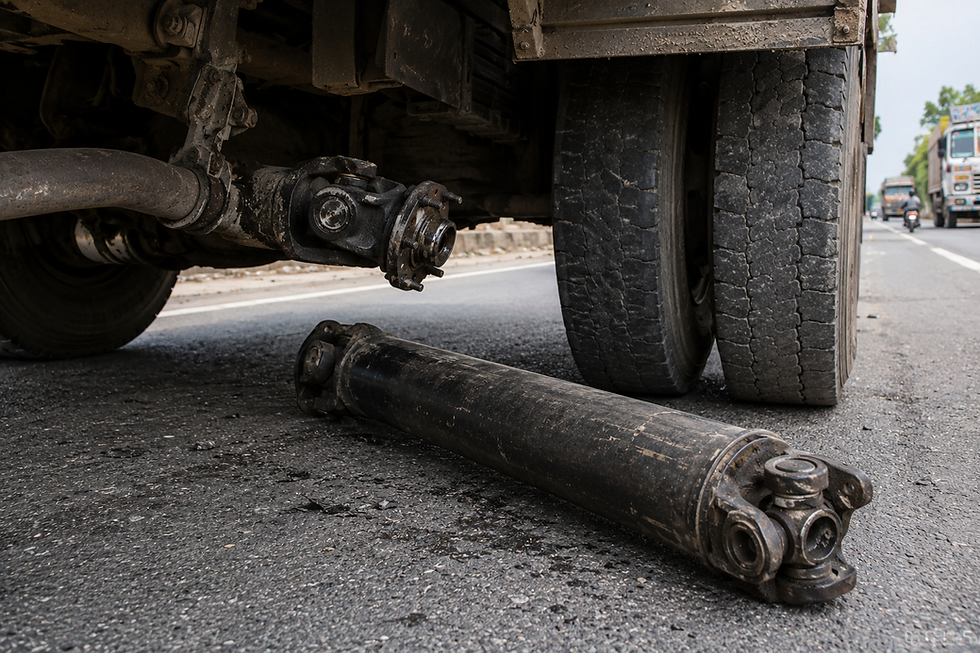
Table of Contents
It's an ordinary weekday afternoon on NH48, somewhere between Ajmer and Kishangarh. A loaded Tata truck holds a steady 70 km/h in the outer lane — engine humming, another routine haul. Then, without warning, the drive goes slack. The engine note rises even as the truck stops gaining speed, and a sharp metallic clatter rises from underneath.
Somewhere along that truck's driveline, a component has just let go. Propeller shaft failure while driving is uncommon, but it happens — and understanding exactly what occurs in that moment is what turns a vague warning label into something drivers and fleet owners actually respect. MOD Plus, an OEM-grade propeller shaft supplier serving India's commercial and agricultural vehicle sector from Sanjay Gandhi Transport Nagar, Delhi, since 1978, put this account together for exactly that reason.
What's Actually Happening Mechanically the Instant a Propeller Shaft Fails While Driving
A propeller shaft's only job is carrying rotational torque from the gearbox to the differential, and from there to the wheels. It does this spinning at several hundred RPM, held in line by universal joints and support components that allow for small changes in angle and length as the vehicle moves. (For the foundational rundown of the part itself, MOD's Propeller Shaft — The Complete Guide covers construction and terminology in full.)
When one of these components — most often a UJ cross, a worn yoke, or the shaft tube itself — gives way completely, that mechanical chain breaks in an instant. For the full breakdown of the UJ cross specifically and how it's replaced, see MOD's vehicle-side UJ cross guide; this piece stays focused on the failure event itself.
The immediate, defining consequence is loss of drive: the wheels stop receiving power. Because the engine is suddenly disconnected from the resistance the wheels used to provide, revs can flare upward even as the vehicle's speed starts to bleed off — a distinct, disorienting mismatch between what the engine sounds like and what the vehicle is actually doing.
What happens to the shaft itself depends on exactly where and how it lets go. If a UJ cross shears, the two sections of the shaft can separate at that joint. If the shaft tube itself fractures, both ends can drop toward the road. A disconnected propeller shaft is no longer held in a fixed line by torque, and in some failures the loose end strikes the underside of the vehicle or the road surface as the wheel continues to turn — producing the sharp bang, clatter, or scraping sound drivers describe as the first sign something has gone seriously wrong.
This is usually accompanied by a burst of vibration through the floor and seat as the sudden imbalance briefly resonates through the chassis, followed by the steadier, duller sensation of a vehicle coasting on momentum alone rather than under power. None of this unfolds gradually — it's a mechanical event measured in a second or two, not a slow decline. What happens next depends far more on the driver's response than on anything else.
What the Driver Experiences and What to Do
From the driver's seat, a propeller shaft failure registers first as a sound and a sensation, not a visual cue. There's typically a bang or clatter from underneath, a jolt of vibration, and the unmistakable feeling of the vehicle no longer responding to the accelerator the way it did a second ago — the engine may even sound like it's revving harder while the road speed stays flat or drops.
This is not a steering event. A propeller shaft carries drive, not steering input, so the vehicle should still turn and brake normally. The real risk is a startled, oversized reaction to the noise and sudden power loss.
Ease off the accelerator gently, avoid sudden braking or sharp steering input, and let the vehicle's own momentum carry it toward the shoulder before bringing it to a controlled stop. Switch on hazard lights as soon as it's safe to do so. Once stopped well clear of the carriageway, resist the urge to look underneath the vehicle without proper jacking and support — a shaft that has failed can still be under residual load or resting at an odd angle.
This is a highway breakdown to be managed calmly, not a crisis to be fought against. Drivers who ease off and let the vehicle coast to a stop consistently have an easier, safer outcome than those who react sharply.
Why This Almost Never Happens Without Warning First
A complete propeller shaft failure at highway speed is the end point of a process, not a random event. In the overwhelming majority of cases, the component that ultimately gives way has been showing propeller shaft warning signs for some time beforehand — play in the joint when rocked by hand, a faint knock on acceleration or deceleration, a low vibration that builds with road speed, or grease staining around a cross that should be sealed.
Two forces do most of the damage that eventually leads to this point: the loads a shaft is asked to carry, and the roads it carries them over. MOD's detailed piece on how overloading and Indian road conditions silently kill propeller shaftswalks through exactly how excess load, potholes, and unpaved stretches accelerate wear long before a driver notices anything is wrong.
The practical implication is a hopeful one: a sudden failure like the one described above is very rarely the first sign of trouble. It's usually the last one — reached only after earlier signs went unnoticed or unaddressed.
What This Actually Costs — Beyond the Repair Bill
The part itself is rarely the largest cost of a propeller shaft failure. A breakdown on NH48 or any other highway means the vehicle is off the road entirely — not slowed down, not limping to a workshop, but stationary and needing to be towed, since there's no drive to the wheels at all.
For a commercial fleet, that translates into towing charges, workshop time, and a vehicle that isn't earning while it's off the road. If the vehicle was carrying a scheduled load — perishables, a committed delivery window, a return trip already booked — the disruption cascades outward to the cargo owner and the next job in the schedule, not just the fleet's own ledger.
There's also a safety dimension that doesn't show up on any invoice: the time spent stopped on or near a live carriageway, arranging recovery, is itself a period of elevated risk that a driver would rather not be in. None of this requires exaggeration to make the point — a failure on the road is simply a more expensive, more disruptive, and less controllable event than a scheduled replacement in a workshop.
The Real Takeaway: This Is Preventable
Everything described above — the loss of drive, the noise, the roadside wait — sits at the end of a chain that usually starts months earlier with a worn joint nobody replaced yet. That's the genuinely useful part of this story: propeller shaft safety is not a matter of luck. It's a matter of maintenance discipline.
A shaft or UJ cross that's inspected on schedule, greased correctly, and replaced at the first sign of play or noise essentially removes this scenario from the list of things a driver needs to worry about. The mechanical event described in this article is dramatic to read about specifically because it's avoidable — every one of the warning signs that precedes it is something a driver, mechanic, or fleet manager can catch during routine attention to the vehicle.
That shifts the real question from "what if this happens to me" to a much more practical one: what condition is the propeller shaft on your vehicle in right now.
Why MOD's Propeller Shaft Components

Preventing the scenario described above comes down to one thing: correct, well-made parts fitted before wear becomes failure. This is where MOD Plus's propeller shaft range is built to do the actual work of prevention, not just replacement.
MOD's coverage spans the vehicle types that make up the bulk of India's commercial road transport — from Tata 407-class light commercial vehicles and pickups through Tata's 709, 909, 1109, and 712 range, up through heavy commercial trucks including the Tata 1210 to 4018 series, Leyland Tauras and interstate models, Eicher Galaxy, and Bharat Benz platforms. Within each application, the range covers the specific components that make up a propeller shaft assembly — UJ crosses, yokes and yoke teeth, cross holders and flanges, long forks, and sleeve bottles — rather than a generic one-size-fits-all part that compromises fitment to save on catalog complexity.
Every component is manufactured to OEM-grade standards: correct steel specification, precision machining, and — on grease-less and Teflon-coated variants — the surface treatments that reduce maintenance burden and extend service life under the heat, dust, and load cycles typical of Indian commercial operation. This matters because propeller shaft replacement in India isn't a one-time transaction; it's an ongoing relationship between a fleet's duty cycle and the parts that have to withstand it, application after application, route after route.
Correct fitment is the actual safeguard against everything described earlier in this article. A part that's the wrong length, the wrong spline count, or built to a lower material standard doesn't just wear faster — it can introduce exactly the kind of premature failure risk this piece has walked through. Sourcing from a single, established supplier who documents fitment by exact vehicle model, rather than mixing components of uncertain origin or approximate compatibility, removes that variable from the equation entirely.
That's the practical case for MOD: nearly five decades of specializing in this specific category, a catalog organized by vehicle model rather than guesswork, and pan-India distribution from Sanjay Gandhi Transport Nagar, Delhi, so that a fleet in any state can source the same OEM-grade component consistently rather than substituting whatever's locally available. For a part responsible for carrying drive to the wheels at highway speed, that consistency is the whole point.
FAQ
What happens if a propeller shaft breaks while driving?
The wheels instantly stop receiving power from the engine, so the vehicle loses drive. The engine's revs can flare up momentarily because the load it was pushing against is suddenly gone, and there's usually a sharp bang, clatter, or scraping noise as the disconnected shaft moves on its remaining mounts. The vehicle then coasts on momentum rather than power.
Can a propeller shaft failure cause loss of vehicle control?
A propeller shaft failure affects power delivery to the wheels, not steering. The main risks are the sudden noise and vibration startling the driver into an abrupt reaction, and the loose shaft potentially striking the vehicle's underside. Calm, gradual driver response is the key factor in keeping the vehicle stable and headed toward a safe stop.
What does a propeller shaft failure sound or feel like?
Drivers typically describe a sudden metallic bang, clatter, or grinding/scraping sound from underneath the vehicle, a burst of vibration through the floor and seat, and a distinct mismatch where the engine note rises but the vehicle stops accelerating or gaining speed.
Is it safe to keep driving after a propeller shaft makes noise?
No. Unusual driveline noise or vibration is one of the propeller shaft warning signs that typically appears well before a complete failure. Continuing to drive on a shaft showing these symptoms increases the chance of a failure event happening at an unpredictable moment, including at highway speed.
What should I do if my propeller shaft fails on the highway?
Ease off the accelerator gently, avoid sudden braking or sharp steering input, turn on your hazard lights, and use the vehicle's remaining momentum to guide it toward the shoulder before coming to a controlled stop. Do not attempt to inspect or move the vehicle underneath it without proper support.
How much does propeller shaft failure repair cost in India?
Cost varies significantly by vehicle type, which component failed, and whether secondary damage occurred to the differential, gearbox output, or underbody. Beyond the part and labour cost, towing, vehicle downtime, and schedule disruption typically add to the total, which is why early replacement of a worn component is usually far cheaper than a roadside failure.
What usually causes a propeller shaft to fail suddenly?
A sudden failure is almost always the end point of gradual wear — a worn UJ cross, a fatigued yoke, or a shaft that has been running with early-stage damage for some time. Overloading, rough Indian road conditions, contamination, and delayed maintenance all accelerate this wear.
How can I prevent propeller shaft failure?
Regular inspection for play, noise, or vibration; keeping to rated load limits; timely greasing; and replacing worn components with correctly fitted, OEM-grade parts rather than waiting for symptoms to worsen are the main defenses. Propeller shaft safety in commercial and agricultural operation comes down to consistent, unglamorous maintenance.
What's the difference between a UJ cross failure and a full propeller shaft failure?
A UJ cross failure is one specific type of driveline failure — the cross joint connecting two sections of the shaft gives way. A full propeller shaft failure can result from a UJ cross failure or from other causes, such as a fractured shaft tube or a failed support bearing, and generally has the same practical outcome: loss of drive to the wheels.
Where can I buy genuine propeller shaft replacement parts in India?
MOD Plus supplies OEM-grade propeller shaft replacement parts across India — UJ crosses, yokes, cross holders, long forks, and sleeve bottles — for LCV and heavy commercial vehicle applications, distributed pan-India from its Delhi base.
Shop MOD Propeller Shaft & UJ Cross Components by Vehicle Type
Light Commercial Vehicles (Tata 407 range, 709/909/712/1109, Eicher E2)
Tata 407 Turbo N/M bearing assembly — bearing no. 6207/88507, coated (Part 13909A-2)
Tata 407 Turbo N/M MSL-type bearing assembly — bearing no. 6207/88507, coated (Part 14020-B)
Tata 407 Turbo / 709 / 909 bearing assembly — bearing no. 6208/8850
Tata 407 Turbo Cityride bus & 709/909 bearing assembly, coated (Part 13910-B)
Eicher E2 yoke & teeth set, Teflon-coated, without bearing (Part 14017C)
Tata 712 Turbo bearing assembly — bearing no. 6210/88510, coated (Part 13878B)
Tata 1109 bearing assembly — bearing no. 6209/88509, coated (Part 13869D)
Heavy Commercial Vehicles & Trucks (Tata 1210–4018 range, Leyland, Eicher Galaxy, Bharat Benz)
Leyland Tauras 2516/3516 UJ cross, circlip design (Part 4104EP)
Tata LPK 2521 / Spicer 2045 yoke & teeth, Teflon-coated (Part 15939B)
Tata 2516 / Volvo / MAN long fork & teeth, Teflon-coated, 15" length (Part 15930D)
Tata 2515 EX / 1613 Turbo long fork, RSB 325 series (Part 15342)
Tata 2518 long fork with dust cover, RSB 403 series, medium (Part 15342B)
Tata 4018 long fork with dust cover, RSB 490 series (Part 15718B-1)
Tata LPS 4928 / Bharat Benz 2523C / 2528C cross holder (Part 15718-I)
Tata 4018/3118 long fork, RSB 490 series, long (Part 15720A)
RSB-325 series yoke & teeth, coated, 12.5" length (Part 15362-I)
Tata 4018 long fork, RSB 490 series, extra long (Part 15718GC)
Tata LPS 4928 / LPT-3138 / Bharat Benz 2523C long fork (Part 15718H-2)
Tata 2518 sleeve bottle, RSB 403 series, extra long, coated (Part 15342ET)
Tata 3118/4018 rear teeth, extra long, full spline, coated (Part 15362B-2)
Tata 2525 EX / 2518 / Eicher Galaxy rear teeth, big (Part 15316)
Tata 2525 EX / 2518 / Eicher Galaxy rear teeth, big, coated (Part 15316B)
Get the Right Propeller Shaft Component Before It Fails
A propeller shaft rarely fails without warning first — but it only takes one missed sign for a routine drive to become a roadside emergency. Talk to MOD Plus for OEM-grade propeller shaft components fitted correctly to your exact vehicle, pan-India.
Written by the MOD Plus Technical Team Reviewed for technical accuracy by MOD Plus's in-house technical team.


Comments