

Rotavator PTO Shaft Explained: Parts, Speed (540 vs 1000 RPM) and Safety

In this guide
What is a PTO shaft, and why does it come up the moment a rotavator goes on a tractor? It is the rotating link that carries engine power from the tractor to the rotavator's gearbox. Mismatched or left unguarded, it is also a well-documented farm safety hazard.
This guide explains the rotavator PTO shaft as one complete assembly: how it connects the machine, what PTO speed at 540 and 1000 RPM means, and the safety habits that matter.
MOD Plus has supplied OEM-grade driveline components from Sanjay Gandhi Transport Nagar, Delhi, since 1978, shipping across India. MOD sells the individual components that make up a PTO shaft, not an assembled unit.
What Is a PTO (Power Take-Off), and What Is the PTO Shaft?
PTO stands for power take-off. On a tractor, it is the splined output stub at the rear that spins when the PTO lever is engaged, letting the engine drive an implement instead of only the wheels. Rotavators, threshers, balers, and PTO-driven pumps all work this way. Most farmers first meet the shaft while fitting a rotavator, when it is locked onto the tractor stub before work begins.
The PTO shaft is the jointed, telescoping shaft that links that tractor stub to the implement input shaft on the machine. You will also hear it called a tractor power take-off shaft or a PTO drive shaft. It is built from several separate components, which is why a worn part can be replaced without replacing everything else.
It has to do three jobs at once: carry torque, accept the changing angle between tractor and implement, and change length as the implement moves. A single rigid rod cannot do that, so the shaft uses universal joints, yokes, and a sliding section instead.
One distinction is worth drawing early. The propeller shaft on a truck or other vehicle carries power from the gearbox to the differential. It shares parts such as the UJ cross, but it is a separate system, covered in MOD's complete propeller shaft guide. This article stays with the tractor and implement end.
How the PTO Shaft Connects a Tractor to a Rotavator
The drive runs in a line from engine to soil. The engine turns the tractor's PTO stub. The tractor-end yoke of the shaft slides onto that stub and locks. The shaft carries the rotation back to the rotavator, where the implement-end yoke locks onto the gearbox input shaft. Inside the gearbox the speed is stepped down and passed on to the rotor and its blades.
The tractor and rotavator never hold a fixed relationship, because the rotavator hangs from a three-point linkage. Lifting at the headland, turning, and uneven ground all change both the angle and the distance between the two splined ends.
A universal joint at each end absorbs the change in angle, and the telescoping section absorbs the change in length. Shock loads from stubble, stones, and hard ground also travel back through the rotor and gearbox to the shaft, which is why its joints and yokes are built heavy and why a worn part shows up quickly as vibration.
Two practical points follow. The shaft must be the right length for the rotavator: too long and it can bottom out when the implement is raised, too short and the two halves can pull apart. And keeping the joint angle moderate while the PTO is turning, especially when lifting the rotavator at turns, reduces strain on the crosses and the vibration that follows. The implement manual usually sets limits for this.
The Main Components, Briefly
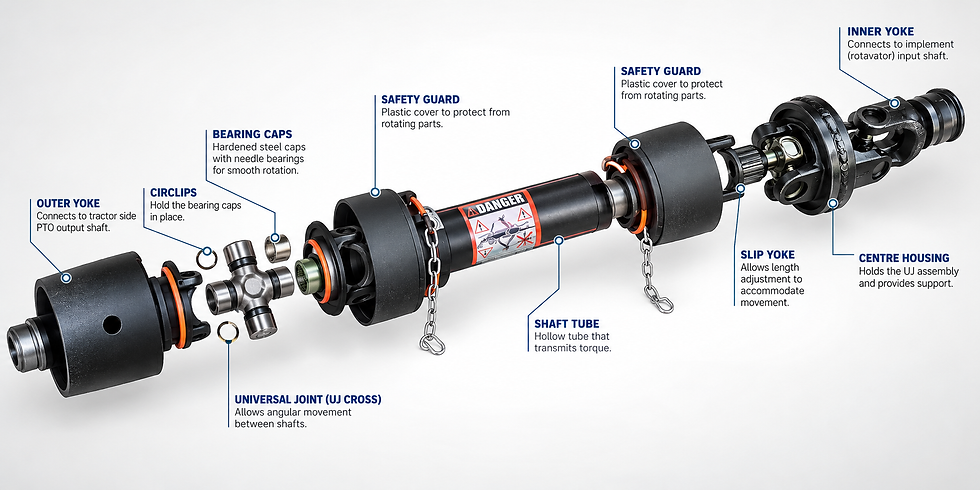
Think of the PTO shaft as five parts in a line: three do the mechanical work, and two protect the machine and the operator.
Universal joint cross
The cross sits inside each yoke pair and lets the shaft transmit power while the angle changes. It is a common wear item because it carries every load spike. MOD's guide to what a UJ cross is and how to replace it covers the vehicle side, and its piece on why the rotavator UJ cross is the backbone of the drive covers the implement side. Hindi readers can follow the step-by-step रोटावेटर क्रॉस कैसे बदलें guide.
Yoke
A yoke is the forked connector that holds the cross, with its other end locking onto the tractor stub or the gearbox input shaft. Yokes differ by lock style, bore, and tooth count, so the right one depends on the machine. MOD's explainer on how yokes work in drivelines and rotavators covers the role in more depth.
Telescoping section
Two nested tubes slide together to change the shaft's length. MOD's catalogue lists these rotavator tubes as triangular tube sets. The same sliding-joint job on a vehicle propeller shaft is done by a sleeve bottle and long fork, which MOD explains in what each of the sleeve bottle and long fork does.
Overload element and shield
Many rotavator shafts include a shearing bolt yoke, built so the bolt shears under overload and protects the drive line. Every shaft should also carry a full-length PTO shield, also called a driveline guard, covered in the safety section below.
PTO Speed Standards: 540 RPM vs. 1000 RPM, and Why It Matters
PTO speed is how fast the tractor's output stub turns, measured in revolutions per minute. Two figures are widely used as standards: 540 RPM, generally the speed on small and mid-size tractors and the usual choice for rotavators in India, and 1000 RPM, typically found on higher-horsepower tractors and heavier implements. Some tractors offer both.
The tractor normally marks the engine speed at which the PTO reaches its rated speed, often on the tachometer. Running the engine at that mark, rather than at a random throttle setting, is how the rated PTO speed is actually delivered.
A rotavator gearbox is designed around one input speed. Run it faster and the gears, bearings, and shaft work harder than they were built to, with extra heat, stress, and a higher risk of failure. Run it slower and the rotor turns slowly, tillage quality drops, and the same power passes through the shaft as higher torque, which can strain crosses and yokes.
Match the PTO speed of the tractor to the speed rating of the rotavator and its shaft before you couple them; read the implement's plate or manual instead of assuming.
The two speeds also use different stub splines. A 540 RPM stub typically has 6 splines, while common 1000 RPM stubs typically have 20 or 21. MOD lists rotavator yokes by tooth count, with 6, 10, and 21-teeth versions, so check your tractor's stub before choosing a replacement. Never force, adapt, or modify a shaft to fit a mismatched pair; the different splines partly exist to stop that mistake.
Size matters as well. MOD's rotavator crosses run from 27 mm to 38 mm, and cross size is part of a shaft's torque capacity, so replace a worn cross with the same size rather than a lighter one.
PTO Shaft Safety: What Every Farmer Should Know
A rotating PTO shaft is a well-documented cause of serious agricultural accidents, and safety bodies around the world treat it as a priority hazard. A spinning shaft can catch loose cloth, hair, or a hand in an instant, and a person cannot pull free.
The UK Health and Safety Executive notes that most PTO accidents are preventable with well-fitted, well-maintained guards and safe working habits. Its guidance on power take-offs and PTO drive shafts is worth sharing with anyone who works near your rotavator.
Always disengage the PTO and switch off the tractor engine before you adjust, inspect, or clear anything on the rotavator.
Do
Keep the PTO shield fitted and intact along the whole shaft, from the tractor end to the rotavator gearbox input.
Replace a damaged, cracked, or missing shield before the machine works again.
Wait until the rotor and shaft have stopped completely before approaching.
Clear straw, stubble, or weeds with a tool, never your hands.
Tie back long hair, and tuck in loose clothing, drawstrings, dupattas, scarf ends, and turban tails.
Confirm both yokes are fully locked before engaging the PTO.
Attach the shield's retaining chains so the guard cannot turn with the shaft.
Follow the manual's limits on lifting the rotavator with the PTO running.
Keep children and bystanders well away from the machine.
Don't
Never step over or lean across a rotating shaft.
Never clear a jam while the shaft is engaged.
Never run the machine with a missing or damaged shield.
Never use the shaft as a step or handhold.
Never couple, adjust, or lubricate while the engine is running.
Paddy straw and stubble wrapping around the rotor is the classic trigger for a dangerous shortcut. The few minutes it takes to stop, switch off, and wait are far cheaper than the alternative. The shield is a separate safety component that should always be present and well maintained; when replacing a damaged one, use a correctly sized shield for your shaft.
Treat this as a family and crew matter. Anyone new to the farm, including a young relative or a seasonal worker, should be shown how to stop the machine safely before they are allowed near the rotavator. The routine takes a minute to teach and protects everyone.
Signs Something's Wrong With a Component
Most PTO shaft trouble announces itself before a part fails. With the engine off and the PTO disengaged, check for these:
A vibration or rhythmic knock that gets worse under load or at turns.
Visible play when you rock a yoke by hand.
Grease leaking or discolouring at the cross cups, or dust packed around them.
A telescoping section that binds when you slide it, or rattles loose.
A yoke lock that no longer seats firmly on the stub or input shaft.
Heat at a joint after a short run.
A worn cross or yoke does not fix itself; it gets worse until it fails in the field. MOD's guide to the 7 signs of a bad rotavator cross explains how to read each warning in more detail. Replace only the component that has worn, and match it to your rotavator's cross size. If more than one sign appears together, stop work and inspect the whole shaft before the next run.
Keeping the Components Running Well
Four habits cover most of it. First, grease the crosses and the sliding section as the implement manual directs, commonly before starting work and again on long working days. MOD's UJ cross greasing schedule sets out the routine, and greaseless crosses need no routine greasing.
Second, clean wrapped stubble and caked mud off the shaft before storage, and rest the shaft on its support rather than on the ground, where the shield can be damaged.
Third, replace worn parts as soon as play shows up. A worn cross loads the yokes and the gearbox input shaft too. Fourth, check that the yoke locks seat fully each time you couple the shaft, because a lock that only half engages can let the shaft work loose under load.
FAQ
What is a PTO shaft on a rotavator?
It is the jointed, telescoping shaft that carries rotation from the tractor's power take-off stub to the rotavator's gearbox input. Universal joint crosses absorb angle changes, a sliding section absorbs length changes, and a shield encloses it.
What does PTO stand for?
PTO stands for power take-off: the tractor output that lets the engine drive an implement. The PTO shaft is the part that carries that power to the machine.
Should a rotavator run at 540 or 1000 RPM?
Most tractor-mounted rotavators in India are generally designed for 540 RPM, while 1000 RPM is typically used on higher-horsepower tractors and heavier implements. The implement's plate or manual gives the correct figure, so use that rather than a guess.
What happens if PTO speed does not match the implement?
Too fast loads the gears, bearings, and shaft with extra heat and stress. Too slow lowers tillage quality and raises torque through the shaft. The different stub splines partly exist to prevent mismatched coupling, so never adapt or force a fit.
Is a PTO shaft the same as a propeller shaft?
No. A propeller shaft carries power from a vehicle's gearbox to the differential, while a PTO shaft carries power from a tractor to an implement. They share parts such as UJ crosses and yokes, but they are separate systems.
Why must the PTO shield always stay on?
The shield keeps clothing, hair, and limbs away from the rotating shaft, which can pull a person in within a moment. Never operate with a missing or damaged shield; replace it first.
Is it safe to clear a rotavator jam with the PTO running?
No. Disengage the PTO, switch off the engine, wait for everything to stop, then clear the jam with a tool rather than your hands.
How often should the PTO shaft components be greased?
Follow the implement manual. Sliding sections and serviceable crosses are commonly greased before starting work and again during long working days. Greaseless crosses need no routine greasing.
Which part of a PTO shaft wears out first?
The universal joint cross is a common wear item because it carries every load spike, but yokes and the telescoping section wear as well. Rocking each yoke by hand with the engine off shows play early. Replace only the component that shows wear.
Rotavator PTO Shaft Components Available From MOD

Each part below is sold on its own, to rebuild or repair a PTO shaft. Find your rotavator's cross size and yoke type first, then match the part.
Rotavator UJ crosses
Spring yokes
Half yokes and triangular yokes
Plain-bore and solid yokes
Shearing bolt yokes
Telescoping triangular tube sets
Sleeve bottle and long fork
MOD lists these under its Propeller Shaft range, which is vehicle-side, not rotavator-specific. Browse the sleeve bottle range and the long fork and yoke range.
Replace the Specific Component That Is Worn
If this guide pointed to a worn cross, a loose yoke, or a binding telescoping section, replace that specific component with the matching part. MOD Plus has supplied OEM-grade driveline components from Delhi to every state in India since 1978. Browse the rotavator parts range, or message MOD on WhatsApp with your rotavator model.
Written by the MOD Plus Technical Team. Reviewed for technical accuracy by MOD Plus's in-house technical team.


Comments