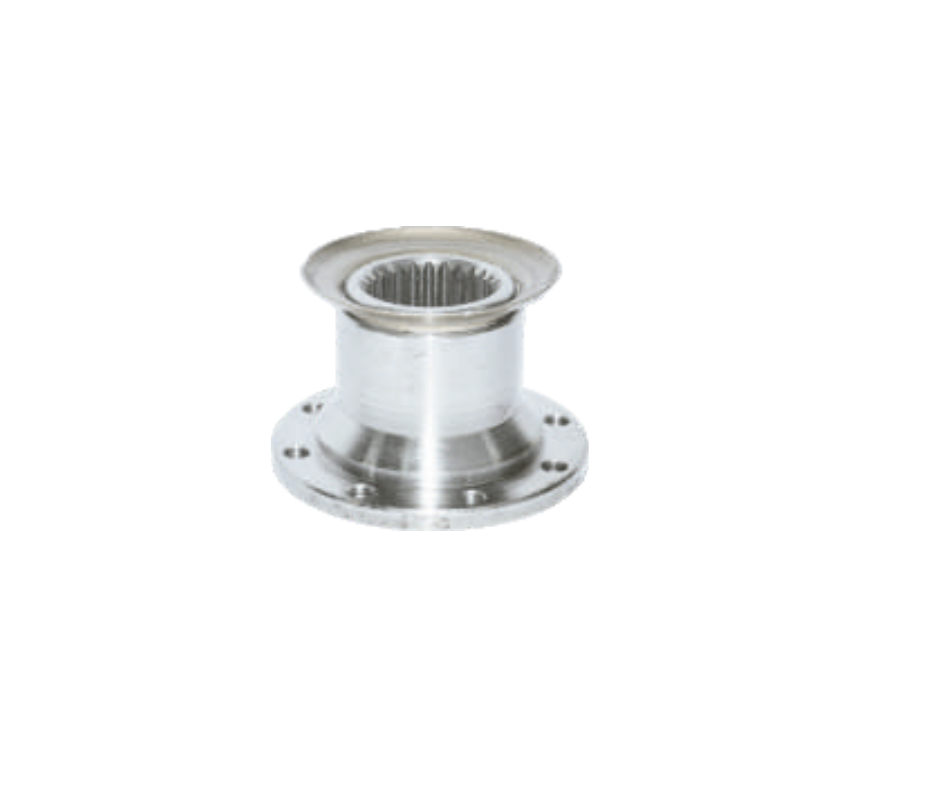
🔩 Gear Coupling – ZF Type (Bell Type) for Leyland/Ashok Leyland Trucks
📌 What a Gear Coupling Is
A gear coupling is a mechanical torque‑transmitting joint that connects two shafts (for example, the gearbox output shaft to the propeller/driveshaft) while accommodating a small amount of angular, radial, or axial misalignment between them. It consists of two flanged hubs with external teeth that connect via a sleeve or bell section with internal teeth to deliver power with minimal backlash.
In truck applications, especially gearboxes made by ZF (ZF transmissions installed on Leyland/Ashok Leyland heavy trucks), such a bell‑type gear coupling is typically used to couple the gearbox output to the driveline flange. These couplings are ruggedly built to handle high torque, vibration, and thermal load in commercial drivetrains.
⚙️ How the ZF Bell‑Type Gear Coupling Works
Serrated / Gear Teeth Interface:
The coupling has meshing teeth (like small gear segments) on both hubs and the sleeve. These teeth interlock to transmit torque effectively, similar to adjacent gears.Bell Design:
In a bell‑type coupling, the outer sleeve resembles a bell or flanged housing — this design helps protect the internal teeth, allows use of lubrication, and distributes forces more evenly across the teeth under load.Flexible Power Transfer:
Unlike a rigid solid flange, gear couplings can handle small misalignments between gearbox output and driveline input — which occur due to engine torque, chassis flex, and suspension movement.
🛞 Where It Fits in an L/L ZF Drivetrain
In vehicles like Leyland L/L series trucks fitted with ZF synchromesh gearboxes (e.g., S5‑36, S6‑36, S5‑45, etc.), this coupling part sits immediately at the gearbox output and provides the mechanical connection to the propeller shaft companion flange:
➡ Gearbox Output → ZF Bell‑Type Gear Coupling → Propeller Shaft → Differential → Axles
This configuration ensures:
Reliable torque transmission from the gearbox to the driveline
Reduction of driveline vibration and backlash
Compensation for slight shaft misalignment
📌 Typical Characteristics
While specific part numbers and dimensions vary by exact ZF gearbox model and truck application, a ZF bell‑type gear coupling flange generally has:
✔ Flanged Gear Hubs: With external gear teeth on both coupling hubs
✔ Internal Gear/Sleeve: A bell‑shaped internal sleeve that mates with the hubs
✔ Lubrication: Often greased internally to reduce wear
✔ High Torque Rating: Designed for heavy commercial use (trucks, buses)
✔ Bolt Pattern: Specific to the ZF gearbox output flange and corresponding driveshaft yoke
These gear couplings are often sold under ZF genuine part numbers for the relevant gearbox (e.g., ZF output flange/coupling kits).
🧠 Why Use a Gear Coupling (Bell Type)?
Compared with simple rigid couplings, a bell‑type gear coupling offers:
⭐ Higher torque capacity for heavy‑truck gearboxes
⭐ Misalignment compensation without excessive vibration
⭐ Long service life due to robust gear mesh design
⭐ Better load distribution across teeth than simple spline flanges
These traits make gear couplings especially suited for ZF transmissions in commercial vehicles where reliability under heavy load and vibration is critical.
📌 Summary
Gear Coupling – ZF Type (Bell Type) for Leyland / Ashok Leyland L/L ZF trucks is a serrated/flanged gear‑to‑gear mechanical coupling used at the gearbox output interface to connect the gearbox to the propeller shaft. Its bell design with internal/external gear teeth allows strong, flexible torque transmission and accommodates slight driveline misalignment — ideal for heavy‑duty truck transmissions.
If you want, I can also help you find the exact OEM part number for the coupling flange for a specific ZF gearbox model (e.g., S5‑36, S6‑36, etc.) used in your Leyland truck — just tell me the gearbox code!