

When Spare Parts Fail: Common Issues and How MOD Prevents Them
- Sargun Sethi
- Aug 20, 2025
- 6 min read


Why Spare Parts Fail More Often Than We Think
When a machine comes to a halt, most operators immediately blame the engine or gearbox. Yet, in reality, the majority of breakdowns occur because of worn-out or poorly designed spare parts. The unsung heroes of tractors, trucks, rotavators, and heavy machinery are not the powerful engines but the smaller components that quietly keep everything in motion. Parts like UJ Crosses, tie rod ends, brake pads, drums, discs, propeller shafts, and yokes are subjected to daily stress, extreme loads, and constant exposure to dust, mud, and weather.
Spare parts fail when they are unable to cope with these demands. A single weak UJ Cross in a rotavator can stop an entire farming operation. A faulty tie rod end in a truck can make steering unsafe on highways. A low-quality brake pad can fade under heat, reducing stopping power and putting lives at risk. These failures are not just technical inconveniences; they translate into financial losses, missed deadlines, and sometimes, dangerous accidents.
The most common reason for spare part failure is the use of substandard materials. Many local market parts are manufactured with low-grade metals that cannot withstand heat, torque, or impact. Another reason is poor precision. Even the smallest deviation in dimension leads to vibrations, misalignment, and excessive wear. Maintenance habits also play a role. Farmers and drivers working long hours often neglect lubrication or replacement schedules, causing parts to wear out before their expected lifespan.
But underlying all of these reasons is one truth: not all spare parts are created equal. The difference between a local part and an OEM-grade part is the difference between constant breakdowns and long-term performance.
The Hidden Costs of Spare Part Failures
At first glance, choosing a cheaper spare part seems like a smart way to save money. A mechanic might offer a locally made UJ Cross or brake drum for a fraction of the price of an OEM part. The vehicle or rotavator runs again, and the operator feels they have saved. But the reality of machinery tells a different story.
Cheap spare parts wear out quickly, forcing frequent replacements. What seemed affordable becomes expensive when the part fails repeatedly. Worse, a failing part rarely fails alone. A substandard tie rod end damages the steering system around it. A weak propeller shaft bearing creates vibrations that crack housings and misalign yokes. A poorly machined brake disc ruins the pads along with it. Suddenly, what was meant to be a cost-saving decision becomes a chain reaction of costly repairs.
Downtime is another hidden cost. For a farmer, losing even a single day in peak sowing or harvesting season can mean a missed crop cycle. For a transporter, a truck stuck on the roadside with a failed component delays deliveries and risks penalties. For contractors, idle construction equipment means lost man-hours and reduced profitability. None of these losses are visible when buying a spare part, but they are felt heavily when failures occur.
There is also the question of safety. A failed UJ Cross in a running vehicle can lock up the driveline, leading to catastrophic accidents. A failed brake drum or pad can lengthen stopping distance and put lives at risk. These are not just mechanical breakdowns—they are risks no operator can afford to take. This is why more and more professionals across agriculture, transport, and construction are moving towards trusted suppliers like MOD, who ensure OEM-level reliability.
Common Spare Parts That Fail and How MOD Reinvents Them
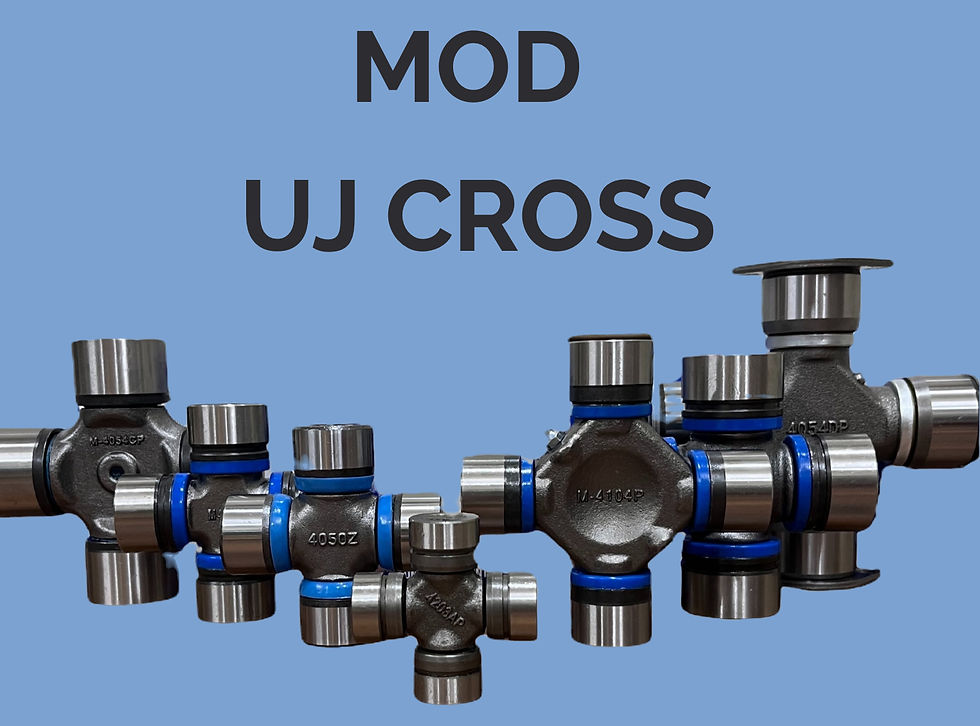
Failures tend to occur in the parts that endure the most stress. The UJ Cross, for example, is constantly transferring torque between misaligned shafts. In rotavators, it handles sudden shocks from hitting stones or hard soil. Local versions of the UJ Cross often break because they are made from weak steel or lack proper heat treatment. MOD solves this by using 20MnCr5 alloy steel, hardened precisely to provide strength at contact points while retaining flexibility in the core. This balance prevents cracking under heavy loads.
Tie rod ends are another weak link. In commercial vehicles, they bear the brunt of steering forces, road shocks, and vibrations. When they fail, steering becomes loose or unresponsive. Local tie rod ends often wear quickly because of poor quality ball studs and seals. MOD’s tie rod ends are built with hardened studs and high-quality dust covers, ensuring longer life and smoother steering control.
Brake systems too are highly vulnerable. Pads that are made with low-grade friction material fade under heat, drums crack, and discs warp. MOD brake components are engineered with high-temperature resistant friction materials and precision machining, guaranteeing consistent performance under repeated braking cycles. For transporters, this means reliable braking on highways; for farmers, it means safety when operating on slopes or muddy ground.
Propeller shafts, yokes, and cross holders also commonly fail when exposed to misalignment and vibration. MOD manufactures them with precision balancing and exact fits, reducing strain on bearings and housings. Every part that MOD produces is designed not just as a replacement but as an improvement over common failures seen in the market.
How MOD Spare Parts Prevent Downtime and Protect Investments
The philosophy at MOD is not just to sell spare parts, but to protect machinery and maximise uptime. Every farmer, fleet owner, or contractor knows that downtime costs more than the price of any single part. That is why MOD focuses on long-lasting, precision-engineered, OEM-grade products.
A farmer using a MOD UJ Cross in a rotavator can finish ploughing the field on time, without worrying about sudden breakdowns. A transporter using MOD brake components can complete long hauls safely without repeated replacements. A construction company using MOD yokes and shafts can keep heavy equipment running without costly downtime. The benefit is not only in avoiding repairs but also in extending the life of the entire machine.
By investing in quality parts, operators save in three ways: fewer replacements, reduced damage to surrounding components, and minimized downtime. In the long run, MOD parts prove more affordable than any cheap alternative. This is why MOD has become a trusted name across India, supplying spare parts not just for tractors and rotavators but also for trucks, buses, and heavy machinery.
The MOD Promise: Reliability in Every Component
MOD’s reputation has been built over years of supplying spare parts that deliver consistent performance in the toughest conditions. Every UJ Cross, tie rod end, brake pad, drum, disc, and propeller shaft component goes through rigorous testing before it reaches the customer. The goal is simple: when a machine is fitted with a MOD part, it should perform as well as, or better than, the original.
Another strength of MOD is its wide compatibility. Farmers using Sonalika or Shaktiman rotavators, transporters driving Tata or Mahindra trucks, and contractors running JCBs can all find the right part within MOD’s catalog. This broad coverage ensures that operators no longer have to depend on local, inconsistent suppliers.
But beyond the technical details, MOD’s promise is about trust. Farmers trust that their machines will keep running in critical harvest season. Transporters trust that their trucks will deliver safely. Contractors trust that their machines won’t let them down mid-project. At MOD, every part is not just steel and engineering—it is a guarantee of reliability.
Conclusion: Failures Can Be Prevented
Every operator knows the frustration of a machine failing at the wrong time. But failures are not inevitable. They are often the result of poor-quality spare parts that were never designed to handle real-world demands. By choosing OEM-grade components from MOD, farmers, transporters, and contractors move from constant repairs to smooth, worry-free operations.
MOD has shown that durability is not about chance—it is about design, materials, and precision. From the smallest UJ Cross in a rotavator to the largest propeller shaft in a truck, every part reflects the same commitment to quality. In the long run, it is not just about replacing a spare part; it is about protecting an investment, ensuring safety, and securing productivity.
When spare parts fail, everything stops. But with MOD, machines keep moving, fields keep producing, and roads keep running. That is the real difference of choosing reliability over compromise.

For more information visit our website.


Comments