

UJ Cross vs. Grease-less UJ Cross: Which One Should You Choose?
- Sargun Sethi
- Aug 17, 2025
- 6 min read

n the world of drivelines and power transmission, few components are as critical yet as underestimated as the UJ Cross (Universal Joint Cross). Whether it’s powering the propeller shaft of a Tata Ace, handling the rugged torque of a Mahindra Bolero, transferring power to a John Deere tractor’s rotavator, or keeping construction equipment like JCBs running, the UJ Cross lies at the very center of smooth, efficient motion.
Over the years, the UJ Cross has evolved from a purely mechanical, service-heavy component to a modern sealed version that demands little to no maintenance. Today, vehicle and farm equipment owners often face a choice: should they stick with the traditional greasable UJ Cross that can be serviced but needs regular attention, or switch to the grease-less UJ Cross, designed for convenience and maintenance-free reliability?
At MOD Spare Parts, where we have spent decades perfecting driveline components such as UJ Crosses, yokes, propeller shafts, and tie rod ends, this debate isn’t just theoretical — it’s practical. Farmers, fleet operators, mechanics, and drivers across India ask us this question daily. This guide explores that choice in depth, comparing the two technologies, their strengths, their limitations, and their place in modern transport and agriculture.

The Role of UJ Cross in Drivelines
A UJ Cross might look like a small piece of metal, but its importance is unmatched. Picture the driveline of a vehicle: power leaves the gearbox or PTO (Power Take-Off in tractors), travels through the propeller shaft, and finally reaches the wheels or blades. Along this path, the shafts rarely align in a perfectly straight line. Angles, vibrations, and movement are inevitable. This is where the UJ Cross steps in.
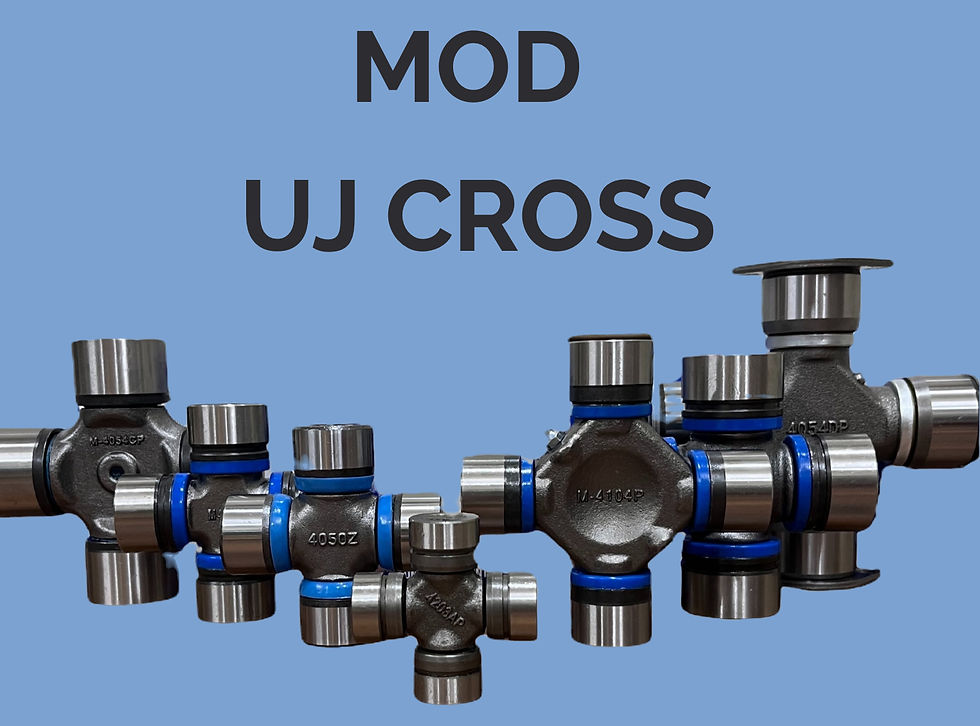
It is a cross-shaped joint with four trunnions, each fitted with a bearing cup containing precision needle bearings. These cups sit inside yokes, allowing the shafts to rotate at different angles without breaking the power flow. This means a truck carrying heavy loads on bumpy Indian highways can continue smoothly, and a rotavator working through muddy farmland can keep turning its blades even as the tractor jerks or shifts.
In commercial vehicles, such as Tata 407, Eicher trucks, BharatBenz haulers, or Mahindra pickups, the UJ Cross bears tremendous loads. It allows the propeller shaft to flex with road movement while keeping torque transmission efficient. In tractors and rotavators, it deals with sudden shocks when blades hit stones or uneven soil. In construction machinery like JCBs, it withstands constant heavy-duty cycles.
Without a UJ Cross, the driveline would seize the first time it encountered misalignment. Worse, it could shatter, damaging the gearbox or PTO and causing expensive downtime. That is why this compact component is rightly called the backbone of the driveline system.
Traditional Greasable UJ Cross – Strength with Maintenance
For decades, the greasable UJ Cross has been the trusted choice for vehicles and machinery across India. Designed with zerk fittings (grease nipples), it allows mechanics to inject fresh grease into the bearing cups during routine servicing. As new grease is pumped in, old contaminants such as dirt, water, and grit are flushed out.
This process ensures that the trunnions rotate smoothly, preventing metal-to-metal contact and extending service life. Farmers servicing tractors after every season know the importance of greasing — it makes the difference between a UJ Cross that lasts years and one that fails mid-season.
In fleet operations, greasable UJ Crosses are valued because they can handle the toughest loads, provided maintenance is consistent. A Tata Ace doing multiple trips daily or a Leyland truck carrying construction materials depends on regular lubrication for its joints. When maintained, greasable UJ Crosses are known to outlast grease-less ones in extreme-duty environments.
But maintenance is the catch. Missing a greasing schedule means bearings run dry, friction builds up, and failure comes quickly. In agriculture, where mud and dust are common, skipping lubrication is especially risky. A farmer who forgets to grease after monsoon fieldwork may find his rotavator joint seizing during sowing season.
Thus, the greasable UJ Cross offers superior strength and longevity — but it comes at the cost of time, labor, and discipline in maintenance.
The Rise of Grease-less UJ Cross – Maintenance-Free Convenience
With advancements in materials and sealing technology, the grease-less UJ Cross emerged as a solution for modern needs. Instead of grease nipples, these joints are factory-filled with long-life lubricant and sealed with high-quality synthetic seals. Once installed, they require no servicing.
For light commercial vehicles and farmers with limited access to workshops, this is a game-changer. A Mahindra Bolero or Tata Ace owner can drive for months without worrying about greasing. A farmer can run his rotavator during peak season without stopping for maintenance. For operators in remote areas, where grease availability or mechanic support is limited, the grease-less UJ Cross reduces downtime dramatically.
The key strength here is convenience. By eliminating the need for regular greasing, grease-less joints save hours of servicing and remove the risk of failure caused by neglect. For smaller fleets or farms, that time translates into productivity and profit.
However, this design is not without limitations. Once the factory grease wears out, there is no way to service the joint — it must be replaced. For heavy-duty fleets operating under extreme stress, grease-less joints may not last as long as regularly serviced greasable ones. Still, for a growing number of users, the balance tilts towards the hassle-free experience of grease-less UJ Crosses.
Comparing the Two – Which Fits Your Needs?
The choice between greasable and grease-less UJ Crosses isn’t about which is universally better — it’s about which fits your vehicle, your workload, and your maintenance habits.
In heavy trucks and buses, where vehicles haul loads across thousands of kilometers, the greasable joint’s durability is unmatched. Fleet workshops can schedule lubrication during service intervals, keeping joints healthy for years. The upfront lower cost of greasable joints also appeals to large fleet operators.
In tractors and rotavators, the decision splits. Farmers who are disciplined with seasonal maintenance prefer greasable UJ Crosses, flushing out mud and dust after every harvest. But small farmers who want to avoid downtime during sowing often opt for grease-less joints, knowing they will last through critical field operations without servicing.
In light commercial vehicles like Tata Ace or Mahindra Bolero, grease-less UJ Crosses are rapidly becoming the preferred option. These vehicles work in urban or semi-urban routes where downtime equals missed trips. Drivers want a part that simply works without constant attention.
In construction equipment, such as JCBs and AMWs, greasable UJ Crosses remain dominant. The extreme stress cycles demand serviceable joints that can be maintained on-site.
Ultimately, the decision comes down to whether you value longevity through maintenance (greasable) or convenience without maintenance (grease-less). Both do the job, but each fits a different philosophy of ownership.
MOD’s Manufacturing Advantage
At MOD Spare Parts, we believe the choice between greasable and grease-less UJ Crosses should never come down to quality. That is why we manufacture both with the same uncompromising standards.
Our UJ Crosses are forged from 20MnCr5 alloy steel, known for its toughness and wear resistance. Advanced CNC machining guarantees dimensional accuracy for perfect fitment. Heat-treatment techniques such as carburizing harden the trunnions for wear resistance while preserving a tough core to absorb shocks.
For greasable UJ Crosses, we design efficient grease channels that allow proper lubrication during servicing, ensuring dirt is flushed out. For grease-less UJ Crosses, we use factory-filled high-performance lubricants and premium sealing technology to lock in lubrication for their service life.
Every UJ Cross is tested for strength, durability, and real-world load conditions before it leaves our plant. This is why farmers, fleet owners, and mechanics across India trust MOD as their spare parts partner.
In the end, choosing between greasable and grease-less UJ Crosses depends on your application, your workload, and your maintenance habits. If you value serviceability and extreme durability, the traditional greasable joint is your ally. If you value convenience and minimal downtime, grease-less joints provide the perfect solution.
Whichever you choose, with MOD Spare Parts, you can rest assured that you are investing in reliability, durability, and OEM-grade quality.
Explore our complete range of UJ Crosses, propeller shafts, yokes, tie rod ends, and agricultural spare parts at modspareparts.com, and keep your vehicles and machinery running at their best.


Comments